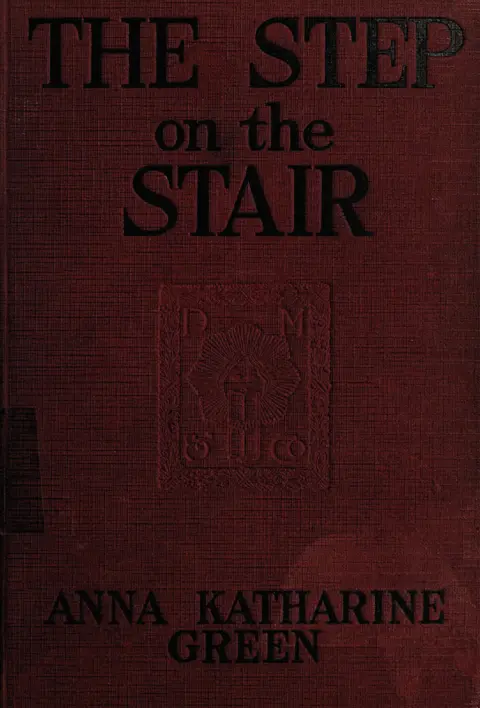
The step on the stair
Anna Katharine Green
THE CLASSIC COLLECTION · 1883
"Hand and Ring" by Anna Katharine Green is a novel written in the late 19th century. The story revolves around a murder case in the small town of Sibley, starting with the discovery of the widow Clemmens, who has been attacked in her home. The narrative introduces several characters, including the young detective Horace Byrd, who is drawn into investigating the crime, while also hinting at the enigmatic Imogene Dare whose connection to the case appears to be more intricate than initially assumed. The opening of the book sets the stage for a tense atmosphere following the court's adjournment, where discussions about crime and its implications unfold amidst casual camaraderie among lawyers and officials. The mood shifts dramatically when they learn about the widow's plight, prompting immediate concern and action. As Byrd begins to piece together the details of the murder, he encounters Imogene, a woman shrouded in mystery and increasingly tied to the unfolding drama. The narrative intricately weaves themes of curiosity, intrigue, and the quest for truth while introducing various twists and characters that complicate the murder investigation and tease the readers about hidden motives and connections.
Introduction adapted from the source catalogue; source summaries may be automatically generated.
Free to read · English · 145,757 words · No account needed
MAKE TIME FOR A GOOD BOOK
On by default. Untick to stop anonymous reading totals. Each page counts after 10 seconds in view. How this works.
Anonymous counting is on unless you have switched it off.
Othello.--What dost thou think?
Iago.-- Think, my lord?
Othello.--By heav'n, he echoes me.
As if there was some monster in his thought
Too hideous to be shown.--OTHELLO.
SIBLEY was in a stir. Sibley was the central point of interest for the whole country. The great trial was in progress and the curiosity of the populace knew no bounds.
In a room of the hotel sat our two detectives. They had just come from the court-house. Both seemed inclined to talk, though both showed an indisposition to open the conversation. A hesitation lay between them; a certain thin vail of embarrassment that either one would have found it hard to explain, and yet which sufficed to make their intercourse a trifle uncertain in its character, though Hickory's look had lost none of its rude good-humor, and Byrd's manner was the same mixture of easy nonchalance and quiet self-possession it had always been.
It was Hickory who spoke at last.
"Well, Byrd?" was his suggestive exclamation.
"Well, Hickory?" was the quiet reply.
"What do you think of the case so far?"
"I think"--the words came somewhat slowly--"I think that it looks bad. Bad for the prisoner, I mean," he explained the next moment with a quick flush.
"Your sympathies are evidently with Mansell," Hickory quietly remarked.
"Yes," was the slow reply. "Not that I think him innocent, or would turn a hair's breadth from the truth to serve him."
"He is a manly fellow," Hickory bluntly admitted, after a moment's puff at the pipe he was smoking. "Do you remember the peculiar straightforwardness of his look when he uttered his plea of 'Not guilty,' and the tone he used too, so quiet, yet so emphatic? You could have heard a pin drop."
"Yes," returned Mr. Byrd, with a quick contraction of his usually smooth
brow.
"Have you noticed," the other broke forth, after another puff, "a certain curious air of disdain that he wears?"
"Yes," was again the short reply.
"I wonder what it means?" queried Hickory carelessly, knocking the ashes
out of his pipe.
Mr. Byrd flashed a quick askance look at his colleague from under his half-fallen lids, but made no answer.
"It is not pride alone," resumed the rough-and-ready detective, half-musingly; "though he's as proud as the best of 'em. Neither is it any sort of make-believe, or I wouldn't be caught by it. 'Tis--'tis--what?" And Hickory rubbed his nose with his thoughtful forefinger, and looked inquiringly at Mr. Byrd.
"How should I know?" remarked the other, tossing his stump of a cigar into the fire. "Mr. Mansell is too deep a problem for me."
"And Miss Dare too?"
Your reading position is saved on this browser. Take it to another device with a library code. Reading pages adapt to text, rather than matching a printed edition.
Anna Katharine Green

Anna Katharine Green
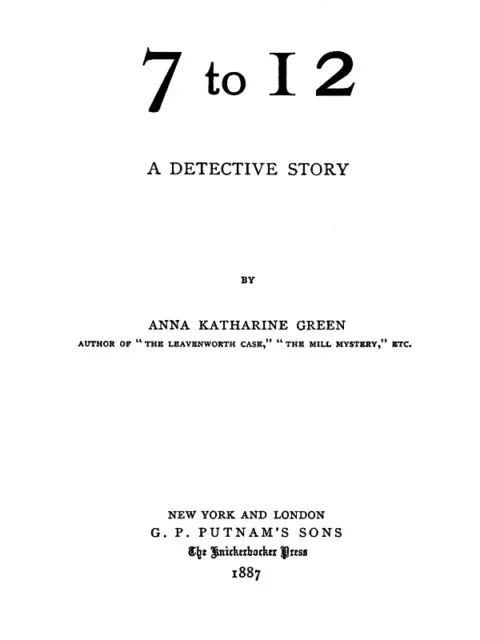
Anna Katharine Green
Anna Katharine Green
BEHIND THE BOOK
This eBook is for the use of anyone anywhere in the United States and most other parts of the world at no cost and with almost no restrictions whatsoever. You may copy it, give it away or re-use it under the terms of the Project Gutenberg License included with this eBook or online at www.gutenberg.org. If you are not located in the United States, you will have to check the laws of the country where you are located before using this eBook. Read the source licence.
The original source file, including credits and licence, is retained by this library. Request an original-format copy at no charge. Please include the book title and Project Gutenberg identifier #31681.
KEEP YOUR CURIOSITY GOING
Coulson Kernahan

Maurice Baring
Frances Wright
Cécile Tormay

Frederic Jesup Stimson

W. H. P. (William Henry Pope) Jarvis