
Last letters from the living dead man
David Patterson (Spirit) Hatch
THE CLASSIC COLLECTION · 1922
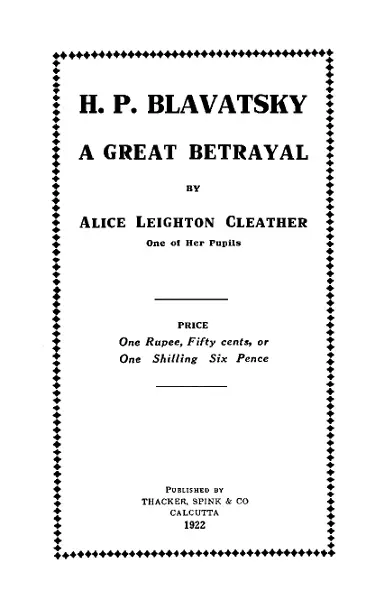
"H. P. Blavatsky; A Great Betrayal" by Alice Leighton Cleather is a critical examination of the Theosophical Society and its leadership, written in the early 20th century. The book focuses particularly on the actions and influence of Annie Besant, Blavatsky's successor, and how they diverge from the original teachings of Blavatsky, especially concerning issues of morality and sexual conduct. Cleather aims to defend Blavatsky's legacy against what she perceives as a betrayal by those who have taken her mantle, highlighting the moral decline within the Society. The opening portion of the work sets the stage for Cleather's argument, revealing the disturbing circumstances surrounding the Theosophical Society post-Blavatsky's death. It recounts the transition of leadership to Besant and her subsequent support of C. W. Leadbeater, a controversial figure accused of immoral practices. Cleather expresses her deep concern over Besant's leadership and the increasing moral degradation within the Society, asserting that true Theosophy has been corrupted by those who prioritize personal power and influence over adherence to the ethical principles that Blavatsky championed. This foreword serves as both a protest and a call to action for those who remain loyal to the original mission of Theosophy.
Introduction adapted from the source catalogue; source summaries may be automatically generated.
Free to read · English · 31,376 words · No account needed
MAKE TIME FOR A GOOD BOOK
On by default. Untick to stop anonymous reading totals. Each page counts after 10 seconds in view. How this works.
Anonymous counting is on unless you have switched it off.
Let us see, however, what others have to say seven years later on the state of the T. S. In 1913 another violent crisis convulsed this miserable travesty of a Society that once stood for the highest principles and ideals, but which even a Lake Harris might blush now to be associated with. As before, it centred round the shocking perverter of morals who had obtained complete ascendancy over Mrs. Besant. A book entitled Mrs. Besant and the Present Crisis in the Theosophical Society was published in 1913 by M. Eugène Lévy, "with a Prefatory Letter by M. Edouard Schuré," the well-known author of The Great Initiates and other mystical works. Writing to M. Charles Blech, General Secretary of the French T. S., M. Schuré states that he feels "compelled to retire officially from the T. S." and that it is his "duty" to give his "reasons straightforwardly." After alluding to the date (1907), when M. Blech had offered and he had accepted the honorary membership in the Society, M. Schuré goes on to speak of Mrs. Besant, as she had then appeared to him, in high terms, expressing the hope that "the nobility of her past career" was an augury "that the T. S. would continue in the broad way of tolerance, impartiality, and veracity which forms an essential part of its programme." M. Schuré then continues:--
Unfortunately things turned out otherwise. The primary cause of this deviation lies in the close alliance of Mrs. Besant with Mr. Leadbeater, a learned occultist, but of an unsettled disposition and doubtful morality. After Mr. Leadbeater had been found guilty by an advisory Committee of the T.S. Mrs. Besant publicly announced her reprobation of the educational methods with which he was charged.... By an inconceivable change of front she soon afterwards declared her intention of bringing Mr. Leadbeater into the T.S. again and she succeeded.... The excuses she gave for this recantation were charity and pardon. The real reason was that the President needed Mr. Leadbeater for her occult investigations, and that this collaboration appeared to her necessary to her prestige. To those who have followed her words and acts from that time onwards, it is clearly manifest that Mrs. Besant has fallen under the formidable suggestive power of her dangerous collaborator, and can only see, think and act under his control. The personality henceforward speaking through her is ... the questionable visionary, the skilful master of suggestion who no longer dares to show himself in London, Paris, or America, but in the obscurity of a summer-house at Adyar governs the T. S. through its President. The ill-omened consequences of this influence were soon to appear before the world through the affair of Alcyone and the founding of the Order of the Star in the East.... If a real Indian initiate, a Brahmin or otherwise, of ripe age, had come to Europe on his own responsibility or in the name of his Masters to teach his doctrines, nothing would have been more natural or interesting.... But it was not in this form that we beheld the new apostle from Adyar. A young Indian, aged thirteen, initiated by Mr. Leadbeater ... is proclaimed and presented to the European public as the future teacher of the new era. Krishnamurti, now called Alcyone, has no other credentials than his master's injunctions and Mrs. Besant's patronage. His thirty-two previous incarnations are related at length, the early ones going back to the Atlantean period. These narrations, given as the result of Mr. Leadbeater's and Mrs. Besant's visions, are for the most part grotesquely puerile, and could convince no serious occultist. They are ostensibly designed to prove that for twenty or thirty thousand years the principal personages in the T. S. have been preparing for the "Great Work" which is soon to be accomplished. In the course of their incarnations, which remind one of a newspaper novel, these personages are decorated with the great names of Greek mythology, and with the most brilliant stars in the firmament. During a meeting at Benares, Krishnamurti presenting certificates to his followers, received honours like a divine being, many persons present falling at his feet. He does not, however, utter a word, but only makes a gesture of benediction, prompted by Mrs. Besant. In reporting this scene Mr. Leadbeater likens it to the descent of the Holy Ghost at Pentecost.
Your reading position is saved on this browser. Take it to another device with a library code. Reading pages adapt to text, rather than matching a printed edition.
BEHIND THE BOOK
This eBook is for the use of anyone anywhere in the United States and most other parts of the world at no cost and with almost no restrictions whatsoever. You may copy it, give it away or re-use it under the terms of the Project Gutenberg License included with this eBook or online at www.gutenberg.org. If you are not located in the United States, you will have to check the laws of the country where you are located before using this eBook. Read the source licence.
The original source file, including credits and licence, is retained by this library. Request an original-format copy at no charge. Please include the book title and Project Gutenberg identifier #36373.
KEEP YOUR CURIOSITY GOING
David Patterson (Spirit) Hatch

David Patterson (Spirit) Hatch

David Patterson (Spirit) Hatch
Cécile Tormay

Moritz Busch
Coulson Kernahan