
Pioneers of the Old Southwest: a chronicle of the dark and bloody ground
Constance Lindsay Skinner
THE CLASSIC COLLECTION · 1917
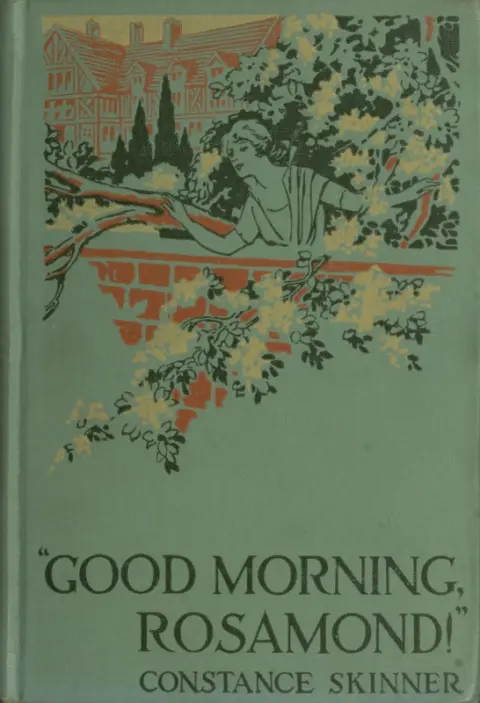
"Good-Morning, Rosamond!" by Constance Lindsay Skinner is a novel written in the early 20th century. The story centers around Rosamond Mearely, a young widow and the wealthiest woman in the small hamlet of Roseborough, as she navigates the complexities of her new life after the passing of her husband, Hibbert Mearely. The book explores themes of societal expectations, personal identity, and the quest for freedom and happiness. At the start of the novel, readers are introduced to Rosamond's daily life, characterized by strict domestic routines managed by her two long-serving housemaids, Amanda and Jemima Frigget. As Rosamond prepares for her morning routine, tensions arise with her staff regarding her lateness, which uncovers social dynamics and expectations related to her late husband's status. The opening scenes reveal Rosamond's inner thoughts about her past marriage, as well as her determination to embrace her youth and beauty on what she deems her one "Wonderful Day." Amidst her reflections, she eagerly anticipates a future filled with love and adventure, hinting at her desire for liberation from the constraints of her high-society life.
Introduction adapted from the source catalogue; source summaries may be automatically generated.
Free to read · English · 82,509 words · No account needed
MAKE TIME FOR A GOOD BOOK
On by default. Untick to stop anonymous reading totals. Each page counts after 10 seconds in view. How this works.
Anonymous counting is on unless you have switched it off.
“I don’t consider it safe for Mrs. Mearely to remain alone to-night,” Mrs. Witherby resumed. “A most villainous-appearing man with a multitude of black whiskers has been seen lurking about. Johnson, the butcher’s boy, told my maid, Hannah Ann, about it. He saw him!”
“I don’t think Mrs. Mearely is timid,” Andrews said.
“In my day, Mr. Andrews, it was not considered well-bred for women to make an exhibition of courage. They had it, but they suppressed it under a mask of timidity and sensitiveness. And the girls married easily at eighteen. And the widows were wives again before they had reached the lavender stage of their mourning. I shall try to insist on Mrs. Mearely’s keeping our Thomas to-night, and I do think it rash of her to don such a rich and conspicuous gown when she is entirely alone....”
“Oh, my trick again! Oh, goody!” Corinne broke in enthusiastically.
“Congratulations, fair partner.” Andrews thought he had done very well with that speech. So did Corinne.
“Oh, you say such lovely things, Mr. Andrews!”
“Losing as usual, aunt?” Mabel’s tone was delicately unpleasant. It
angered her aunt.
“Not at all! I doubt if there is a woman in Roseborough who plays a
better hand.”
In turning to make her speech more impressive and to give Miss Crewe a broadside, as it were, of her displeasure, she had a full view of the verandah, and was in the nick of time to see a swarthy, black-whiskered face, topped by a soft, black felt hat, slowly raised over the verandah rail. She panted twice from terror’s cold shock; then screamed with all her might. The apparition disappeared.
“Eh? What?” Dr. Wells looked up, jerkily, from his cards. Howard had half risen, from habit, at the feminine cry of distress. The Judge, peering over his pince-nez, offered a practical explanation.
“A beetle? The summer bugs do bite.”
“Mamma! I wish you wouldn’t shriek when there’s no need.”
Mrs. Witherby was angry now as well as frightened. She gestured
frantically and gasped.
“There--there! I saw him! Oh! the terrible man! Oh, quick--catch
him--a man!”
She continued to point and wave and gasp at such a rate, that Judge Giffen and Wilton Howard, concealing their mirth as best they could, went to the verandah and made a perfunctory investigation. The movement of their shoulders suggested that they were not looking over the verandah rail so much as laughing over it. Miss Crewe gave herself up to an almost hysterical hilarity.
“You have so much imagination, Aunt Emma.”
Dr. Wells cackled with delight, “Te-he-he! The cry of the eternal feminine--‘Catch him! Catch the man!’ Te-he-he.”
Your reading position is saved on this browser. Take it to another device with a library code. Reading pages adapt to text, rather than matching a printed edition.
Constance Lindsay Skinner
BEHIND THE BOOK
This eBook is for the use of anyone anywhere in the United States and most other parts of the world at no cost and with almost no restrictions whatsoever. You may copy it, give it away or re-use it under the terms of the Project Gutenberg License included with this eBook or online at www.gutenberg.org. If you are not located in the United States, you will have to check the laws of the country where you are located before using this eBook. Read the source licence.
The original source file, including credits and licence, is retained by this library. Request an original-format copy at no charge. Please include the book title and Project Gutenberg identifier #57254.
KEEP YOUR CURIOSITY GOING
Coulson Kernahan

Maurice Baring
Frances Wright
Cécile Tormay

Frederic Jesup Stimson

W. H. P. (William Henry Pope) Jarvis