Pioneers of the Old Southwest: a chronicle of the dark and bloody ground
Constance Lindsay Skinner
THE CLASSIC COLLECTION · 1917
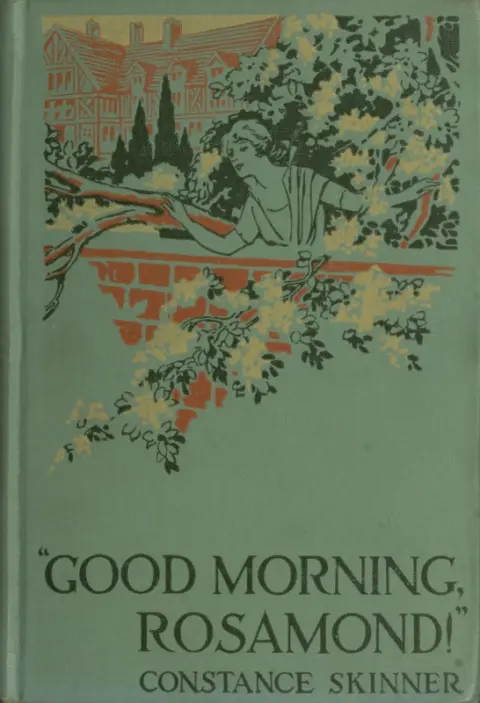
"Good-Morning, Rosamond!" by Constance Lindsay Skinner is a novel written in the early 20th century. The story centers around Rosamond Mearely, a young widow and the wealthiest woman in the small hamlet of Roseborough, as she navigates the complexities of her new life after the passing of her husband, Hibbert Mearely. The book explores themes of societal expectations, personal identity, and the quest for freedom and happiness. At the start of the novel, readers are introduced to Rosamond's daily life, characterized by strict domestic routines managed by her two long-serving housemaids, Amanda and Jemima Frigget. As Rosamond prepares for her morning routine, tensions arise with her staff regarding her lateness, which uncovers social dynamics and expectations related to her late husband's status. The opening scenes reveal Rosamond's inner thoughts about her past marriage, as well as her determination to embrace her youth and beauty on what she deems her one "Wonderful Day." Amidst her reflections, she eagerly anticipates a future filled with love and adventure, hinting at her desire for liberation from the constraints of her high-society life.
Introduction adapted from the source catalogue; source summaries may be automatically generated.
Free to read · English · 82,509 words · No account needed
MAKE TIME FOR A GOOD BOOK
On by default. Untick to stop anonymous reading totals. Each page counts after 10 seconds in view. How this works.
Anonymous counting is on unless you have switched it off.
“Good-bye, for the present.” Rosamond waited an instant to offer cheer to her remaining guests, before joining Mrs. Lee and Frei on the verandah. “Some of you will have time for another game before we return. The chess board is just as you and Wilton left it, Judge. When cards and chess pall, you will find sandwiches and salad, with perhaps a jelly or two and some of Amanda’s parsnip wine on the dining-room table. I know we can’t persuade Mrs. Lee.”
“No, dear, not in the evening. Good-night, dear friends. I shall see you all at breakfast, to-morrow. A quarter to eleven. Don’t fail me.”
“We won’t!” Corinne called to her, above the calmer promises of the
older folk.
“Oh, joy! A new man is coming to Roseborough! Though I suppose he’s pretty old,” she added, after Mrs. Lee and her two escorts had disappeared. “Mrs. Lee calls men of fifty ‘dear boys,’ if they ever went to Charleroy.”
Mrs. Witherby, Wells, and Andrews seated themselves at the card table. For the moment, Mrs. Witherby’s mind was occupied with something more important than cards. Assuring herself that her niece could not hear her, she said:
“Mrs. Barton is not coming from Poplars Vale till next week, so I shall try to persuade Mrs. Mearely to let me leave our Thomas to sleep in the house here, to-night. With her sister absent, she is quite alone. You know, I consider it suspicious that her two maids should have been called to their sick mother’s bedside the same day that her coachman was obliged to take the gray mare out to the farm. It leaves Mrs. Mearely quite alone. I consider it very suspicious. I think Mrs. Barton should have been sent for. I think it peculiar that Mrs. Mearely herself did not tell me about it.”
Wells, who was dealing, replied humorously:
“But--the maids being sisters--naturally, if Jemima’s mother is ill, so is Amanda’s mother, te-he-he.”
He was rewarded with a frosty glance.
“It pleases you to be facetious. Corinne, come--we are having another
game.”
Corinne came, none too willingly. The Judge, who had had enough of the Digest for that evening, nodded to Wilton.
“Er--shall we try the chessmen to-night, Howard? Perhaps Miss Crewe will sit by and inspire us.”
Howard, anxious to avoid another tête-à-tête with Mabel, answered with alacrity, “By all means.”
Mabel, yawning, sank among the cushions of the settee. She was not interested in chess, but she could watch her lover’s profile from this position.
“Oh, I wish there were something young to do,” Corinne protested. “Cards aren’t young.”
Your reading position is saved on this browser. Take it to another device with a library code. Reading pages adapt to text, rather than matching a printed edition.
Constance Lindsay Skinner
BEHIND THE BOOK
This eBook is for the use of anyone anywhere in the United States and most other parts of the world at no cost and with almost no restrictions whatsoever. You may copy it, give it away or re-use it under the terms of the Project Gutenberg License included with this eBook or online at www.gutenberg.org. If you are not located in the United States, you will have to check the laws of the country where you are located before using this eBook. Read the source licence.
The original source file, including credits and licence, is retained by this library. Request an original-format copy at no charge. Please include the book title and Project Gutenberg identifier #57254.
KEEP YOUR CURIOSITY GOING
Coulson Kernahan

Maurice Baring
Frances Wright
Cécile Tormay

Frederic Jesup Stimson

W. H. P. (William Henry Pope) Jarvis