THE CLASSIC COLLECTION✦An outlaw’s diary: the CommuneCLASSIC FREE BOOKS
An outlaw’s diary: the Commune
Cécile Tormay
THE CLASSIC COLLECTION · 1886
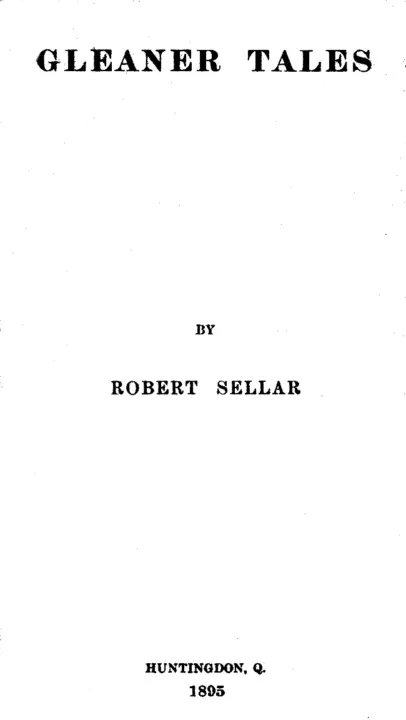
"Gleaner Tales" by Robert Sellar is a collection of historical tales written in the late 19th century. The work aims to capture pivotal moments in the early life of Canada, focusing on the experiences of settlers from the British Isles during the period of their first settlement. Among the characters are Lieutenant Morton and the Indigenous guide Hemlock, who navigate the complexities of war and survival against the backdrop of historical events involving the American invasion. The opening of "Gleaner Tales" presents a vivid and intense scene set in 1813, following Lieutenant Morton as he is ordered to escort an ammunition train during a time of conflict. We witness Morton's interactions with his comrades and the unfolding drama surrounding a spy's escape attempt and subsequent capture. As the narrative progresses, Morton's character develops amidst tension and action, particularly in his encounters with both the enemy and his companions. The stakes become dire when he is caught in a web of suspicion after an officer is found dead nearby, leading to his trial as a spy. The atmosphere of apprehension and the need for bravery resonate throughout the opening chapters, setting the stage for further exploration of themes like loyalty, sacrifice, and the turmoil of early Canadian history.
Introduction adapted from the source catalogue; source summaries may be automatically generated.
Free to read · English · 114,938 words · No account needed
MAKE TIME FOR A GOOD BOOK
On by default. Untick to stop anonymous reading totals. Each page counts after 10 seconds in view. How this works.
Anonymous counting is on unless you have switched it off.
As the shore was neared the boat was brought closer to the wind, and lying over somewhat deeply, the helmsman told those on the lee side to change seats. In the movement a man rubbed against Morton, and he felt that his clothes were wet. Looking sharply at him, he saw he was one of the boat’s crew, when his resemblance to the spy he had seen escape the bullets of the firing-party struck him. The more he looked the more convinced he grew that he was correct, and, improbable as it seemed, within an arm’s length, almost, sat the man he saw plunge into the river and whom he, with everybody else, believed to have been swept into the deadly rapids. With all a soldier’s detestation of a spy, he resolved he should not escape, yet to attempt to seize him in the boat would be to imperil all in it, for that the fellow would make a desperate struggle Morton knew. Prudently resolving to make no move until the boat neared its moorings, he slipped his hand into his breast-pocket and grasped the stock of one of his pistols.
As the boat approached the shore the sharply-cut eminence, which Morton had taken to be a fortification, resolved itself into a grassy knoll, destitute of glacis or rampart, and round the eastern extremity of which they glided into a smooth narrow channel, whose margin was fretted by the shadows cast by the trees which leant over from its banks. The sail now flapped uselessly and the order was given to get out the oars. The suspected spy rose with the other boatmen to get them into place and stood on a cross-bench as he lifted a heavy oar to its lock. It was a mere pretence. In a moment his foot was on the gunwale and he made a sudden spring towards the bank. There was the sound of a plunge, of a few brief strokes by a strong swimmer, a movement among the bushes, and then silence. Morton was intensely excited, he drew his pistol, rose and cocking it fired at random. Turning to the captain of the boat he shouted in fury, “You villain; you have assisted in the escape of a King’s prisoner.” With stolid countenance the captain shifted the helm to suit the windings of the channel, and answered, “Me no spik Ingleese.” Feeling he was powerless, Morton resumed his seat and in a minute or two a cluster of white-washed huts came in view and the boat drew alongside a landing-stage in front of them. Several soldiers were standing on it awaiting them, and on asking where he would find the commissariat officer, Morton was directed to one of the houses, in front of which paced a sentry. Entering he perceived it consisted of two rooms, divided by a board-partition. In the larger end was a woman, surrounded by several children, cooking at an open-fire, and in the other, the door and windows of which were open, for the evening was sultry, were four officers in dishabille, seated round a rickety table playing cards, and with a pewter-measure in the middle of it. One of them rose on seeing the stranger, while the others turned carelessly to examine him. Assuring himself he was addressing the officer of the commissariat, Morton explained his business. “Oh, that’s all right; the powder-kegs must remain in the boat and in the morning I will get carts to forward them to the front. There’s an empty box, Lieutenant Morton; pull it up and join us,” and hospitably handed him the pewter-measure. It contained strong rum grog, of which a mouthful sufficed Morton. Not so the others, who, in listening to what he had to tell of the news of Montreal and of the movements of the troops, emptied it, and shouted to the woman to refill it, and, at the same time, she brought in the supper, consisting of fried fish and potatoes. That disposed of, the cards were reproduced and the four were evidently bent on making a night of it. On returning from seeing how his men were quartered, Morton found that the grog and the excitement of the card-playing were telling on his companions, who were noisy and quarrelsome. Asking where he should sleep, the woman pointed to the ladder that reached to a trap in the roof, and he quietly ascended. It was merely a loft, with a small window in either gable and a few buffalo robes and blankets laid on its loose flooring. The place was so stiflingly hot that Morton knew sleep was out of the question even if there had been no noise beneath, and he seated himself by the side of one of the windows through which the wind came in puffs. The sky was now partially clouded and the growl of distant thunder was heard. Fatigue told on the young soldier and he dozed as he sat. A crash of thunder awoke him. Startled he rose and was astonished to find himself in utter darkness, save for the rays that came through the chinks of the flooring from the candle beneath, where the officers were still carousing. He leant out of the window and saw that the moon had been blotted out by thick clouds. While gazing there was a flash of lightning, revealing to him a man crouched beside the window below. In the brief instant of intense light, Morton recognized the spy, and guessed he was listening to the officers, hoping to pick up information, in their drunken talk, of use to his employers. “He cheated the provost-marshal, he cheated me, but he shall not escape again,” muttered Morton, who drew his pistols, got them ready, and, grasping one in each hand, leant out of the window to await the next flash that he might take aim. It came and instantly Morton fired. The unsuspecting spy yelled, jumped to his feet, and rushed to the cover of the woods. Then all was darkness. A crash of thunder, the sweep of the coming hurricane and the pelting of rain, increased the futility of attempting to follow. “I hope I’ve done for him,” said Morton to himself, “and that like a stricken fox he will die in cover.”
Your reading position is saved on this browser. Take it to another device with a library code. Reading pages adapt to text, rather than matching a printed edition.
BEHIND THE BOOK
This eBook is for the use of anyone anywhere in the United States and most other parts of the world at no cost and with almost no restrictions whatsoever. You may copy it, give it away or re-use it under the terms of the Project Gutenberg License included with this eBook or online at www.gutenberg.org. If you are not located in the United States, you will have to check the laws of the country where you are located before using this eBook. Read the source licence.
The original source file, including credits and licence, is retained by this library. Request an original-format copy at no charge. Please include the book title and Project Gutenberg identifier #66150.
KEEP YOUR CURIOSITY GOING
Cécile Tormay

Moritz Busch
Coulson Kernahan
John L. Ransom

Maurice Baring
Frances Wright