THE CLASSIC COLLECTION✦An outlaw’s diary: the CommuneCLASSIC FREE BOOKS
An outlaw’s diary: the Commune
Cécile Tormay
THE CLASSIC COLLECTION · 1886
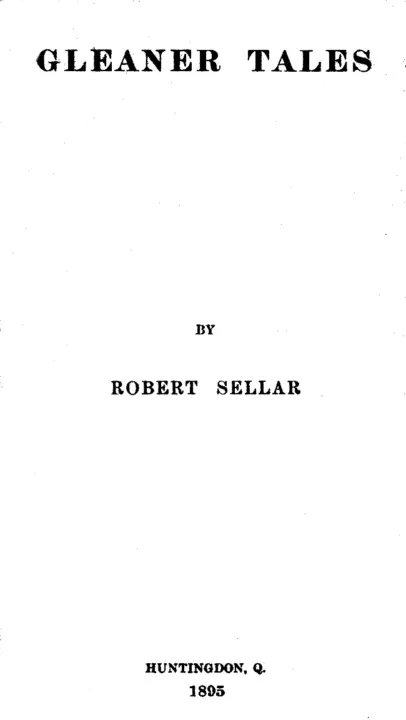
"Gleaner Tales" by Robert Sellar is a collection of historical tales written in the late 19th century. The work aims to capture pivotal moments in the early life of Canada, focusing on the experiences of settlers from the British Isles during the period of their first settlement. Among the characters are Lieutenant Morton and the Indigenous guide Hemlock, who navigate the complexities of war and survival against the backdrop of historical events involving the American invasion. The opening of "Gleaner Tales" presents a vivid and intense scene set in 1813, following Lieutenant Morton as he is ordered to escort an ammunition train during a time of conflict. We witness Morton's interactions with his comrades and the unfolding drama surrounding a spy's escape attempt and subsequent capture. As the narrative progresses, Morton's character develops amidst tension and action, particularly in his encounters with both the enemy and his companions. The stakes become dire when he is caught in a web of suspicion after an officer is found dead nearby, leading to his trial as a spy. The atmosphere of apprehension and the need for bravery resonate throughout the opening chapters, setting the stage for further exploration of themes like loyalty, sacrifice, and the turmoil of early Canadian history.
Introduction adapted from the source catalogue; source summaries may be automatically generated.
Free to read · English · 114,938 words · No account needed
MAKE TIME FOR A GOOD BOOK
On by default. Untick to stop anonymous reading totals. Each page counts after 10 seconds in view. How this works.
Anonymous counting is on unless you have switched it off.
10.--A steamer came in this morning to take away emigrants, and I am sure over a thousand were packed on board. Her purser brought a package of letters; one of them was for myself.
Montreal, June 8, 1847.
My Dear Gerald,--I had it in mind to have written you several days ago, but postponed taking pen in hand day after day in expectation of being able to convey to you the intelligence that would cheer your heart--that the government had decided on adopting a policy of adequate relief. That, it grieves me to say, they have not done, although I have exerted myself to arouse them to a sense of their duty, but it is little a poor priest can do with our public men. When I reached here I went first to see the premier. After waiting my turn for an hour with a crowd of visitors, I was admitted. He was civil, but is a dull man, and did not seem to realize what I was telling him. He told me to go to the provincial secretary, to whose department emigration belongs, and see him. I left in no good humor, to do as Mr Sherwood bade me. Mr Daly was not at his lodgings; he had gone to the back of the mountain to dine. I have learned since, he is better at dining and wining than attending to his duties. I had an interview with him next day. You may not know that Mr Daly is of ourselves. He is a Galway man himself and his lady is from Kilkenny. Appealing to an Irishman and a Catholic I expected him to fall in with me--that all I had to do, was to seize him of the actual facts of the situation at Grosse isle and he would act with energy. That was what I expected of him but all I got from him, Gerald, was soft words and promises, and neither the one nor the other will feed the starving or cure the sick. He told me to call next day, as he wanted time to go over the reports. When I went, his servant man said he was out, and I never found him in again for me. When the house opened, I managed to get in, to hear what the governor would say about the emigrants. The words put in his mouth about them made me angry. The government pretended they had made ample preparation for the expected influx and that everything was going on well. Beside him stood two men smiling among a bevy of ladies who knew better, for I had told them all. In the debate since then, when a member on the opposition side referred to the rumors of the state of matters at quarantine, Mr Daly begged the house not to give heed to alarmist reports and to rest assured the government was doing everything that was required, had appointed a commission of three doctors to visit Grosse isle, and would act on their report. I had little respect before for Canadian politicians, I have less now. I was advised to wait on the new minister, John A. Macdonald, the youngest member of the government. I told my friend that if Mr Daly would not do the decent thing by his countrymen, I was not going to ask the member for the Orange city of Kingston, who, like all the others of them, is engrossed in intrigues to keep his party in office. The talk of the city is whether the ministry will stand, for its majority is only one or two, and there is a good deal of excitement about it. More attention is being paid to the ribaldry of The Pilot than anything else. This will not be for long. The evil has come to the door of this city. The forwarding by wholesale of all emigrants able to move, has brought the fever. The emigration sheds are at Windmill point, an inconvenient place, for there is not water enough to permit the steamers to come up to the wharf, and the emigrants have to be landed by scows, which is sore on the sick. I am not going to say that the journey from Grosse isle to here is as bad as the voyage across the Atlantic, but it has a few features worse than it. The steamers come in with emigrants packed on their lower deck like herrings in a fish-box. The steamers are chartered by the government from their supporters, and a few of them are old, worn-out tubs, that take two days to a trip that ought to be made inside 20 hours. Without food or cover, blistered by the sun in the day and chilled by the river breezes at night, the poor creatures are landed here more dead than alive. Many who went aboard feeling well, are carried off in a dying state. My curse and the curse of every Irishman be on the government that allows the helplessness of our countrymen to be traded upon to make money for their followers. If their transportation was left open to all ship-owners, the emigrants would be brought here in large and speedy steamers, and a limit could be put to the number they carry. Once landed, the emigrants are decently treated. I am thankful to be able to say that. It is the city and not the government that manages. For sick and well there is plenty of wholesome food, and no lack of doctors or nurses. The food, to be sure, is coarse and the cooking not good, but you know the saying, The poor drink wather and the rich sip tay. After Grosse isle it is fine. What I have seen here has shown me the necessity of moving the quarantine to the flats below Quebec. If the sick were moved from Grosse isle to near the city they would get all the supplies and service needed. I expect to return to Quebec in a day or so, and before leaving here hope to get the bishop to wait on the premier, to ask that the new fever sheds be placed on the outskirts of Quebec. I hear from the emigrants as they arrive of you, and as they speak they bless you. I hope to see you soon.
Your reading position is saved on this browser. Take it to another device with a library code. Reading pages adapt to text, rather than matching a printed edition.
BEHIND THE BOOK
This eBook is for the use of anyone anywhere in the United States and most other parts of the world at no cost and with almost no restrictions whatsoever. You may copy it, give it away or re-use it under the terms of the Project Gutenberg License included with this eBook or online at www.gutenberg.org. If you are not located in the United States, you will have to check the laws of the country where you are located before using this eBook. Read the source licence.
The original source file, including credits and licence, is retained by this library. Request an original-format copy at no charge. Please include the book title and Project Gutenberg identifier #66150.
KEEP YOUR CURIOSITY GOING
Cécile Tormay

Moritz Busch
Coulson Kernahan
John L. Ransom

Maurice Baring
Frances Wright