THE CLASSIC COLLECTION✦An outlaw’s diary: the CommuneCLASSIC FREE BOOKS
An outlaw’s diary: the Commune
Cécile Tormay
THE CLASSIC COLLECTION · 1886
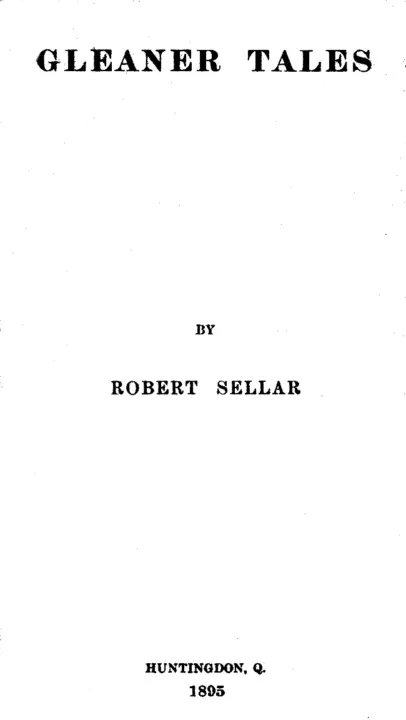
"Gleaner Tales" by Robert Sellar is a collection of historical tales written in the late 19th century. The work aims to capture pivotal moments in the early life of Canada, focusing on the experiences of settlers from the British Isles during the period of their first settlement. Among the characters are Lieutenant Morton and the Indigenous guide Hemlock, who navigate the complexities of war and survival against the backdrop of historical events involving the American invasion. The opening of "Gleaner Tales" presents a vivid and intense scene set in 1813, following Lieutenant Morton as he is ordered to escort an ammunition train during a time of conflict. We witness Morton's interactions with his comrades and the unfolding drama surrounding a spy's escape attempt and subsequent capture. As the narrative progresses, Morton's character develops amidst tension and action, particularly in his encounters with both the enemy and his companions. The stakes become dire when he is caught in a web of suspicion after an officer is found dead nearby, leading to his trial as a spy. The atmosphere of apprehension and the need for bravery resonate throughout the opening chapters, setting the stage for further exploration of themes like loyalty, sacrifice, and the turmoil of early Canadian history.
Introduction adapted from the source catalogue; source summaries may be automatically generated.
Free to read · English · 114,938 words · No account needed
MAKE TIME FOR A GOOD BOOK
On by default. Untick to stop anonymous reading totals. Each page counts after 10 seconds in view. How this works.
Anonymous counting is on unless you have switched it off.
“An so there’s only yirsilf left?” asks my wife.
“Av our family,” says she, “but unless he’s dead since I left, there’s my cousin Gerald in the fever sheds at quarantine.”
Gerald was my sister’s only child and I had heard after her death he had gone to Maynooth to be a priest.
“Do you tell me my nephew, that rode on my knee the day I left Ireland, is in Canada? Why did he not come wid you?”
Then she explained; told us of what he had been to the sick and dying and how the day before she left he had been stricken himself. She wanted to stay with him, but he told her to hasten to her uncle and if he had a mind he might come and help him; she could do no good to stay. I jumps up. “I’ll go,” I cries, “and will bring him back wid me here safe and sound.” As I said that I caught my wife’s eye so pleading like, not to go. But I did. I got my neighbors to look after my hay and off I started next morning, bright and early, to catch the stage at the Potash. When old Mr Oliver heard my errand, he told me to go back to my family, but my mind was made up. When my own brother was adying I was in comfort. I was determined my nephew would not suffer like him and me so near. When the stage came along I jumped into a seat and before darkening I was in the city. All the talk there was about the fever, and how the poor creatures were dying by the hundred in the sheds at Point St Charles. Everybody was in mortal dread of infection and the police had orders to watch that none of the emigrants got past the wharves or out of the sheds, but some did, and they were hunted down and taken back. I kept my whisht as to my errand and listened in the bar-room of the tavern to one story after another, that made the blood run cold to my heart. After an early breakfast next day I left the tavern and walked down to where the steamer sailed for Quebec. It was a beautiful morning and I thought it the prettiest sight I had seen for a long time, the blue river sparkling in the sun and the islands and the other shore looking so fresh and green, with the blue mountains beyant. It was going to be a while before the steamer was ready, for there was a pile of freight to put on board, and I walked up a bit to look round me. In turning the corner of a shed I sees lying on the ground a young lad with a girl leaning over him. I went up to them. “What’s come over you, my boy, that you be lyin on the ground?” asks I. Never a word from either. I went close up and I sees his eyes closed and his face white as death, with his head resting on the girl’s lap. “God save us, what’s wrong?” Never a word. “Can I do anything for you?” I says, placing my hand on her shoulder. She lifted up her head that was bowed down on the young man’s, oh so slowly, and looked at me, her face white and sunk like. “No,” she whispered, “he’s adyin.” “Dyin like this in a Christian land,” says I, “I will get help.” I ran back to where the crowd was and tould a policeman. “They’ll be escaped imigrants,” says he, “and must be sent back, the villins,” and off he comes with me. I led him to the place and he flourished his big stick, shouting, “What div ye mean, coming among Christian people agin orders?” I caught his arm. “Don’t touch them; he’s dyin,” for I heard the rattle in his throat. We stood aside for a minute or so, there was a gurgle and a drawin up of the legs, and all was over. “Oh, my brother, my brother, hev you died afore me,” moaned the poor girl as she tighter clutched his body. “Come wid me,” I said, stooping over and trying to lift her, “I am Irish like yersilf, and will spind my last dollar if need be to bury your brother. Lave him, and I will take you where you will find friends.” I could not loosen her hould on the body. The policeman said he would go for the ambulance and left me. I stroked her hair, I talked to her as if she had been my own daughter; I tried to comfort her. Never a sign or a word. There was a sound of wheels and I looked and saw the ambulance. The men came and I grasped the girl to lift her off the corpse. I caught a look at her face--she was dead too. The ambulance men said that was nothing, that fever patients dropped dead every day without a sign. I looked at the poor colleen as I helped to lift her into the ambulance beside her brother’s corpse, and I knew it was not of the fever alone she had died, but of a broken heart. Och, och, to come to Ameriky to die on the quay. “Drive to the cimitry,” says I, “and I will pay all expinses,” trying to get up beside the driver. “Have you lost your sinses,” says he, “they wad not bury them in the cimitry; they go to Point St Charles, and if yer wise ye’ll tell nobody you handled faver patients and go about your business.” Wid that he cracks his whip, and rattles aff at a great rate. “Well, well,” I said to myself, “at ony rate they will be united in burial as they were in life and death,” and they rest in the field where a big stone tells more than 3000 were buried. I turned with a heavy heart to the steamer, which was ringing a warning bell to get on board and lying down on a pile of bags fell asleep. It was afternoon when I awoke and soon after we were at Three Rivers, where I went ashore and got something to eat. When we had left it a while a steamer hove in sight, coming up the river. We crowded to see her in passing. It was a sight that sunk like a stone on my heart. Her lower deck was chuck full of women and childer and men, all in rags, and with faces as sharp as hatchets from starvation, and most all of them white or yellow from the fever. She passed between us and the wind and the smell was awful. A sailor told me steamboats passed every day like her on their way from quarantine, and never a one reached Montreal without a row of corpses on her upper deck for burial and a lot of sick to be carried to Point St Charles.
Your reading position is saved on this browser. Take it to another device with a library code. Reading pages adapt to text, rather than matching a printed edition.
BEHIND THE BOOK
This eBook is for the use of anyone anywhere in the United States and most other parts of the world at no cost and with almost no restrictions whatsoever. You may copy it, give it away or re-use it under the terms of the Project Gutenberg License included with this eBook or online at www.gutenberg.org. If you are not located in the United States, you will have to check the laws of the country where you are located before using this eBook. Read the source licence.
The original source file, including credits and licence, is retained by this library. Request an original-format copy at no charge. Please include the book title and Project Gutenberg identifier #66150.
KEEP YOUR CURIOSITY GOING
Cécile Tormay

Moritz Busch
Coulson Kernahan
John L. Ransom

Maurice Baring
Frances Wright