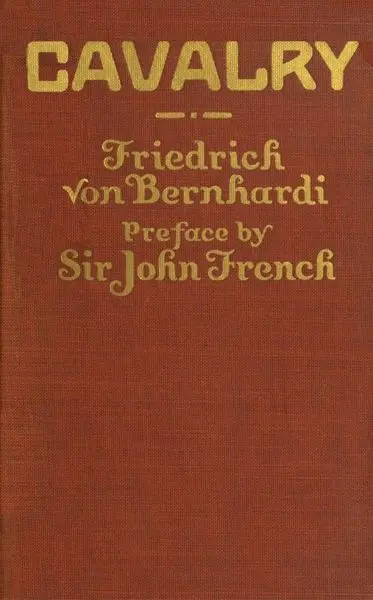
Cavalry A Popular Edition of “Cavalry in War and Peace”
Friedrich von Bernhardi
THE CLASSIC COLLECTION · 1912
"Germany and the Next War" by Friedrich von Bernhardi is a military and political treatise written in the early 20th century. The work elaborates on the rationale and necessity of war as a means for national self-assertion and the pursuit of power, asserting that for Germany, conflict is not merely an option but a duty in the face of external threats and internal weaknesses. The opening of the book sets a tone of urgency, reflecting on the public sentiment in Germany during the summer of 1911, amidst a perceived threat to national honor and political stability, particularly concerning the Morocco crisis. Von Bernhardi aims to clarify the national objectives, difficulties, and sacrifices required for Germany to secure its future. He emphasizes the need for a candid discussion of the rights and responsibilities of nations concerning war, framing it not only as an inevitability but also a moral obligation. Through this lens, he seeks to galvanize a nationalistic fervor, arguing that war is essential for maintaining and enhancing a nation's strength and cultural vitality.
Introduction adapted from the source catalogue; source summaries may be automatically generated.
Free to read · English · 98,480 words · No account needed
MAKE TIME FOR A GOOD BOOK
On by default. Untick to stop anonymous reading totals. Each page counts after 10 seconds in view. How this works.
Anonymous counting is on unless you have switched it off.
Against this brilliant prosperity must be placed a very large national debt, both in the Empire and in the separate States. The German Empire in the year 1910 had 5,016,655,500 marks debt, and in addition the national debt of the separate States on April 1, 1910, reached in--
Marks Prussia 9,421,770,800 Bavaria 2,165,942,900 Saxony 893,042,600 Würtemberg 606,042,800 Baden 557,859,000 Hesse 428,664,400 Alsace-Lorraine 31,758,100 Hamburg 684,891,200 Lübeck 666,888,400 Bremen 263,431,400
Against these debts may be placed a considerable property in domains, forests, mines, and railways. The stock capital of the State railways reached, on March 31, 1908, in millions of marks, in--
Marks,
Prussia (Hesse) 9,888
Bavaria 1,694
Saxony 1,035
Würtemburg 685
Baden 727
Alsace-Lorraine 724
--a grand total, including the smaller State systems, of 15,062 milliard marks. This sum has since risen considerably, and reached at the end of 1911 for Prussia alone 11,050 milliards. Nevertheless, the national debts signify a very heavy burden, which works the more disadvantageously because these debts are almost all contracted in the country, and presses the more heavily because the communes are also often greatly in debt.
The debt of the Prussian towns and country communes of 10,000 inhabitants and upwards alone amounts to 3,000 million marks, in the whole Empire to some 5,000 million marks. This means that interest yearly has to be paid to the value of 150 million marks, so that many communes, especially in the east and in the western industrial regions, are compelled to raise additional taxation to the extent of 200, 300, or even 400 per cent. The taxes also are not at all equally distributed according to capacity to pay them. The main burden rests on the middle class; the large fortunes are much less drawn upon. Some sources of wealth are not touched by taxation, as, for example, the speculative income not obtained by carrying on any business, but by speculations on the Stock Exchange, which cannot be taxed until it is converted into property. Nevertheless, the German nation is quite in a position to pay for the military preparations, which it certainly requires for the protection and the fulfilment of its duties in policy and civilization, so soon as appropriate and comprehensive measures are taken and the opposing parties can resolve to sacrifice scruples as to principles on the altar of patriotism.
Your reading position is saved on this browser. Take it to another device with a library code. Reading pages adapt to text, rather than matching a printed edition.
Friedrich von Bernhardi
BEHIND THE BOOK
This eBook is for the use of anyone anywhere in the United States and most other parts of the world at no cost and with almost no restrictions whatsoever. You may copy it, give it away or re-use it under the terms of the Project Gutenberg License included with this eBook or online at www.gutenberg.org. If you are not located in the United States, you will have to check the laws of the country where you are located before using this eBook. Read the source licence.
The original source file, including credits and licence, is retained by this library. Request an original-format copy at no charge. Please include the book title and Project Gutenberg identifier #11352.
KEEP YOUR CURIOSITY GOING
Cécile Tormay

Moritz Busch
John L. Ransom
Frances Wright
Cécile Tormay

Mabel Potter Daggett