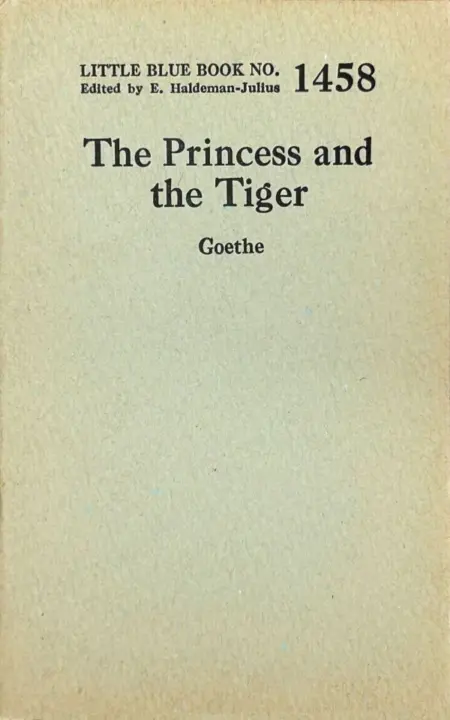
The princess and the tiger
Johann Wolfgang von Goethe
THE CLASSIC COLLECTION · 1917
"German Fiction" by Fontane, Goethe, Keller, and Storm is a collection of selected works from notable German authors written in the late 19th century. The compilation includes significant literary contributions from luminaries such as Johann Wolfgang von Goethe, Gottfried Keller, Theodor Storm, and Theodor Fontane, exploring complex themes of life, emotion, and character development within the context of German culture. The book likely delves into the internal struggles and nuanced experiences of its protagonists, inviting readers to reflect on deeper issues of existence and sentiment. The opening of the book presents a scholarly overview that examines the German novel's evolution and its intersections with international literature. It highlights the unique psychological depth characteristic of German literature, focusing on the internal emotional landscapes of characters more than on external action. Addressing the reader directly, it posits that German fiction often prefers psychological exploration over sensational narratives, appealing to those who appreciate intricate character studies and subtle developments over traditional plot-driven storytelling. The examination serves as a thoughtful introduction to the selected works, preparing readers for the emotional and intellectual depth they can expect from the writers featured in this anthology.
Introduction adapted from the source catalogue; source summaries may be automatically generated.
Free to read · English · 173,213 words · No account needed
MAKE TIME FOR A GOOD BOOK
On by default. Untick to stop anonymous reading totals. Each page counts after 10 seconds in view. How this works.
Anonymous counting is on unless you have switched it off.
The next forenoon the sun, which was already rather high, shone into the yard of the Doerr's little establishment and lighted up a considerable number of buildings, among which was the "castle" of which Frau Nimptsch had spoken on the previous evening with roguish playfulness. Such a "castle"! In the twilight its general outlines might have passed for something of the sort, but to-day, as it stood in the remorselessly bright light, one could see only too plainly, that the building with its Gothic windows painted on the walls clear to the top, was nothing more than a wretched old wooden house, in the two gable ends of which had been set some timber framing, the spaces of which were filled with plaster, a comparatively solid structure which indicated two gable rooms. All the rest of the house was merely a stone-paved space from which a confused looking set of ladders led to a loft or garret and from that to the tower which served as a pigeon house. Formerly, before Doerr's time, the whole great wooden "shack" had served merely as a store-house for bean poles and watering pots, perhaps even as a potato cellar, but since, some years ago, the garden had been bought by its present owner, the real dwelling house had been rented to Frau Nimptsch, and the old building painted in the Gothic style, with the addition of the two gable rooms already mentioned, had been arranged as a dwelling for Doerr, who was then a widower; a very primitive arrangement it was, which was in no wise altered by his speedy second marriage. In the summer this cool store house with its stone pavements and almost no windows was not a bad dwelling place, but in the winter Doerr and his wife as well as a rather feeble-minded twenty-year-old son of the former marriage, would have actually frozen, had it not been for the two big hothouses which stood on the other side of the yard. In these the three Doerrs spent their time exclusively from November until March, but even in the warmer and more comfortable part of the year, the family life, when it was not actually necessary to seek refuge from the sun, was mostly carried on in front of these hot houses or in them, because everything there was more convenient. Here were the steps and shelves on which the flowers that were brought out of the hothouses every morning had their airing, here was the stall for the cow and the goat, and here the kennel for the dog that was used to pull the little wagon, and from here extended outward the double row of hotbeds, perhaps fifty paces long, and with a little path between, until they reached the vegetable garden which lay further back. This garden did not look very neat, partly because Doerr had no sense of order, and also because he had such a passion for poultry, that he would allow his favorites to scratch and pick everywhere, without regard to the damage that they did. To be sure, the damage was not great, for there was nothing very fine in the garden except the asparagus beds. Doerr thought that the commonest things were also the most profitable, and therefore raised marjoram and other herbs for seasoning sausages, especially "borre," concerning which he held the opinion that a genuine Berliner really needs only three things: his pale ale, his "gilka" and "borre." "With borre," he always concluded, "one is never at a loss." He was decidedly an eccentric, wholly self-sufficient in his views and was decidedly indifferent as to what might be said about him. His second marriage was in keeping with this tendency, a marriage of inclination, upon which the idea of his wife's unusual beauty had had its effect as well as her former relation to the Count, which instead of injuring her chances, had tipped the balance for the better and had simply served as a complete proof that her charms were irresistible. If there was any hint of overvaluing personal charms--and there was good ground for this opinion--it could not be on the side of Doerr himself, for whom nature, so far as outward appearances were concerned, had done uncommonly little. Thin, of medium height and with five strands of grey hair drawn over his head and brow, his looks would have been completely ordinary had not a brown mole between his eye and his left temple given him a certain mark of distinction. For this reason his wife, with some reason and in her own free and easy fashion used to say: "He is withered looking, but from the left he reminds me of a 'Borsdorfer'."
Your reading position is saved on this browser. Take it to another device with a library code. Reading pages adapt to text, rather than matching a printed edition.
Johann Wolfgang von Goethe
Johann Wolfgang von Goethe
Johann Wolfgang von Goethe
Gottfried Keller
BEHIND THE BOOK
This eBook is for the use of anyone anywhere in the United States and most other parts of the world at no cost and with almost no restrictions whatsoever. You may copy it, give it away or re-use it under the terms of the Project Gutenberg License included with this eBook or online at www.gutenberg.org. If you are not located in the United States, you will have to check the laws of the country where you are located before using this eBook. Read the source licence.
The original source file, including credits and licence, is retained by this library. Request an original-format copy at no charge. Please include the book title and Project Gutenberg identifier #34506.
KEEP YOUR CURIOSITY GOING
Coulson Kernahan

Maurice Baring
Frances Wright
Cécile Tormay

Frederic Jesup Stimson

W. H. P. (William Henry Pope) Jarvis