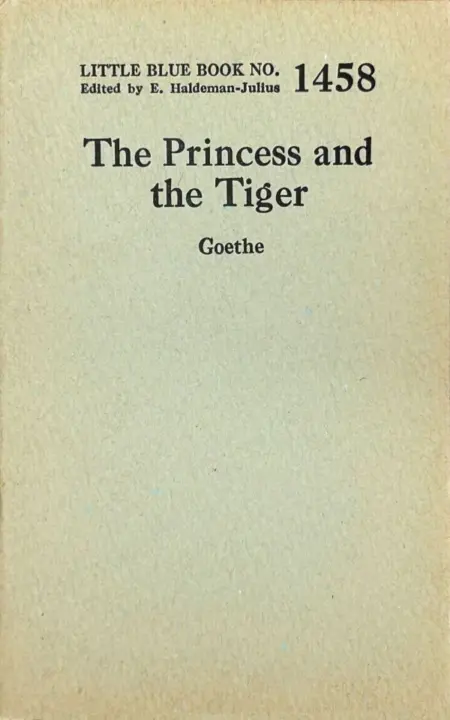
The princess and the tiger
Johann Wolfgang von Goethe
THE CLASSIC COLLECTION · 1917
"German Fiction" by Fontane, Goethe, Keller, and Storm is a collection of selected works from notable German authors written in the late 19th century. The compilation includes significant literary contributions from luminaries such as Johann Wolfgang von Goethe, Gottfried Keller, Theodor Storm, and Theodor Fontane, exploring complex themes of life, emotion, and character development within the context of German culture. The book likely delves into the internal struggles and nuanced experiences of its protagonists, inviting readers to reflect on deeper issues of existence and sentiment. The opening of the book presents a scholarly overview that examines the German novel's evolution and its intersections with international literature. It highlights the unique psychological depth characteristic of German literature, focusing on the internal emotional landscapes of characters more than on external action. Addressing the reader directly, it posits that German fiction often prefers psychological exploration over sensational narratives, appealing to those who appreciate intricate character studies and subtle developments over traditional plot-driven storytelling. The examination serves as a thoughtful introduction to the selected works, preparing readers for the emotional and intellectual depth they can expect from the writers featured in this anthology.
Introduction adapted from the source catalogue; source summaries may be automatically generated.
Free to read · English · 173,213 words · No account needed
MAKE TIME FOR A GOOD BOOK
On by default. Untick to stop anonymous reading totals. Each page counts after 10 seconds in view. How this works.
Anonymous counting is on unless you have switched it off.
His father stood still. "That's blood that you have spilled!"
The young man flushed hotly. "Why, has Trin Jans been here with her
cat?"
The old man nodded: "Why did you kill it?"
Hauke uncovered his bleeding arm. "That's why," he said. "She had torn
my bird away from me!"
Thereupon the old man said nothing. For a time he began to walk up and down, then he stood still in front of the young man and looked at him for a while almost absently.
"This affair with the cat I have made all right," he said, "but look, Hauke, this place is too small; two people can't stay on it--it is time you got a job!"
"Yes, father," replied Hauke; "I have been thinking something of the
sort myself."
"Why?" asked the old man.
"Well, one gets wild inside unless one can let it out on a decent piece
of work!"
"Is that so?" said the old man, "and that's why you have killed the Angora cat? That might easily lead to something worse!"
"You may be right, father, but the dikemaster has discharged his farmhand; I could do that work all right!"
The old man began to walk up and down, and meanwhile spat out the black tobacco. "The dikemaster is a blockhead, as stupid as a goose! He is dikemaster only because his father and grandfather have been the same, and on account of his twenty-nine fens. Round Martinmas, when the dike and sluice bills have to be settled, then he feeds the schoolmaster on roast goose and mead and wheat buns, and sits by and nods while the other man runs down the columns of figures with his pen, and says: 'Yes, yes, schoolmaster, God reward you! How finely you calculate!' But when the schoolmaster can't or won't, then he has to go at it himself and sits scribbling and striking out again, his big stupid head growing red and hot, his eyes bulging out like glass balls, as if his little bit of sense wanted to get out that way."
The young man stood up straight in front of his father and marveled at his talking; he had never heard him speak like that. "Yes, God knows," he said, "no doubt he is stupid, but his daughter Elke, she can calculate!"
The old man looked at him sharply.
"Hallo, Hauke," he exclaimed "what do you know about Elke Volkerts?"
"Nothing, father; only the schoolmaster has told me?"
The old man made no reply; he only pushed his piece of tobacco thoughtfully from one cheek into the other. "And you think," he said, "that you can help in the counting there too."
Your reading position is saved on this browser. Take it to another device with a library code. Reading pages adapt to text, rather than matching a printed edition.
Johann Wolfgang von Goethe
Johann Wolfgang von Goethe
Johann Wolfgang von Goethe
Gottfried Keller
BEHIND THE BOOK
This eBook is for the use of anyone anywhere in the United States and most other parts of the world at no cost and with almost no restrictions whatsoever. You may copy it, give it away or re-use it under the terms of the Project Gutenberg License included with this eBook or online at www.gutenberg.org. If you are not located in the United States, you will have to check the laws of the country where you are located before using this eBook. Read the source licence.
The original source file, including credits and licence, is retained by this library. Request an original-format copy at no charge. Please include the book title and Project Gutenberg identifier #34506.
KEEP YOUR CURIOSITY GOING
Coulson Kernahan

Maurice Baring
Frances Wright
Cécile Tormay

Frederic Jesup Stimson

W. H. P. (William Henry Pope) Jarvis