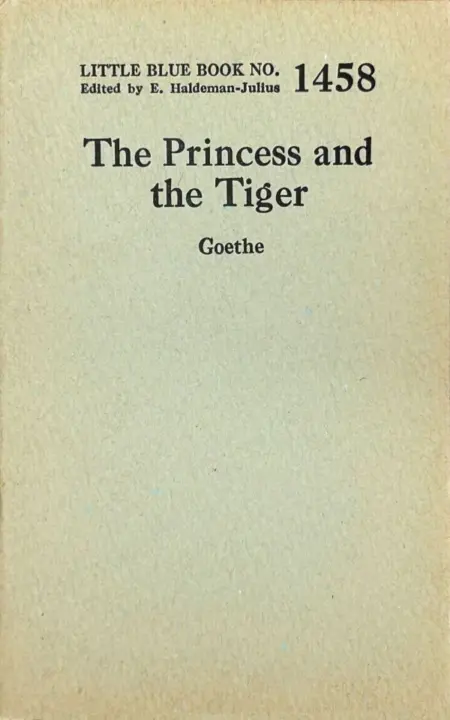
The princess and the tiger
Johann Wolfgang von Goethe
THE CLASSIC COLLECTION · 1917
"German Fiction" by Fontane, Goethe, Keller, and Storm is a collection of selected works from notable German authors written in the late 19th century. The compilation includes significant literary contributions from luminaries such as Johann Wolfgang von Goethe, Gottfried Keller, Theodor Storm, and Theodor Fontane, exploring complex themes of life, emotion, and character development within the context of German culture. The book likely delves into the internal struggles and nuanced experiences of its protagonists, inviting readers to reflect on deeper issues of existence and sentiment. The opening of the book presents a scholarly overview that examines the German novel's evolution and its intersections with international literature. It highlights the unique psychological depth characteristic of German literature, focusing on the internal emotional landscapes of characters more than on external action. Addressing the reader directly, it posits that German fiction often prefers psychological exploration over sensational narratives, appealing to those who appreciate intricate character studies and subtle developments over traditional plot-driven storytelling. The examination serves as a thoughtful introduction to the selected works, preparing readers for the emotional and intellectual depth they can expect from the writers featured in this anthology.
Introduction adapted from the source catalogue; source summaries may be automatically generated.
Free to read · English · 173,213 words · No account needed
MAKE TIME FOR A GOOD BOOK
On by default. Untick to stop anonymous reading totals. Each page counts after 10 seconds in view. How this works.
Anonymous counting is on unless you have switched it off.
I mentioned to you the other day that I had become acquainted with S----, the district judge, and that he had invited me to go and visit him in his retirement, or rather in his little kingdom. But I neglected going, and perhaps should never have gone, if chance had not discovered to me the treasure which lay concealed in that retired spot. Some of our young people had proposed giving a ball in the country, at which I consented to be present. I offered my hand for the evening to a pretty and agreeable, but rather commonplace, sort of girl from the immediate neighbourhood; and it was agreed that I should engage a carriage, and call upon Charlotte, with my partner and her aunt, to convey them to the ball. My companion informed me, as we drove along through the park to the hunting-lodge, that I should make the acquaintance of a very charming young lady. "Take care," added the aunt, "that you do not lose your heart." "Why?" said I. "Because she is already engaged to a very worthy man," she replied, "who is gone to settle his affairs upon the death of his father, and will succeed to a very considerable inheritance." This information possessed no interest for me. When we arrived at the gate, the sun was setting behind the tops of the mountains. The atmosphere was heavy; and the ladies expressed their fears of an approaching storm, as masses of low black clouds were gathering in the horizon. I relieved their anxieties by pretending to be weather-wise, although I myself had some apprehensions lest our pleasure should be interrupted.
I alighted; and a maid came to the door, and requested us to wait a moment for her mistress. I walked across the court to a well-built house, and, ascending the flight of steps in front, opened the door, and saw before me the most charming spectacle I had ever witnessed. Six children, from eleven to two years old, were running about the hall, and surrounding a lady of middle height, with a lovely figure, dressed in a robe of simple white, trimmed with pink ribbons. She was holding a rye loaf in her hand, and was cutting slices for the little ones all round, in proportion to their age and appetite. She performed her task in a graceful and affectionate manner; each claimant awaiting his turn with outstretched hands, and boisterously shouting his thanks. Some of them ran away at once, to enjoy their evening meal; whilst others, of a gentler disposition, retired to the courtyard to see the strangers, and to survey the carriage in which their Charlotte was to drive away. "Pray forgive me for giving you the trouble to come for me, and for keeping the ladies waiting: but dressing, and arranging some household duties before I leave, had made me forget my children's supper; and they do not like to take it from any one but me." I uttered some indifferent compliment: but my whole soul was absorbed by her air, her voice, her manner; and I had scarcely recovered myself when she ran into her room to fetch her gloves and fan. The young ones threw inquiring glances at me from a distance; whilst I approached the youngest, a most delicious little creature. He drew back; and Charlotte, entering at the very moment, said, "Louis, shake hands with your cousin." The little fellow obeyed willingly; and I could not resist giving him a hearty kiss, notwithstanding his rather dirty face. "Cousin," said I to Charlotte, as I handed her down, "do you think I deserve the happiness of being related to you?" She replied, with a ready smile, "Oh! I have such a number of cousins that I should be sorry if you were the most undeserving of them." In taking leave, she desired her next sister, Sophy, a girl about eleven years old, to take great care of the children, and to say good-by to papa for her when he came home from his ride. She enjoined to the little ones to obey their sister Sophy as they would herself, upon which some promised that they would; but a little fair-haired girl, about six years old, looked discontented, and said, "But Sophy is not you, Charlotte; and we like you best." The two eldest boys had clambered up the carriage; and, at my request, she permitted them to accompany us a little way through the forest, upon their promising to sit very still, and hold fast.
Your reading position is saved on this browser. Take it to another device with a library code. Reading pages adapt to text, rather than matching a printed edition.
Johann Wolfgang von Goethe
Johann Wolfgang von Goethe
Johann Wolfgang von Goethe
Gottfried Keller
BEHIND THE BOOK
This eBook is for the use of anyone anywhere in the United States and most other parts of the world at no cost and with almost no restrictions whatsoever. You may copy it, give it away or re-use it under the terms of the Project Gutenberg License included with this eBook or online at www.gutenberg.org. If you are not located in the United States, you will have to check the laws of the country where you are located before using this eBook. Read the source licence.
The original source file, including credits and licence, is retained by this library. Request an original-format copy at no charge. Please include the book title and Project Gutenberg identifier #34506.
KEEP YOUR CURIOSITY GOING
Coulson Kernahan

Maurice Baring
Frances Wright
Cécile Tormay

Frederic Jesup Stimson

W. H. P. (William Henry Pope) Jarvis