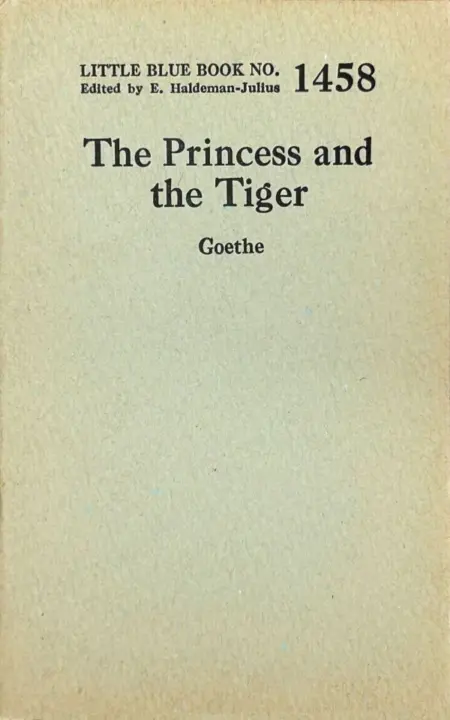
The princess and the tiger
Johann Wolfgang von Goethe
THE CLASSIC COLLECTION · 1917
"German Fiction" by Fontane, Goethe, Keller, and Storm is a collection of selected works from notable German authors written in the late 19th century. The compilation includes significant literary contributions from luminaries such as Johann Wolfgang von Goethe, Gottfried Keller, Theodor Storm, and Theodor Fontane, exploring complex themes of life, emotion, and character development within the context of German culture. The book likely delves into the internal struggles and nuanced experiences of its protagonists, inviting readers to reflect on deeper issues of existence and sentiment. The opening of the book presents a scholarly overview that examines the German novel's evolution and its intersections with international literature. It highlights the unique psychological depth characteristic of German literature, focusing on the internal emotional landscapes of characters more than on external action. Addressing the reader directly, it posits that German fiction often prefers psychological exploration over sensational narratives, appealing to those who appreciate intricate character studies and subtle developments over traditional plot-driven storytelling. The examination serves as a thoughtful introduction to the selected works, preparing readers for the emotional and intellectual depth they can expect from the writers featured in this anthology.
Introduction adapted from the source catalogue; source summaries may be automatically generated.
Free to read · English · 173,213 words · No account needed
MAKE TIME FOR A GOOD BOOK
On by default. Untick to stop anonymous reading totals. Each page counts after 10 seconds in view. How this works.
Anonymous counting is on unless you have switched it off.
The progress can be traced from "Immensee" through "At the Castle" and "At the University" to the objective narrative of "In the Village on the Heath" and "At Cousin Christian's." In "Eekenhof" and "Hans and Heinz Kirsch" he is frankly realistic, and the complete evolution from his early subjectivity is seen in the dramatic depicting of human struggles in "The Sons of the Senator," "Renate," and, last and greatest of his works, "The Rider on the White Horse."
In this masterpiece, Storm exhibits a man's will in conflict, on one side, with unintelligent conservatism among his fellowmen and, on the other, with the forces of nature. The figure of the dike-master emerges from the double struggle with a fine impressiveness; and the tragedy which finally engulfs him and his family is profoundly moving. At the same time we are given a vivid picture of the landscape of the low-lying coast of the North Sea, with the ever-present menace of the flood tide; and the sternness of the action is tempered with glimpses of humor and a picture of warm affection. Here Storm's art reached a pitch which places him beside the masters of the short novel.
By Adolf Stern
Within his special North German world, Storm's view extends back through the decades and centuries. It reaches also, from the humblest classes of the people, whose solidity and peculiar virtues he understands as well as anyone, up to the circles of the most liberal and profound culture. But the class that stands out most conspicuously is the bourgeoisie, with their moderate means and their traditional eagerness to assure to their children circumstances as good as their own or better; among them his novels are usually laid; and among them he finds his richest and most original characters. All these people are deeply rooted in the soil of the family, of the home in the narrower sense; with all of them the memories of childhood, the earliest surroundings, play a more important part than would be the case with people of the same type of mind and the same social position from another region. With all of them a conservative element is predominant, which makes itself felt in all their doings, their way of seeing things, their habits. Men and women appear to be in the peculiar bondage of a convention more formal than severe; they seem possessed by a feeling of responsibility towards a conception of life which dominates them, a conception which does not, to be sure, exclude free will, a noble passion or warm affection, but which recognizes such and admits them to their world only under special conditions, watchfully, carefully, and with reserve. They are more dependent on the opinion of their environment than the more careless and indifferent children of other stocks. But though all the characters which Storm likes to portray are wonderfully and apparently inextricably overgrown with tradition and custom, yet they are, on the other hand, strong individualities, independent to the point of stubbornness, and fully conscious of their right to their own inner life. In these natures so honestly sober, testing and weighing so sensibly, living in such well-established order, there reigns secretly a powerful imagination, a longing and a determination to win, each for himself, a piece of life after his heart's desire. They are all ready under certain circumstances to enter into the sharpest conflict, even into the most irreconcilable struggle with all the conventions, as soon as they feel their inmost being seized by such a yearning. They have little inclination to yield to their imaginations in the things of everyday life, or to urge their desires beyond the usual. But sometimes in decisive moments they are carried away, they become conscious of the ardor and at the same time of the strength of their hearts, for once they must follow the call of their feelings which tells them they are free and have to work out their own salvation. It is among such natures that there is scope for the strong and deep passion of love, for that faithful affection that gives no outward sign--we stand on the shore whence rose the song of Gudrun in the gray days of old.
Your reading position is saved on this browser. Take it to another device with a library code. Reading pages adapt to text, rather than matching a printed edition.
Johann Wolfgang von Goethe
Johann Wolfgang von Goethe
Johann Wolfgang von Goethe
Gottfried Keller
BEHIND THE BOOK
This eBook is for the use of anyone anywhere in the United States and most other parts of the world at no cost and with almost no restrictions whatsoever. You may copy it, give it away or re-use it under the terms of the Project Gutenberg License included with this eBook or online at www.gutenberg.org. If you are not located in the United States, you will have to check the laws of the country where you are located before using this eBook. Read the source licence.
The original source file, including credits and licence, is retained by this library. Request an original-format copy at no charge. Please include the book title and Project Gutenberg identifier #34506.
KEEP YOUR CURIOSITY GOING
Coulson Kernahan

Maurice Baring
Frances Wright
Cécile Tormay

Frederic Jesup Stimson

W. H. P. (William Henry Pope) Jarvis