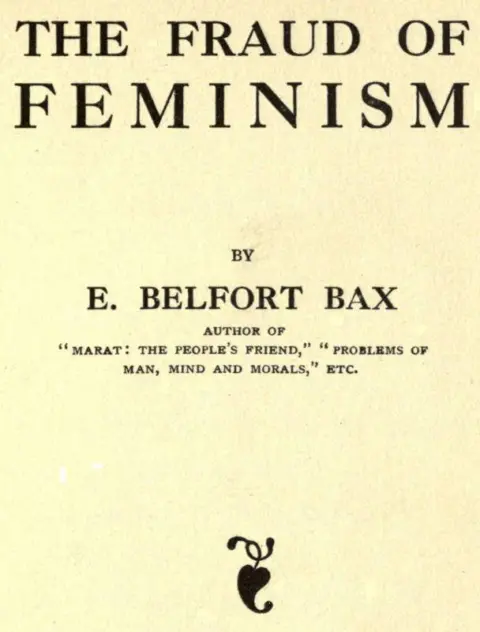
The Fraud of Feminism
Ernest Belfort Bax
THE CLASSIC COLLECTION · 1915
"German Culture Past and Present" by Ernest Belfort Bax is a historical account written in the early 20th century. The text explores the social and intellectual life of Germany, particularly focusing on the transformative period from the end of the medieval era through the Reformation. It aims to shed light on little-known aspects of German culture during this pivotal time, emphasizing the origins of contemporary German character and societal structure. The opening of the work sets the stage by discussing the condition of medieval Europe at the close of the 15th century, illustrating how feudal structures were still outwardly intact but undergoing significant underlying changes that would lead to their disintegration. It highlights key factors, such as the advent of firearms, the rise of the merchant class, and the spread of the Renaissance, which contributed to a growing awareness of individual rights and an emergent capitalist economy. Bax hints at the socio-political struggles that would culminate in major upheavals, including the Reformation, suggesting that the tensions and transformations of this era were crucial in shaping modern German society.
Introduction adapted from the source catalogue; source summaries may be automatically generated.
Free to read · English · 58,114 words · No account needed
MAKE TIME FOR A GOOD BOOK
On by default. Untick to stop anonymous reading totals. Each page counts after 10 seconds in view. How this works.
Anonymous counting is on unless you have switched it off.
The year following the collapse of Franz Sickingen's rebellion saw the first mutterings of the great movement known as the Peasants' War, the most extensive and important of all the popular insurrections of the Middle Ages, which, as we have seen in a previous chapter, had been led up to during the previous half-century by numerous sporadic movements throughout Central Europe having like aims.
The first actual outbreak of the Peasants' War took place in August 1524, in the Black Forest, in the village of Stuehlingen, from an apparently trivial cause. It spread rapidly throughout the surrounding districts, having found a leader in a former soldier of fortune, Hans Mueller by name. The so-called Evangelical Brotherhood sprang into existence. On the new movement becoming threatening it was opposed by the Swabian League, a body in the interests of the Germanic Federation, its princes, and cities, whose function it was to preserve public tranquillity and enforce the Imperial decrees. The peasant army was armed with the rudest weapons, including pitchforks, scythes, and axes; but nothing decisive of a military character took place this year. Meanwhile the work of agitation was carried on far and wide throughout the South German territories. Preachers of discontent among the peasantry and the former towns were everywhere agitating and organizing with a view to a general rising in the ensuing spring. Negotiations were carried on throughout the winter with nobles and the authorities without important results. A diversion in favour of the peasants was caused by Duke Ulrich of Wuertemberg favouring the peasants' cause, which he hoped to use as a shoeing-horn to his own plans for recovering his ancestral domains, from which he had been driven on the grounds of a family quarrel under the ban of the empire in 1519. He now established himself in his stronghold of Hohentwiel, in Wuertemberg, on the Swiss frontier. By February or the beginning of March peasant bands were organizing throughout Southern Germany. Early in March a so-called Peasants' Parliament was held at Memmingen, a small Swabian town, at which the principal charter of the movement, the so-called "Twelve Articles," was adopted. This important document has a strong religious colouring, the political and economic demands of the peasants being led up to and justified by Biblical quotations. They all turn on the customary grievances of the time. The "Twelve Articles" remain throughout the chief Bill of Rights of the South German peasantry, though there were other versions of the latter current in certain districts. What was said before concerning the local sporadic movements which had been going en for a generation previously applies equally to the great uprising of 1525. The rapidity with which the ideas represented by the movement, and in consequence the movement itself, spread, is marvellous. By the middle of April it was computed that no less than 300,000 peasants, besides necessitous townsfolk, were armed and in open rebellion. On the side of the nobles no adequate force was ready to meet the emergency. In every direction were to be seen flaming castles and monasteries. On all sides were bodies of armed countryfolk, organized in military fashion, dictating their will to the countryside and the small towns, whilst disaffection was beginning to show itself in a threatening manner among the popular elements of not a few important cities. A slight success gained by the Swabian League at the Upper Swabian village of Leipheim in the second week of April did not improve matters. In Easter week, 1525, it looked indeed as if the "Twelve Articles" at least would become realized, if not the Christian Commonwealth dreamed of by the religious sectaries established throughout the length and breadth of Germany. Princes, lords, and ecclesiastical dignitaries were being compelled far and wide to save their lives, after their property was probably already confiscated, by swearing allegiance to the Christian League or Brotherhood of the peasants and by countersigning the "Twelve Articles" and other demands of their refractory villeins and serfs. So threatening was the situation that the Archduke Ferdinand began himself to yield, in so far as to enter into negotiations with the insurgents. In many cases the leaders and chief men of the bands were got up in brilliant costume. We read of purple mantles and scarlet birettas with ostrich plumes as the costume of the leaders, of a suite of men in scarlet dress, of a vanguard of ten heralds, gorgeously attired. As Lamprecht justly observes (Deutsche Geschichte, vol. v. p. 343): "The peasant revolts were, in general, less in the nature of campaigns, or even of an uninterrupted series of minor military operations, than of a slow process of mobilization, interrupted and accompanied by continual negotiations with lords and princes--a mobilization which was rendered possible by the standing right of assembly and of carrying arms possessed by the peasants." The smaller towns everywhere opened their gates without resistance to the peasants, between whom and the poorer inhabitants an understanding commonly existed. The bands waxed fat with plunder of castles and religious houses, and did full justice to the contents of the rich monastic wine-cellars.
Your reading position is saved on this browser. Take it to another device with a library code. Reading pages adapt to text, rather than matching a printed edition.
Ernest Belfort Bax

Ernest Belfort Bax
BEHIND THE BOOK
This eBook is for the use of anyone anywhere in the United States and most other parts of the world at no cost and with almost no restrictions whatsoever. You may copy it, give it away or re-use it under the terms of the Project Gutenberg License included with this eBook or online at www.gutenberg.org. If you are not located in the United States, you will have to check the laws of the country where you are located before using this eBook. Read the source licence.
The original source file, including credits and licence, is retained by this library. Request an original-format copy at no charge. Please include the book title and Project Gutenberg identifier #20461.
KEEP YOUR CURIOSITY GOING
Cécile Tormay

Moritz Busch
John L. Ransom
Frances Wright
Cécile Tormay

Mabel Potter Daggett