THE CLASSIC COLLECTION✦Great Men as Prophets of a New EraCLASSIC FREE BOOKS
Great Men as Prophets of a New Era
Newell Dwight Hillis
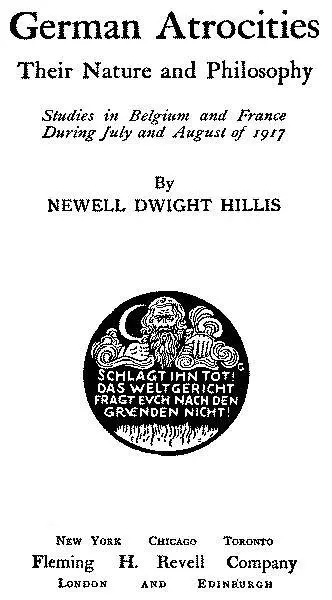
THE CLASSIC COLLECTION · 1918
"German Atrocities: Their Nature and Philosophy" by Newell Dwight Hillis is a historical account written in the early 20th century. The work delves into the brutal actions perpetrated by German forces during World War I, providing a detailed investigation of atrocities witnessed in Belgium and France. The author aims to document these events by compiling testimonies, photographs, and reports, asserting the existence of a systematic and horrific campaign of violence against civilians. At the start of the book, Hillis establishes the rationale behind his inquiries into the German atrocities, recounting the chilling accounts received from Belgian refugees. He expresses a strong desire to corroborate these testimonies with extensive research and firsthand observations, which ultimately led him to war-torn regions to gather evidence from survivors and witnesses. He emphasizes that the evidence of atrocities is overwhelming, supported by various forms of proof including testimonies from children and soldiers' diaries. This introduction not only sets the stage for a detailed examination of the reported atrocities but also raises questions about the moral implications of such actions in the context of modern warfare.
Introduction adapted from the source catalogue; source summaries may be automatically generated.
Free to read · English · 28,773 words · No account needed
MAKE TIME FOR A GOOD BOOK
On by default. Untick to stop anonymous reading totals. Each page counts after 10 seconds in view. How this works.
Anonymous counting is on unless you have switched it off.
German apostasy began with German military success. What the Kaiser offered to Germany in exchange for her soul was the Pan-German empire. The originator of the world empire scheme was the Kaiser; Nietzsche was its philosopher; Treitsche its historian; Bernhardi its advocate; and von Hindenburg its executive. The first conference regarding the Pan-German empire seems to have been called in 1895, and was held in the Potsdam Palace. During the next two or three years, a world organization was brought together by the "Potsdam gang," with the Kaiser at the center, an inner circle of officers, and politicians, a larger circle of bankers, manufacturers, and ship owners. Finally there was a far-flung web of diplomats, spies, commercial travellers, Pan-German League agents, organizing in New York, Chicago and San Francisco, in Buenos Ayres and Rio de Janeiro, in Buda Pesth and Vienna, in Constantinople and Cairo, German Veteran Leagues, German Commercial Associations, all looking towards the day when the Kaiser would be the world emperor, and all countries would become provinces paying tribute to the world capital, Berlin. "What about international law?" asked an American diplomat of Bernhardi. "There will be no international law," was the answer. "Berlin will decide what laws are best for the rest of the world."
The Pan-German empire pamphlets, maps, books, magazine articles, published during the next ten years, were legion, but Professor Tannemann, a personal friend of the Kaiser, in 1911 restated the Kaiser's scheme. The essence of Pan-German plan was condensed into a few sentences: "From Hamburg and the North Sea to the Persian Gulf; the immediate goal, by 1915, the conquest of 250,000,000 of people; the ultimate goal, the Germanization of all the nations of the world." One of the Kaiser's speeches contains the explanation of his dream of becoming a world conqueror: "From my childhood I have been under the influence of five men,--Alexander, Julius Cæsar, Theodoric II, Frederick the Great and Napoleon. Each of these men dreamed a dream of a world empire; they failed. I am dreaming a dream of a German world empire--and my mailed fist shall succeed." The Kaiser printed a map headed, "The Roman Empire; Cæsar Augustus, world emperor." That map shows the once great states, Athens, Ephesus, Jerusalem, Alexandria, Carthage, reduced to county seat towns, paying tribute to the world capital, while their captive kings had walked as slaves in the triumphal processions along the Appian Way, towards the palace of the world ruler, Cæsar Augustus. One of the Pan-German empire pamphlets, and many of the German newspapers contain a revised map of Europe, showing "Germania" stamped across the continent, with St. Petersburg, Paris and London become county seat towns, paying tribute to the world capital, Berlin. Many German newspapers, during this war, have published maps showing Canada as a German province, with the name "Germania" stamped across South America, Mexico and Central America. These many pamphlets and Pan-German empire books explain Admiral Dewey's report to President McKinley. That report seems to have been written in the cabin of the flag-ship Olympia, in Manila Bay. Dewey states that the German admiral told him plainly to make a note of this prophecy that within fifteen years (1899, report of Admiral Dewey), Germany would crush France and Belgium, seize Holland and Denmark, utterly destroy England, and take Canada as a German province. Admiral Dewey added that the German admiral told him that while the Kaiser intended to seize New York and Washington and hold them for an indemnity, he did not intend to permanently hold in subjection the United States, but he did intend to retain Mexico and South America, and then "dispose of the Monroe Doctrine as he thinks best." This may explain the Kaiser's word to Mr. Gerard: "After this war I will stand no nonsense from the United States." So astounding were these claims that the statesmen and rulers of the world laughed at these threats, deeming it incredible that Germany was plotting a world war. Two or three men of remarkable prescience and vision, General Roberts in London, Chéradame in Paris, and Ex-President Roosevelt, understood and therefore never ceased warning the nation to prepare and make ready for a conflict that seemed to them inevitable.
Your reading position is saved on this browser. Take it to another device with a library code. Reading pages adapt to text, rather than matching a printed edition.
Newell Dwight Hillis
Newell Dwight Hillis
Newell Dwight Hillis
Newell Dwight Hillis
BEHIND THE BOOK
This eBook is for the use of anyone anywhere in the United States and most other parts of the world at no cost and with almost no restrictions whatsoever. You may copy it, give it away or re-use it under the terms of the Project Gutenberg License included with this eBook or online at www.gutenberg.org. If you are not located in the United States, you will have to check the laws of the country where you are located before using this eBook. Read the source licence.
The original source file, including credits and licence, is retained by this library. Request an original-format copy at no charge. Please include the book title and Project Gutenberg identifier #49515.
KEEP YOUR CURIOSITY GOING
Cécile Tormay

Moritz Busch
John L. Ransom
Frances Wright
Cécile Tormay

Mabel Potter Daggett