
Lying lips
William Le Queux
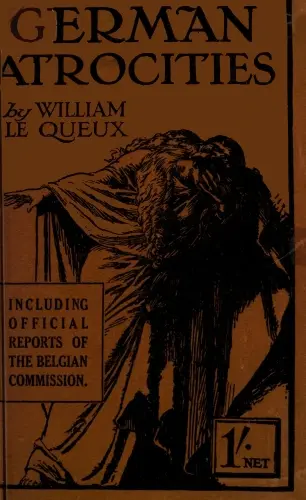
THE CLASSIC COLLECTION · 1915
"German Atrocities: A Record of Shameless Deeds" by William Le Queux is a historical account written in the early 20th century. The text serves to expose and document the horrific acts committed by German troops during World War I, particularly in Belgium, highlighting the moral and ethical violations perpetrated against civilians. It relies on a range of sources, including official reports and firsthand accounts, to paint a disturbing picture of wartime brutality. At the start of the work, the author presents a preface that sets the tone for what is to follow, emphasizing the urgency in providing an honest portrayal of the German military actions that have led to widespread suffering. Le Queux describes the systematic and horrific atrocities inflicted upon the Belgian populace, portraying the German forces as barbaric invaders motivated by a ruthless military ethos. The opening argument establishes that these acts are not random but are part of a deliberate strategy to instill fear and suppress resistance among the civilian population, drawing comparisons to historical figures like Attila and setting the stage for a detailed examination of the inhumanity committed during the war.
Introduction adapted from the source catalogue; source summaries may be automatically generated.
Free to read · English · 27,933 words · No account needed
MAKE TIME FOR A GOOD BOOK
On by default. Untick to stop anonymous reading totals. Each page counts after 10 seconds in view. How this works.
Anonymous counting is on unless you have switched it off.
=It is specially forbidden “To kill or wound an enemy who, having laid down his arms, or having no longer means of defence, has surrendered at discretion. To make improper use of a flag of truce, of the national flag, or of the military insignia and uniform of the enemy.”--Hague Convention, Article XXIII.=
Wanton Brutality.
I have made it plain from the official documents I have quoted that the German troops violated every item of this article. But in addition to cases of brutality already cited in the official document, the Belgian Mission, while in London, gave me the following:--
On August 19th Aerschot, in North Brabant, with about five thousand inhabitants, was, as already reported, destroyed. It appears that during the three days the German soldiery massacred and pillaged the town, which had not resisted, although there was no military force there whatever.
In the neighbouring village of Diest many of the inhabitants were put to the sword. The wife of Francis Luyckx, aged forty-five, and her daughter, twelve years of age, had, in their terror, taken refuge in a sewer. They were discovered, dragged out, and shot.
The little daughter of Jean Oyyen, a pretty child of nine, was shot, and a man named Andre Willem, aged twenty-three, the village sexton, was bound to a tree and burned alive.
In the village of Schaffen, near Diest, two men, named Lodts and Marken, both aged forty, were captured and entombed. When exhumed, it was found that they had been buried alive, head downwards. These occurrences--which are only a few of a very long list--had been fully inquired into, and confirmed by the committee of investigation, which was composed of the highest magistrates of Belgium and the chief professors of the Universities.
Statements were made that aged villagers in many places on the Franco-German frontier were hanged to trees; others, after being killed, had their eyes gouged out. In one place fifteen bodies were found mutilated in a heap, and along the whole frontier from Luxemburg to Basle outrages were committed on women, girls, and children.
Mlle. Marie Malet, the daughter of a judicial official in Brussels, who had been sent to London with a party of Belgian girls for safety, stated that she had seen a little girl, a friend of hers, aged ten, savagely sabred by a German officer, merely because she made a remark that the Germans were bullies. The child died an hour afterwards. Mlle. Malet stated that she had been sent from near Brussels with her sister, owing to the insults to which Belgian girls were subjected by German soldiers. Her mother had been wounded and her home looted of food and valuables.
Your reading position is saved on this browser. Take it to another device with a library code. Reading pages adapt to text, rather than matching a printed edition.
William Le Queux
William Le Queux
William Le Queux
William Le Queux
BEHIND THE BOOK
This eBook is for the use of anyone anywhere in the United States and most other parts of the world at no cost and with almost no restrictions whatsoever. You may copy it, give it away or re-use it under the terms of the Project Gutenberg License included with this eBook or online at www.gutenberg.org. If you are not located in the United States, you will have to check the laws of the country where you are located before using this eBook. Read the source licence.
The original source file, including credits and licence, is retained by this library. Request an original-format copy at no charge. Please include the book title and Project Gutenberg identifier #52082.
KEEP YOUR CURIOSITY GOING
Cécile Tormay

Moritz Busch
John L. Ransom
Frances Wright
Cécile Tormay

Mabel Potter Daggett