THE CLASSIC COLLECTION✦Atoms and electronsCLASSIC FREE BOOKS
Atoms and electrons
J. W. N. (John William Navin) Sullivan
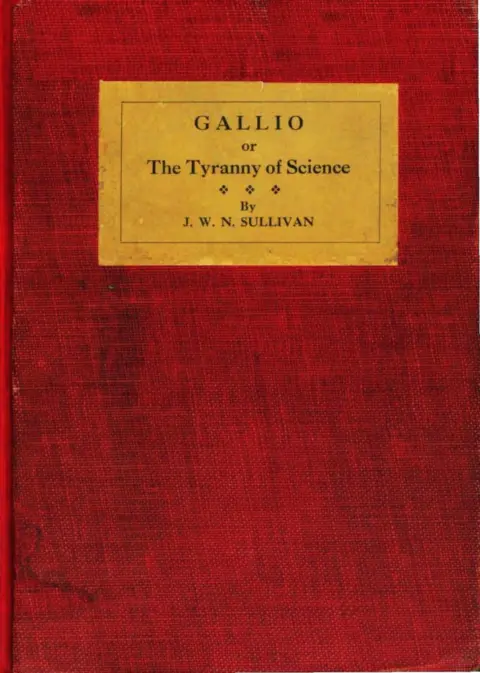
THE CLASSIC COLLECTION · 1928
"Gallio : or, The tyranny of science by J. W. N. Sullivan" is a philosophical essay of cultural criticism written in the early 20th century. The book examines the growing prestige of science and challenges its claim to define reality, especially where it sidelines art, morals, and spiritual experience. Its likely topic is the limits of scientific method and the need to recognize values, purpose, and imagination as central to human knowledge. The essay opens with the rise of scientific authority from Darwin to Einstein, noting how artists first resisted and then, after the War, often embraced a bleak materialism. It argues that modern physics—especially relativity—undermines the old “iron laws,” showing that scientific laws are mind-shaped selections from a world of “point-events,” and that science offers only partial, abstract descriptions of reality. Sullivan criticizes the fetish of measurement and the misuse of scientific prestige in fields like eugenics, crude psychoanalysis, and behaviourism, as well as the fallacy of “explaining by origins.” He urges humility before quantum mysteries and calls for richer abstractions, drawing on thinkers like Eddington and Whitehead to replace “substance” with “organism” and to reconnect space, time, memory, and expectation. Art—especially music—is presented as a mode of genuine knowledge that reveals possibilities of the spirit and anticipates human growth. The book closes by denying that science should tyrannize culture: its scope is limited, its laws are provisional and self-referential, and it is largely irrelevant to the deepest moral and spiritual concerns.
Introduction adapted from the source catalogue; source summaries may be automatically generated.
Free to read · English · 9,555 words · No account needed
MAKE TIME FOR A GOOD BOOK
On by default. Untick to stop anonymous reading totals. Each page counts after 10 seconds in view. How this works.
Anonymous counting is on unless you have switched it off.
A more definitely materialistic bias is observable in the attempts to explain psychological happenings in terms of physiology. The result is that learned and acute men, caught in the jungle of neurology, painfully fight their way out with some such epoch-making discovery as that one learns a subject more rapidly if one is interested in it. This result, which is supposed to be incompatible with the purely physiological theory of the mind, owes all its difficulty to that in compatibility. Otherwise it is a perfectly obvious fact of experience. If it were not for the prestige achieved by materialism in the Victorian age it is probable that psychology would be very much further advanced than it is. But the side-tracking influence of that philosophy has meant that psychologists have had painfully to discover the obvious. But if materialism, in small doses, delays the recognition of the obvious, it does, when fully developed, deny the obvious. This is what the behaviourists do. They deny that we think or that we can form images in our minds. The only possible answer to this theory is a satire, as when Voltaire answered the theory that in this world everything is for the best in the best of all possible worlds by writing Candide. But in this queer modern world behaviourism, instead of being greeted with laughter, is answered carefully and politely, apparently in the spirit in which Monsieur Bergeret shook hands with the vers libriste poet, “for fear of wronging beauty in disguise”. The position of the ordinary man in face of these theories is, nevertheless, a difficult one. Behaviourism may sound to him nonsense, but so does non-Euclidean geometry. His natural reaction would be to class both of them with the theory that the English are descended from the lost ten tribes of Israel. Nevertheless, non-Euclidean geometry is not nonsense. In these circumstances it is probably fortunate that there are people patient enough to prepare careful and reasoned refutations of any whimsy that anybody cares to put forth. The extraordinary predisposition of the learned towards concocting merely silly theories must always be borne in mind. Studious persons often have a very small range of experience of life; they have nothing like so broadly based a sense of probability as the ordinary man of the world possesses, which is why so many of them seem curiously innocent and gullible. The beaming and genial professor expounding his theory often seems curiously like a child playing with toys. The mixture of amusement and respect with which the world watches him is, on the whole, the correct reaction. As long as he is dealing with the incomprehensible one may grant him authority. Nobody dreams of questioning astronomical pronouncements about forthcoming eclipses. But when he is talking about the very stuff of our ordinary experience, as in psychology, we do wrong to accept the obviously absurd for fear that it cannot be as silly as it looks. A great deal of what is called psycho-analysis, for instance, is merely silly. Only people singularly deficient in common-sense and completely lacking in a sense of humour could have invented anything so preposterous. Undoubtedly some pathological states are of sexual origin, but the lengths to which the theory has been carried and the kind of interpretations that are given make the development of psycho-analysis one of the greatest psychological curiosities of our time. Whole-hearted belief in psycho-analysis certainly points to the existence of a complex. As with any other complex, it is defended by arguments to which none except those who are similarly afflicted can attach the slightest validity. The complex is strongly materialistic, not in the sense that everything is reduced to “matter and motion”, but in the sense that the lowest human activities are made explanatory of all the rest. One often finds, associated with a belief in materialism, a desire to deny any form of spiritual excellence. The ostensible motive is simplification, as when material substances are reduced to a small number of chemical elements; but it is usually obvious, from the forced explanations that are attempted, that the real motive is something very different. Much, of course, must be attributed to insensitiveness, as we see when we turn to psycho-analytic explanations of works of art. The extraordinary force of the psycho-analysts’ complex is well shown by the sort of arguments they find convincing. Thus they may profess to show that artistic tastes never exist without suppressed sexual desires. Their way of establishing this fact, which is chiefly by asserting it, is comparatively rational. But they then proceed to the statement that a taste for art is merely a disguised form of sexual desire. They might as well say that it is a disguised form of hunger, since artists are quite as notorious for being hungry as for being erotic, and artistic tastes are never found to exist in a man who takes no nourishment.
Your reading position is saved on this browser. Take it to another device with a library code. Reading pages adapt to text, rather than matching a printed edition.
J. W. N. (John William Navin) Sullivan
J. W. N. (John William Navin) Sullivan
BEHIND THE BOOK
This eBook is for the use of anyone anywhere in the United States and most other parts of the world at no cost and with almost no restrictions whatsoever. You may copy it, give it away or re-use it under the terms of the Project Gutenberg License included with this eBook or online at www.gutenberg.org. If you are not located in the United States, you will have to check the laws of the country where you are located before using this eBook. Read the source licence.
The original source file, including credits and licence, is retained by this library. Request an original-format copy at no charge. Please include the book title and Project Gutenberg identifier #76629.
KEEP YOUR CURIOSITY GOING

David Patterson (Spirit) Hatch

David Patterson (Spirit) Hatch

David Patterson (Spirit) Hatch
Coulson Kernahan

Ralph Waldo Emerson

Maurice Baring