THE CLASSIC COLLECTION✦Atoms and electronsCLASSIC FREE BOOKS
Atoms and electrons
J. W. N. (John William Navin) Sullivan
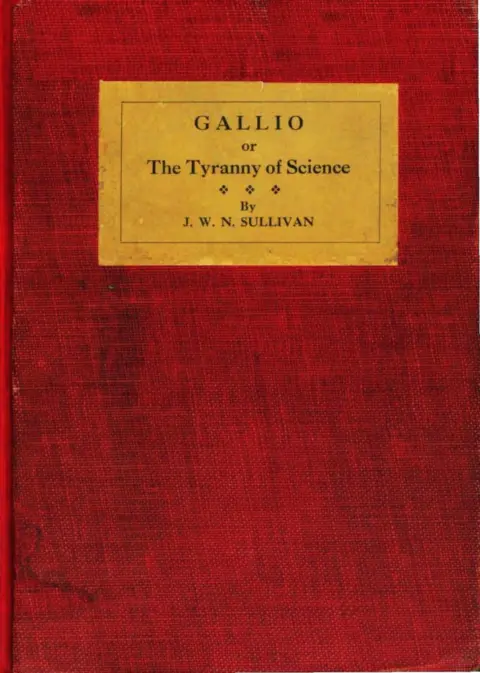
THE CLASSIC COLLECTION · 1928
"Gallio : or, The tyranny of science by J. W. N. Sullivan" is a philosophical essay of cultural criticism written in the early 20th century. The book examines the growing prestige of science and challenges its claim to define reality, especially where it sidelines art, morals, and spiritual experience. Its likely topic is the limits of scientific method and the need to recognize values, purpose, and imagination as central to human knowledge. The essay opens with the rise of scientific authority from Darwin to Einstein, noting how artists first resisted and then, after the War, often embraced a bleak materialism. It argues that modern physics—especially relativity—undermines the old “iron laws,” showing that scientific laws are mind-shaped selections from a world of “point-events,” and that science offers only partial, abstract descriptions of reality. Sullivan criticizes the fetish of measurement and the misuse of scientific prestige in fields like eugenics, crude psychoanalysis, and behaviourism, as well as the fallacy of “explaining by origins.” He urges humility before quantum mysteries and calls for richer abstractions, drawing on thinkers like Eddington and Whitehead to replace “substance” with “organism” and to reconnect space, time, memory, and expectation. Art—especially music—is presented as a mode of genuine knowledge that reveals possibilities of the spirit and anticipates human growth. The book closes by denying that science should tyrannize culture: its scope is limited, its laws are provisional and self-referential, and it is largely irrelevant to the deepest moral and spiritual concerns.
Introduction adapted from the source catalogue; source summaries may be automatically generated.
Free to read · English · 9,555 words · No account needed
MAKE TIME FOR A GOOD BOOK
On by default. Untick to stop anonymous reading totals. Each page counts after 10 seconds in view. How this works.
Anonymous counting is on unless you have switched it off.
The old materialistic outlook, although it no longer has any scientific justification, is still active in many branches of science. It has made popular certain types of explanation and is the cause of the direction pursued by certain researches. In particular it has led to a great deal of useless or misleading work being done in the attempt to reduce qualitative to quantitative differences.
A good deal of what passes for scientific work amongst eugenists and psychologists consists of attempts to match things which are qualitatively different. This is the favourite procedure of that kind of psycho-analysis which reduces everything to sex. Discrimination is fatiguing; also, it makes appeal to sensibilities which many earnest “scientific workers” do not possess. It is much easier to make measurements than to know exactly what you are measuring.
To give up the ideal of measurability would be equivalent, to many people, to abandoning “science” altogether. “Science is measurement”, we are informed. This ideal is borrowed from physics, the science whose aim it is to give mathematical descriptions of phenomena. But we may have branches of knowledge that may fairly be called science although they are not mathematical. We may find it necessary to use concepts that cannot be mathematically defined. It may not be mere lack of knowledge which prevents biology, for instance, from being a mathematical science. It may be impossible in the nature of things ever to give the equation to a chicken. But the bias towards measurability is very strong and has led to measurements being made, particularly in psychology, where we really have no clear idea at all as to what is being measured. When, for instance, Professor Karl Pearson compares fraternal resemblances in such things as stature and arm-length with fraternal resemblances in intelligence and conscientiousness, what exactly is he doing? A great deal of what is called experimental psychology impresses one as being nothing but the application of an inappropriate technique by exceptionally innocent and unworldly “scientists”. The methods found so successful in physics are applied to everything under the sun. It is pretty obvious that this is not due to some mystic, Pythagorean conviction that number is the principle of all things, but merely to mental inertia. Many “intelligence tests” and many of the statistical results obtained by the eugenists impress the ordinary person as being laughably superficial. In their eagerness to “measure” something our researcher seem to lose their ordinary common sense, whereas their subject really requires the subtlety and sympathy of a very good novelist. It is amazing the number of dull, unimaginative people who find a congenial life work in prosecuting researches in pseudo-science. The ordinary public, unfortunately, does not discriminate between one kind of science and another, with the result that the contempt they rightly feel for some so-called men of science is apt to be extended to all scientific men. Thus Mr G. K. Chesterton, having heard that some “scientists” explain the shape of a church spire as symbolical of phallic worship, begins to doubt the whole Royal Society. It must be remembered that in science real insight and imagination are as rare as in any other human activity. In the clear-cut sciences, such as physics and chemistry, where the right way of attacking problems is known and where an elaborate technique has been built up, there is plenty of room for valuable routine work. All the difficult preliminary work of getting right conceptions and principles has been done. The routine worker can measure the electric capacities of different condensers because the difficult notion of electric capacity has been made clear by his masters. But the routine worker in psychology who measures “intelligence” is not doing anything definite at all. His subject is not yet ripe for the application of such exact methods. In this way the prestige of physics has exerted a harmful influence on the study of psychology. It is true that some experimental psychologists are becoming aware of the fact that they do not always know what they are measuring. There are controversies as to what a given set of measurements has measured, and some measurements seem to be undertaken on the off-chance that a meaning will some day be found for them. It is not suggested that all experimental psychology is of this kind, but it is certainly true that many psychological papers, complete with correlation coefficients and “curves” of all kinds, wear an air of precision to which they have no real claim.
Your reading position is saved on this browser. Take it to another device with a library code. Reading pages adapt to text, rather than matching a printed edition.
J. W. N. (John William Navin) Sullivan
J. W. N. (John William Navin) Sullivan
BEHIND THE BOOK
This eBook is for the use of anyone anywhere in the United States and most other parts of the world at no cost and with almost no restrictions whatsoever. You may copy it, give it away or re-use it under the terms of the Project Gutenberg License included with this eBook or online at www.gutenberg.org. If you are not located in the United States, you will have to check the laws of the country where you are located before using this eBook. Read the source licence.
The original source file, including credits and licence, is retained by this library. Request an original-format copy at no charge. Please include the book title and Project Gutenberg identifier #76629.
KEEP YOUR CURIOSITY GOING

David Patterson (Spirit) Hatch

David Patterson (Spirit) Hatch

David Patterson (Spirit) Hatch
Coulson Kernahan

Ralph Waldo Emerson

Maurice Baring