THE CLASSIC COLLECTION✦Atoms and electronsCLASSIC FREE BOOKS
Atoms and electrons
J. W. N. (John William Navin) Sullivan
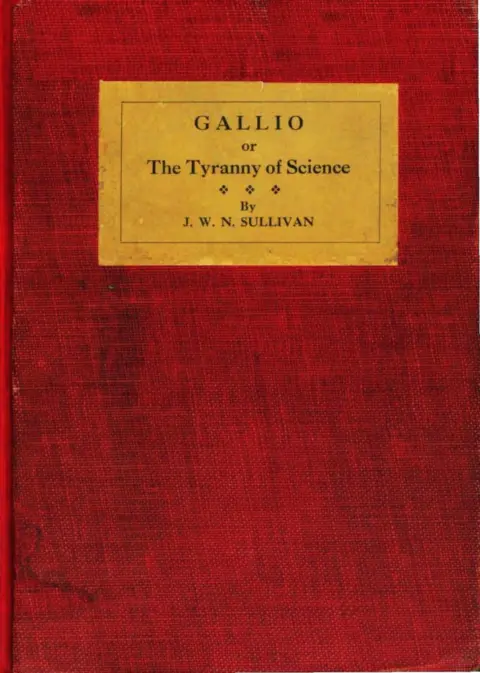
THE CLASSIC COLLECTION · 1928
"Gallio : or, The tyranny of science by J. W. N. Sullivan" is a philosophical essay of cultural criticism written in the early 20th century. The book examines the growing prestige of science and challenges its claim to define reality, especially where it sidelines art, morals, and spiritual experience. Its likely topic is the limits of scientific method and the need to recognize values, purpose, and imagination as central to human knowledge. The essay opens with the rise of scientific authority from Darwin to Einstein, noting how artists first resisted and then, after the War, often embraced a bleak materialism. It argues that modern physics—especially relativity—undermines the old “iron laws,” showing that scientific laws are mind-shaped selections from a world of “point-events,” and that science offers only partial, abstract descriptions of reality. Sullivan criticizes the fetish of measurement and the misuse of scientific prestige in fields like eugenics, crude psychoanalysis, and behaviourism, as well as the fallacy of “explaining by origins.” He urges humility before quantum mysteries and calls for richer abstractions, drawing on thinkers like Eddington and Whitehead to replace “substance” with “organism” and to reconnect space, time, memory, and expectation. Art—especially music—is presented as a mode of genuine knowledge that reveals possibilities of the spirit and anticipates human growth. The book closes by denying that science should tyrannize culture: its scope is limited, its laws are provisional and self-referential, and it is largely irrelevant to the deepest moral and spiritual concerns.
Introduction adapted from the source catalogue; source summaries may be automatically generated.
Free to read · English · 9,555 words · No account needed
MAKE TIME FOR A GOOD BOOK
On by default. Untick to stop anonymous reading totals. Each page counts after 10 seconds in view. How this works.
Anonymous counting is on unless you have switched it off.
The philosophical implications of relativity theory will doubtless take a long time to work out. The four-dimensional universe of point-events is something that can be argued about but it is, to use an old-fashioned phrase, “inconceivable”. Mankind, excepting professional logicians, never remains content with the inconceivable. A purely logical conclusion is not enough; it has to be grasped imaginatively, by which I do not necessarily mean that it has to be pictured. To become familiar with a theory does not merely mean that one is able, as a form of mental wire-walking, to slip nimbly back and forth over the logical connections of the structure. It means taking it into oneself in some indefinable manner――becoming “intimate” with it. Only when a theory is “realized”, as we say, do we feel that we truly understand it. Ideas, points of view, that we were able to see only in flashes, become part of our normal intellectual equipment. The process may well be called a growth of consciousness. There are ideas which our consciousness, when it first approaches them is, as it were, too flabby to grasp. We first have to exercise our mental muscles. Every student of a line of thought such as mathematics, which is rather outside our normal preoccupations, becomes aware of an actual change in his mental powers. Notions so abstract that at first they seemed almost meaningless gradually become perfectly clear and permanent additions to one’s mental resources. Students of musical composition find that their capacity for mentally hearing a number of parts rapidly increases. In some cases it is almost as if a new faculty of the mind were born and developed.
The physics of recent years has made heavy demands upon our capacity for realization. The electron theory, with its analysis of matter into “disembodied charges of electricity” required, for its understanding, the breaking up of old habits of thought. To young students the idea was, at first, extremely baffling――almost nonsense. To realize it one had to make more abstract one’s idea of matter until the notion of “substance” was replaced by the notion of “behaviour”. Anything that behaved in the way characteristic of matter was matter. The central idea of the restricted principle of relativity, the idea of different time-systems, was still more difficult to grasp. In this case we had to become convinced that our ordinary idea of simultaneity, an idea which seemed perfectly clear, was really a bogus idea. The attacks on the theory of relativity show, for the most part, merely that their authors are unable to abandon old habits of thought. With the complete theory of relativity, as we have it now, the task of adjustment has become enormous. There cannot be, even now, more than very few scientific men who naturally approach a problem from the point of view of relativity theory. In most cases a conscious effort of mental preparation is required, such as occurs when a novelist, sitting down to continue his work, deliberately thinks himself into the appropriate frame of mind. Yet doubtless the next generation or so will think in terms of relativity theory as naturally as we thought in terms of the Newtonian system. I would not hold it as impossible that the human mind may come to realize, imaginatively as well as logically, the four-dimensional space-time continuum. But it seems that the mind of the physicist, at any rate, will have to do more than become familiar with relativity theory. It will have to accommodate itself somehow to the quantum theory for, although we can write down the laws which govern sub-atomic phenomena and make deductions from them, these laws are, at present, unintelligible. An electron behaves as if it had foreknowledge of what it was about to do and could make the mathematical calculations necessary to achieve its end. We cannot admit this to be possible, and we can only suppose that the difficulty arises from the way we think about things. We must learn to think in a different way, and what the consequences of that new way of thinking will be no one can say. We know very little of the possibilities of the development of the human consciousness.
Your reading position is saved on this browser. Take it to another device with a library code. Reading pages adapt to text, rather than matching a printed edition.
J. W. N. (John William Navin) Sullivan
J. W. N. (John William Navin) Sullivan
BEHIND THE BOOK
This eBook is for the use of anyone anywhere in the United States and most other parts of the world at no cost and with almost no restrictions whatsoever. You may copy it, give it away or re-use it under the terms of the Project Gutenberg License included with this eBook or online at www.gutenberg.org. If you are not located in the United States, you will have to check the laws of the country where you are located before using this eBook. Read the source licence.
The original source file, including credits and licence, is retained by this library. Request an original-format copy at no charge. Please include the book title and Project Gutenberg identifier #76629.
KEEP YOUR CURIOSITY GOING

David Patterson (Spirit) Hatch

David Patterson (Spirit) Hatch

David Patterson (Spirit) Hatch
Coulson Kernahan

Ralph Waldo Emerson

Maurice Baring