READ · DISCOVER · ENJOYClassic literature · Always free
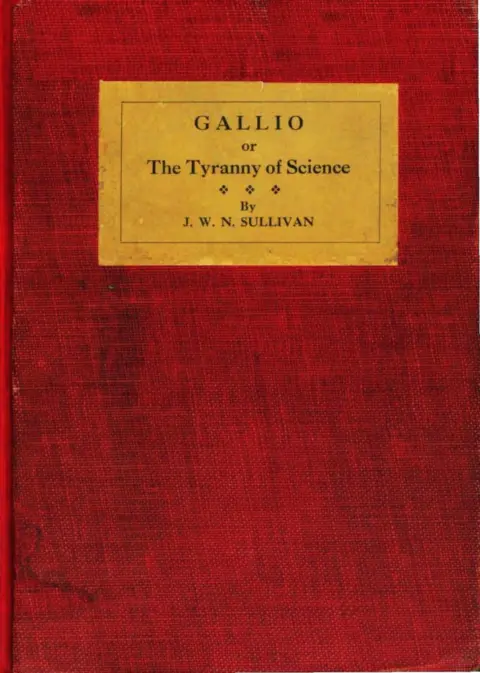
Gallio — digital edition cover

THE CLASSIC COLLECTION · 1928

Gallio

"Gallio : or, The tyranny of science by J. W. N. Sullivan" is a philosophical essay of cultural criticism written in the early 20th century. The book examines the growing prestige of science and challenges its claim to define reality, especially where it sidelines art, morals, and spiritual experience. Its likely topic is the limits of scientific method and the need to recognize values, purpose, and imagination as central to human knowledge. The essay opens with the rise of scientific authority from Darwin to Einstein, noting how artists first resisted and then, after the War, often embraced a bleak materialism. It argues that modern physics—especially relativity—undermines the old “iron laws,” showing that scientific laws are mind-shaped selections from a world of “point-events,” and that science offers only partial, abstract descriptions of reality. Sullivan criticizes the fetish of measurement and the misuse of scientific prestige in fields like eugenics, crude psychoanalysis, and behaviourism, as well as the fallacy of “explaining by origins.” He urges humility before quantum mysteries and calls for richer abstractions, drawing on thinkers like Eddington and Whitehead to replace “substance” with “organism” and to reconnect space, time, memory, and expectation. Art—especially music—is presented as a mode of genuine knowledge that reveals possibilities of the spirit and anticipates human growth. The book closes by denying that science should tyrannize culture: its scope is limited, its laws are provisional and self-referential, and it is largely irrelevant to the deepest moral and spiritual concerns.

Introduction adapted from the source catalogue; source summaries may be automatically generated.

Start reading ↓

Free to read · English · 9,555 words · No account needed

MAKE TIME FOR A GOOD BOOK

Gallio

On by default. Untick to stop anonymous reading totals. Each page counts after 10 seconds in view. How this works.

Anonymous counting is on unless you have switched it off.

Gallio

[3] Science and Poetry, 1926.

[4] But possibly Mr Richards means that the scientific description does not include values. See Section 5 of this essay.

3

The idea that there is a conflict between science and art, which is at bottom the idea that there is a conflict between science and mysticism, rests, I have suggested, upon an old-fashioned conception of the status of physics. The first duty of a man who bases his conclusions on science is to make sure that his science is up-to-date. The science that leads to the depressing conclusions I have just sketched is not up-to-date. Until a few years ago the physicist thought that the material universe he dealt with was a real, objectively existing universe in the sense that, in the absence of consciousness, it would be very much the same as it appeared to be. This universe was subject to laws, and these laws might conceivably have been different. There was no a priori reason, for instance, why the force of gravitation should not vary as the inverse cube of the distance. There was no a priori reason why matter and energy should be conserved. These were laws of governance of the material universe; their discovery had required much effort and the rejection of alternatives. Man was in no sense responsible for them: he happened to live in a universe governed by them. These were the iron laws of the Victorians and are the laws, apparently, that depress modern poets. One of the great discoveries of relativity theory is that these laws need be no more depressing than the laws of Euclidean geometry. No artist has felt his aspirations baseless because he cannot draw a circle whose circumference is six times its radius. He has no more right to despair because there is an inexorable law of gravitation. This has been made clear by Professor Eddington, whose mathematical development of relativity theory is of great philosophical importance, and would, in a more adequately educated community, be given more newspaper headlines than Tutankhamen. The real universe, according to relativity theory, is a four-dimensional world of point-events. Of the nature of point-events we know nothing. All that we require to know, for the purposes of physics, is that it takes four numbers to specify a point-event uniquely, and that some kind of structure――a minimum amount of structure――may be postulated of the world of point-events. We then find, purely by mathematical processes, that certain characteristics of this world will have the quality of permanence. The mind, faced with this world of evanescent point-events, selects those characteristics that are permanent as being of special interest. This is merely because the mind happens to be that kind of thing. As a consequence of this predilection of the mind there arises space and time, matter, and the laws of nature. There arises, in fact, the “objective universe”. The real world of point-events has many other characteristics to which the mind pays no attention. A different principle of selection, exercised on the same total world of point-events, would result in an utterly different universe, a universe that is, for us, quite unimaginable. And the universe that the mind has selected and constructed from the world of point-events does not in the least depend on what the point-events are. All that is necessary is that a certain minimum amount of structure should be attributed to the world of point-events. It is from the relations between the point-events, quite independent of their substance, that the mind has created the material universe and its laws. These laws, it must be emphasized, are necessary consequences of the mind’s selective action. They are necessary in the same sense that the sum of the three interior angles of a Euclidean triangle must be two right angles. Of the underlying reality deduced by physics we can say almost nothing. It may be what Newton called the “sensorium” of God, and the point-events may be his thoughts. They do not succeed one another in time for, at this stage of analysis, space and time are “merged in one”. This perfectly gratuitous hypothesis may appeal to some mystics, for our thoughts, considered as belonging to the world of point-events, would be part of the thoughts of God. It would be indeed true that in him we lived and moved and had our being. We see, then, the limitations of physics. All that depends on the structure of reality belongs to physics, including other universes than ours. All that depends upon the substance of reality for ever lies outside physics. As to the actual universe we live in, why we should regard it as actual is a problem for psychology. The difference between the actual and the non-actual is a distinction conferred by our minds. It is very probable that the whole movement of the universe in time is also contributed by our minds. It seems to be true that events do not take place――we come across them. Why we do not know the future is again a question of psychology. Ignorance of the future, like the existence of the material universe, is a clue to the constitution of our minds. This has a bearing on the question of “purpose” in the universe. The conception of purpose seems to suppose a process in time, and therefore may be a totally irrelevant idea when applied to reality.

Your reading position is saved on this browser. Take it to another device with a library code. Reading pages adapt to text, rather than matching a printed edition.

More from this author

BEHIND THE WORDS

About J. W. N. (John William Navin) Sullivan
J. W. N. (John William Navin) Sullivan (1886–1937). Explore Atoms and electrons, Aspects of science, Gallio in this collection. These books span literature & collections, essays & ideas, philosophy.
Explore this author’s books →

THE READERS’ VERDICT

How did this story stay with you?

Not rated yet
Your rating for Gallio

Be the first to share your verdict.

One rating per browser, which you can change or remove. A necessary browser identifier remembers your vote. How ratings work

A GOOD STORY DESERVES COMPANY

Pass this book along.

A great read is even better when it’s shared.

SEND A LITTLE INSPIRATION

Share this book

BEHIND THE BOOK

Edition & source details.

Title
Gallio
Author
J. W. N. (John William Navin) Sullivan
Publication year
1928
Digital edition publisher
Project Gutenberg
Gutenberg release date
2025-08-03
Language
English
Source edition imprint
$aNew York :$bE. P. Dutton & Co., $c1928.
Source identifier
Project Gutenberg #76629
Contributors
No additional named contributors in source metadata

Public-domain source & licence

This eBook is for the use of anyone anywhere in the United States and most other parts of the world at no cost and with almost no restrictions whatsoever. You may copy it, give it away or re-use it under the terms of the Project Gutenberg License included with this eBook or online at www.gutenberg.org. If you are not located in the United States, you will have to check the laws of the country where you are located before using this eBook. Read the source licence.

Full source licence and obtaining an original copy

The original source file, including credits and licence, is retained by this library. Request an original-format copy at no charge. Please include the book title and Project Gutenberg identifier #76629.

the full Project Gutenberg License must appear
prominently whenever any copy of a Project Gutenberg work (any work
on which the phrase “Project Gutenberg” appears, or with which the
phrase “Project Gutenberg” is associated) is accessed, displayed,
performed, viewed, copied or distributed:

This eBook is for the use of anyone anywhere in the United States and most
other parts of the world at no cost and with almost no restrictions
whatsoever. You may copy it, give it away or re-use it under the terms
of the Project Gutenberg™ License included with this eBook or online
at www.gutenberg.org. If you
are not located in the United States, you will have to check the laws
of the country where you are located before using this eBook.

1.E.2. If an individual Project Gutenberg electronic work is
derived from texts not protected by U.S. copyright law (does not
contain a notice indicating that it is posted with permission of the
copyright holder), the work can be copied and distributed to anyone in
the United States without paying any fees or charges. If you are
redistributing or providing access to a work with the phrase “Project
Gutenberg” associated with or appearing on the work, you must comply
either with the requirements of paragraphs 1.E.1 through 1.E.7 or
obtain permission for the use of the work and the Project Gutenberg
trademark as set forth in paragraphs 1.E.8 or 1.E.9.

1.E.3. If an individual Project Gutenberg electronic work is posted
with the permission of the copyright holder, your use and distribution
must comply with both paragraphs 1.E.1 through 1.E.7 and any
additional terms imposed by the copyright holder. Additional terms
will be linked to the Project Gutenberg License for all works
posted with the permission of the copyright holder found at the
beginning of this work.

1.E.4. Do not unlink or detach or remove the full Project Gutenberg
License terms from this work, or any files containing a part of this
work or any other work associated with Project Gutenberg.

1.E.5. Do not copy, display, perform, distribute or redistribute this
electronic work, or any part of this electronic work, without
prominently displaying the sentence set forth in paragraph 1.E.1 with
active links or immediate access to the full terms of the Project
Gutenberg License.

1.E.6. You may convert to and distribute this work in any binary,
compressed, marked up, nonproprietary or proprietary form, including
any word processing or hypertext form. However, if you provide access
to or distribute copies of a Project Gutenberg work in a format
other than “Plain Vanilla ASCII” or other format used in the official
version posted on the official Project Gutenberg website
(www.gutenberg.org), you must, at no additional cost, fee or expense
to the user, provide a copy, a means of exporting a copy, or a means
of obtaining a copy upon request, of the work in its original “Plain
Vanilla ASCII” or other form. Any alternate format must include the
full Project Gutenberg License as specified in paragraph 1.E.1.

1.E.7. Do not charge a fee for access to, viewing, displaying,
performing, copying or distributing any Project Gutenberg works
unless you comply with paragraph 1.E.8 or 1.E.9.

1.E.8. You may charge a reasonable fee for copies of or providing
access to or distributing Project Gutenberg electronic works
provided that:

• You pay a royalty fee of 20% of the gross profits you derive from
the use of Project Gutenberg works calculated using the method
you already use to calculate your applicable taxes. The fee is owed
to the owner of the Project Gutenberg trademark, but he has
agreed to donate royalties under this paragraph to the Project
Gutenberg Literary Archive Foundation. Royalty payments must be paid
within 60 days following each date on which you prepare (or are
legally required to prepare) your periodic tax returns. Royalty
payments should be clearly marked as such and sent to the Project
Gutenberg Literary Archive Foundation at the address specified in
Section 4, “Information about donations to the Project Gutenberg
Literary Archive Foundation.”

• You provide a full refund of any money paid by a user who notifies
you in writing (or by e-mail) within 30 days of receipt that s/he
does not agree to the terms of the full Project Gutenberg™
License. You must require such a user to return or destroy all
copies of the works possessed in a physical medium and discontinue
all use of and all access to other copies of Project Gutenberg™
works.

• You provide, in accordance with paragraph 1.F.3, a full refund of
any money paid for a work or a replacement copy, if a defect in the
electronic work is discovered and reported to you within 90 days of
receipt of the work.

• You comply with all other terms of this agreement for free
distribution of Project Gutenberg™ works.


1.E.9. If you wish to charge a fee or distribute a Project
Gutenberg™ electronic work or group of works on different terms than
are set forth in this agreement, you must obtain permission in writing
from the Project Gutenberg Literary Archive Foundation, the manager of
the Project Gutenberg™ trademark. Contact the Foundation as set
forth in Section 3 below.

1.F.

1.F.1. Project Gutenberg volunteers and employees expend considerable
effort to identify, do copyright research on, transcribe and proofread
works not protected by U.S. copyright law in creating the Project
Gutenberg™ collection. Despite these efforts, Project Gutenberg™
electronic works, and the medium on which they may be stored, may
contain “Defects,” such as, but not limited to, incomplete, inaccurate
or corrupt data, transcription errors, a copyright or other
intellectual property infringement, a defective or damaged disk or
other medium, a computer virus, or computer codes that damage or
cannot be read by your equipment.

1.F.2. LIMITED WARRANTY, DISCLAIMER OF DAMAGES - Except for the “Right
of Replacement or Refund” described in paragraph 1.F.3, the Project
Gutenberg Literary Archive Foundation, the owner of the Project
Gutenberg™ trademark, and any other party distributing a Project
Gutenberg™ electronic work under this agreement, disclaim all
liability to you for damages, costs and expenses, including legal
fees. YOU AGREE THAT YOU HAVE NO REMEDIES FOR NEGLIGENCE, STRICT
LIABILITY, BREACH OF WARRANTY OR BREACH OF CONTRACT EXCEPT THOSE
PROVIDED IN PARAGRAPH 1.F.3. YOU AGREE THAT THE FOUNDATION, THE
TRADEMARK OWNER, AND ANY DISTRIBUTOR UNDER THIS AGREEMENT WILL NOT BE
LIABLE TO YOU FOR ACTUAL, DIRECT, INDIRECT, CONSEQUENTIAL, PUNITIVE OR
INCIDENTAL DAMAGES EVEN IF YOU GIVE NOTICE OF THE POSSIBILITY OF SUCH
DAMAGE.

1.F.3. LIMITED RIGHT OF REPLACEMENT OR REFUND - If you discover a
defect in this electronic work within 90 days of receiving it, you can
receive a refund of the money (if any) you paid for it by sending a
written explanation to the person you received the work from. If you
received the work on a physical medium, you must return the medium
with your written explanation. The person or entity that provided you
with the defective work may elect to provide a replacement copy in
lieu of a refund. If you received the work electronically, the person
or entity providing it to you may choose to give you a second
opportunity to receive the work electronically in lieu of a refund. If
the second copy is also defective, you may demand a refund in writing
without further opportunities to fix the problem.

1.F.4. Except for the limited right of replacement or refund set forth
in paragraph 1.F.3, this work is provided to you ‘AS-IS’, WITH NO
OTHER WARRANTIES OF ANY KIND, EXPRESS OR IMPLIED, INCLUDING BUT NOT
LIMITED TO WARRANTIES OF MERCHANTABILITY OR FITNESS FOR ANY PURPOSE.

1.F.5. Some states do not allow disclaimers of certain implied
warranties or the exclusion or limitation of certain types of
damages. If any disclaimer or limitation set forth in this agreement
violates the law of the state applicable to this agreement, the
agreement shall be interpreted to make the maximum disclaimer or
limitation permitted by the applicable state law. The invalidity or
unenforceability of any provision of this agreement shall not void the
remaining provisions.

1.F.6. INDEMNITY - You agree to indemnify and hold the Foundation, the
trademark owner, any agent or employee of the Foundation, anyone
providing copies of Project Gutenberg™ electronic works in
accordance with this agreement, and any volunteers associated with the
production, promotion and distribution of Project Gutenberg™
electronic works, harmless from all liability, costs and expenses,
including legal fees, that arise directly or indirectly from any of
the following which you do or cause to occur: (a) distribution of this
or any Project Gutenberg work, (b) alteration, modification, or
additions or deletions to any Project Gutenberg work, and (c) any
Defect you cause.

Section 2. Information about the Mission of Project Gutenberg

Project Gutenberg is synonymous with the free distribution of
electronic works in formats readable by the widest variety of
computers including obsolete, old, middle-aged and new computers. It
exists because of the efforts of hundreds of volunteers and donations
from people in all walks of life.

Volunteers and financial support to provide volunteers with the
assistance they need are critical to reaching Project Gutenberg’s
goals and ensuring that the Project Gutenberg collection will
remain freely available for generations to come. In 2001, the Project
Gutenberg Literary Archive Foundation was created to provide a secure
and permanent future for Project Gutenberg and future
generations. To learn more about the Project Gutenberg Literary
Archive Foundation and how your efforts and donations can help, see
Sections 3 and 4 and the Foundation information page at www.gutenberg.org.

Section 3. Information about the Project Gutenberg Literary Archive Foundation

The Project Gutenberg Literary Archive Foundation is a non-profit
501(c)(3) educational corporation organized under the laws of the
state of Mississippi and granted tax exempt status by the Internal
Revenue Service. The Foundation’s EIN or federal tax identification
number is 64-6221541. Contributions to the Project Gutenberg Literary
Archive Foundation are tax deductible to the full extent permitted by
U.S. federal laws and your state’s laws.

The Foundation’s business office is located at 41 Watchung Plaza #516,
Montclair NJ 07042, USA, +1 (862) 621-9288. Email contact links and up
to date contact information can be found at the Foundation’s website
and official page at www.gutenberg.org/contact

Section 4. Information about Donations to the Project Gutenberg
Literary Archive Foundation

Project Gutenberg™ depends upon and cannot survive without widespread
public support and donations to carry out its mission of
increasing the number of public domain and licensed works that can be
freely distributed in machine-readable form accessible by the widest
array of equipment including outdated equipment. Many small donations
($1 to $5,000) are particularly important to maintaining tax exempt
status with the IRS.

The Foundation is committed to complying with the laws regulating
charities and charitable donations in all 50 states of the United
States. Compliance requirements are not uniform and it takes a
considerable effort, much paperwork and many fees to meet and keep up
with these requirements. We do not solicit donations in locations
where we have not received written confirmation of compliance. To SEND
DONATIONS or determine the status of compliance for any particular state
visit www.gutenberg.org/donate.

While we cannot and do not solicit contributions from states where we
have not met the solicitation requirements, we know of no prohibition
against accepting unsolicited donations from donors in such states who
approach us with offers to donate.

International donations are gratefully accepted, but we cannot make
any statements concerning tax treatment of donations received from
outside the United States. U.S. laws alone swamp our small staff.

Please check the Project Gutenberg web pages for current donation
methods and addresses. Donations are accepted in a number of other
ways including checks, online payments and credit card donations. To
donate, please visit: www.gutenberg.org/donate.

Section 5. General Information About Project Gutenberg electronic works

Professor Michael S. Hart was the originator of the Project
Gutenberg concept of a library of electronic works that could be
freely shared with anyone. For forty years, he produced and
distributed Project Gutenberg eBooks with only a loose network of
volunteer support.

Project Gutenberg eBooks are often created from several printed
editions, all of which are confirmed as not protected by copyright in
the U.S. unless a copyright notice is included. Thus, we do not
necessarily keep eBooks in compliance with any particular paper
edition.

Most people start at our website which has the main PG search
facility: www.gutenberg.org.

This website includes information about Project Gutenberg,
including how to make donations to the Project Gutenberg Literary
Archive Foundation, how to help produce our new eBooks, and how to
subscribe to our email newsletter to hear about new eBooks.


KEEP YOUR CURIOSITY GOING

Your next chapter awaits.




