THE CLASSIC COLLECTION✦Atoms and electronsCLASSIC FREE BOOKS
Atoms and electrons
J. W. N. (John William Navin) Sullivan
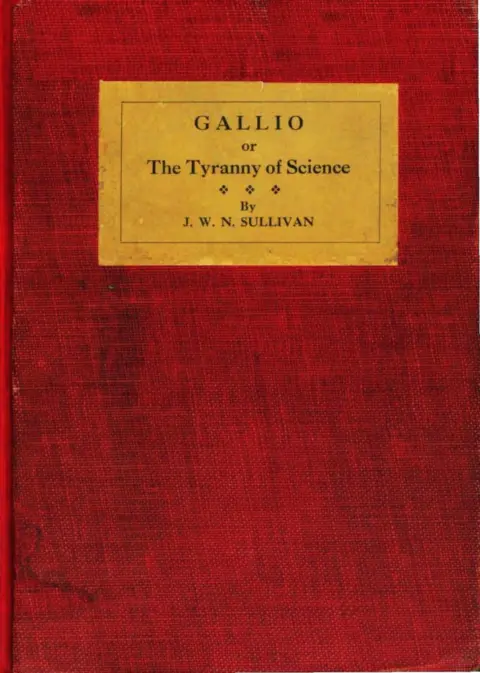
THE CLASSIC COLLECTION · 1928
"Gallio : or, The tyranny of science by J. W. N. Sullivan" is a philosophical essay of cultural criticism written in the early 20th century. The book examines the growing prestige of science and challenges its claim to define reality, especially where it sidelines art, morals, and spiritual experience. Its likely topic is the limits of scientific method and the need to recognize values, purpose, and imagination as central to human knowledge. The essay opens with the rise of scientific authority from Darwin to Einstein, noting how artists first resisted and then, after the War, often embraced a bleak materialism. It argues that modern physics—especially relativity—undermines the old “iron laws,” showing that scientific laws are mind-shaped selections from a world of “point-events,” and that science offers only partial, abstract descriptions of reality. Sullivan criticizes the fetish of measurement and the misuse of scientific prestige in fields like eugenics, crude psychoanalysis, and behaviourism, as well as the fallacy of “explaining by origins.” He urges humility before quantum mysteries and calls for richer abstractions, drawing on thinkers like Eddington and Whitehead to replace “substance” with “organism” and to reconnect space, time, memory, and expectation. Art—especially music—is presented as a mode of genuine knowledge that reveals possibilities of the spirit and anticipates human growth. The book closes by denying that science should tyrannize culture: its scope is limited, its laws are provisional and self-referential, and it is largely irrelevant to the deepest moral and spiritual concerns.
Introduction adapted from the source catalogue; source summaries may be automatically generated.
Free to read · English · 9,555 words · No account needed
MAKE TIME FOR A GOOD BOOK
On by default. Untick to stop anonymous reading totals. Each page counts after 10 seconds in view. How this works.
Anonymous counting is on unless you have switched it off.
It is one of the great services of relativity theory to philosophy that it provides an answer to this question. The answer is that the entities discussed by physics are defined in terms of one another. The three hundred years of building up exact science really amounts, in the last analysis, to doing what the dictionary compiler did when he defined a violin as a small violoncello and a violoncello as a large violin. Of course, if this statement were literally true, science would give us no information about the universe at all. Nevertheless, the statement is true about the actual procedure of science, and it is in virtue of this procedure that science forms a closed system. But what is left out of this description is the scientist himself. The mysterious process which is not taken into account in this description of the scientific method is the process by which the consciousness of the scientist makes contact with the entities he is talking about. In deducting the world from “point-events”, for instance, we begin by talking about something we have no direct cognisance of, namely point-events. From point-events we deduce “potentials”――again a mere word. But from potentials we deduce “matter”, and here we are talking of something of which we have direct knowledge. Similarly, the circular definition of violin and violoncello tells us nothing as it stands. But to a man who can identify one of these entities, to a man who has ever seen a violin, it gives genuine information.
We need not be surprised, therefore, that nothing from the outside ever seems to disturb the equanimity that reigns within the closed system of physics. The abstractions with which it begins are all it ever has to deal with. There are no subsequent fresh contacts with reality. If the region covered by relativity theory embraced the whole of physics it would seem that, so far as physical science is concerned, we knew all that there is to be known. But it is notorious that, of recent years, an entirely new set of phenomena has been discovered in physical science. These phenomena arise when we consider, not matter in bulk but matter in its smallest particles. These phenomena are, at present, strictly incomprehensible. The celebrated quantum theory provides us with rules for dealing with some of them, but does not make them intelligible. It seems that science has here reached its limits. Professor Eddington has even hinted that these phenomena may indicate that the universe is finally irrational, that is, that the attempt to describe nature mathematically will have to be given up. This is a possibility that Newton foresaw. But it seems more likely that our present state of bewilderment has a different cause. That cause, we shall probably find, is the insufficiency of the abstractions hitherto used in science. We have to go back to the concrete facts of experience and build up a richer, fuller set of abstractions. Physics is now paying the penalty of inadequate abstraction. In particular, it must revise its notions of space, time, and substance. This revision is quite independent of the Einstein theory, and is made necessary, not by that theory but by the quantum theory. A first attempt at this revision has been made by that great mathematical philosopher, Professor Whitehead.[5] We need not deal with his investigation, which is at present in a highly technical state. The space and time of the new theory are interconnected and do not consist of independent volumes and instants. Every volume of space has reference to the whole of space, and every moment of time refers both to the past and the future. Hence both memory and expectation are given a rational basis. On the old view, as Hume pointed out, there is no reason whatever to suppose that the order of nature should continue. Why do we expect that the force of gravity will be in existence to-morrow? There was no reason at all for this expectation or for any other. That is to say, the whole of science itself was based on blind faith. The new foundations of science make science itself a rational activity. As for the notion of “substance”, Professor Whitehead proposes to replace it by the notion of “organism”. We may imagine an electron, for instance, as a repeated pattern of events. One of the great difficulties of the quantum phenomena is that an electron seems to pass from one place to another without passing through the intervening space. On the basis of the new abstractions this difficulty can be overcome. We have to imagine an electron as requiring a certain time to manifest itself――just as a tune does.
Your reading position is saved on this browser. Take it to another device with a library code. Reading pages adapt to text, rather than matching a printed edition.
J. W. N. (John William Navin) Sullivan
J. W. N. (John William Navin) Sullivan
BEHIND THE BOOK
This eBook is for the use of anyone anywhere in the United States and most other parts of the world at no cost and with almost no restrictions whatsoever. You may copy it, give it away or re-use it under the terms of the Project Gutenberg License included with this eBook or online at www.gutenberg.org. If you are not located in the United States, you will have to check the laws of the country where you are located before using this eBook. Read the source licence.
The original source file, including credits and licence, is retained by this library. Request an original-format copy at no charge. Please include the book title and Project Gutenberg identifier #76629.
KEEP YOUR CURIOSITY GOING

David Patterson (Spirit) Hatch

David Patterson (Spirit) Hatch

David Patterson (Spirit) Hatch
Coulson Kernahan

Ralph Waldo Emerson

Maurice Baring