THE CLASSIC COLLECTION✦Atoms and electronsCLASSIC FREE BOOKS
Atoms and electrons
J. W. N. (John William Navin) Sullivan
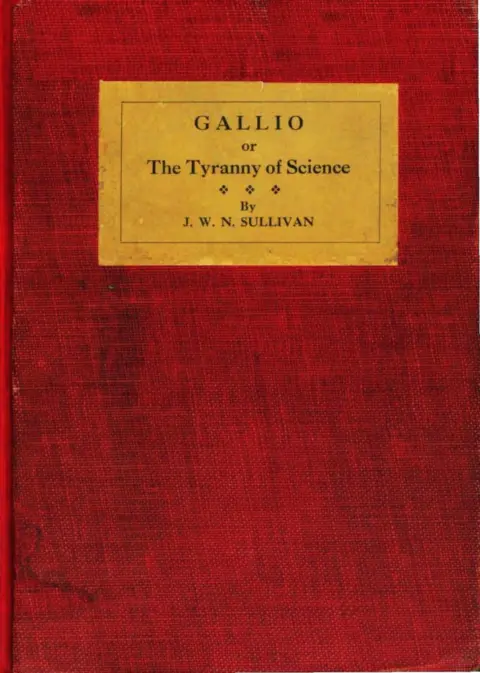
THE CLASSIC COLLECTION · 1928
"Gallio : or, The tyranny of science by J. W. N. Sullivan" is a philosophical essay of cultural criticism written in the early 20th century. The book examines the growing prestige of science and challenges its claim to define reality, especially where it sidelines art, morals, and spiritual experience. Its likely topic is the limits of scientific method and the need to recognize values, purpose, and imagination as central to human knowledge. The essay opens with the rise of scientific authority from Darwin to Einstein, noting how artists first resisted and then, after the War, often embraced a bleak materialism. It argues that modern physics—especially relativity—undermines the old “iron laws,” showing that scientific laws are mind-shaped selections from a world of “point-events,” and that science offers only partial, abstract descriptions of reality. Sullivan criticizes the fetish of measurement and the misuse of scientific prestige in fields like eugenics, crude psychoanalysis, and behaviourism, as well as the fallacy of “explaining by origins.” He urges humility before quantum mysteries and calls for richer abstractions, drawing on thinkers like Eddington and Whitehead to replace “substance” with “organism” and to reconnect space, time, memory, and expectation. Art—especially music—is presented as a mode of genuine knowledge that reveals possibilities of the spirit and anticipates human growth. The book closes by denying that science should tyrannize culture: its scope is limited, its laws are provisional and self-referential, and it is largely irrelevant to the deepest moral and spiritual concerns.
Introduction adapted from the source catalogue; source summaries may be automatically generated.
Free to read · English · 9,555 words · No account needed
MAKE TIME FOR A GOOD BOOK
On by default. Untick to stop anonymous reading totals. Each page counts after 10 seconds in view. How this works.
Anonymous counting is on unless you have switched it off.
This material is chiefly the Newtonian set of abstractions. Newton postulated, as the fundamental constituents out of which the perceived universe is built up, Space, Time, and Matter. Space and time he regarded as absolute and as quite independent of matter. Matter was an enduring substance that simply inhabited space and time. The analysis of these conceptions has resulted in the Einstein theory, in which neither space, time, nor matter are fundamental. The interesting thing about this analysis, from our present point of view, is that it shows clearly what arbitrary elements are present in the scientific description of the universe. For we must remember that moral and æsthetic elements were ruled out of the real universe simply because science did not find it necessary to mention them. The foundation stones of the scientific edifice, namely space, time, and matter, were supposed to be the only realities. Everything else was a sort of illusion. Men who must have been theory-mad soberly maintained that little particles of matter wandering about purposelessly in space and time produced our minds, our hopes, and fears, the scent of the rose, the colours of the sunset, the songs of the birds, and our knowledge of the little particles themselves. The sole realities were the little wandering particles and the space and time they wandered in. The existence of everything else depended on the mind, and was inconceivable without the mind. It is interesting, therefore, that science has now reached a position where space, time, and matter also depend on the mind. In giving a scientific description of the universe Einstein does not find it necessary to begin with space, time, and matter. These entities become “derivative”. The universe becomes more spectral than ever if we are going to adopt the materialist principle that what depends on the mind does not really exist. Even the universe of wandering particles is comparatively cosy compared with this modern universe of undefinable “point-events”. But if we do not adopt the materialist principle we may assert that moral and æsthetic values are as much a part of the real universe as anything else, and that the reason why science does not find it necessary to mention them is not because they are not there but because science is a game played according to certain rules, and those rules have excluded these values from the outset. The life-insurance actuary may, for his purposes, neglect many things about men, and yet calculate, quite correctly, what percentage of them will die at forty. But he has not proved that the qualities he has neglected do not exist simply because they do not come in to upset his calculations. A politician finds that he has to base his calculations on quite different aspects of mankind from those found satisfactory by the actuary. In the same way, a mountain is a different thing to a poet from what it is to a man of science. For the kind of understanding of the universe that the man of science is after, the mountain is merely a heap of certain kinds of matter weighing so many millions of tons. The poet, who is after a different kind of vision, finds it necessary to take into account quite other factors which enter into his total experience of the mountain. The scientist may also experience emotions of awe and reverence in the presence of the mountain, but for the purposes of his science these factors of his experience may be neglected. He abstracts from the total concrete fact of his experience of the mountain. The mountain, as he describes it in the scientific paper he proceeds to write, is a mere pale shadow of the real mountain; he probably leaves it indistinguishable from any other mountain that happens to weigh the same, just as to the life-insurance actuary all men of forty are exactly alike. If we believe that the factors in experience that the scientific man neglects are quite as real as those he takes into account, it becomes a matter for wonder that science is possible. How is it that science forms a closed system――that nothing from the worlds it neglects ever comes in to disturb it?
Your reading position is saved on this browser. Take it to another device with a library code. Reading pages adapt to text, rather than matching a printed edition.
J. W. N. (John William Navin) Sullivan
J. W. N. (John William Navin) Sullivan
BEHIND THE BOOK
This eBook is for the use of anyone anywhere in the United States and most other parts of the world at no cost and with almost no restrictions whatsoever. You may copy it, give it away or re-use it under the terms of the Project Gutenberg License included with this eBook or online at www.gutenberg.org. If you are not located in the United States, you will have to check the laws of the country where you are located before using this eBook. Read the source licence.
The original source file, including credits and licence, is retained by this library. Request an original-format copy at no charge. Please include the book title and Project Gutenberg identifier #76629.
KEEP YOUR CURIOSITY GOING

David Patterson (Spirit) Hatch

David Patterson (Spirit) Hatch

David Patterson (Spirit) Hatch
Coulson Kernahan

Ralph Waldo Emerson

Maurice Baring