THE CLASSIC COLLECTION✦Andersonville diaryCLASSIC FREE BOOKS
Andersonville diary
John L. Ransom
THE CLASSIC COLLECTION · 1922
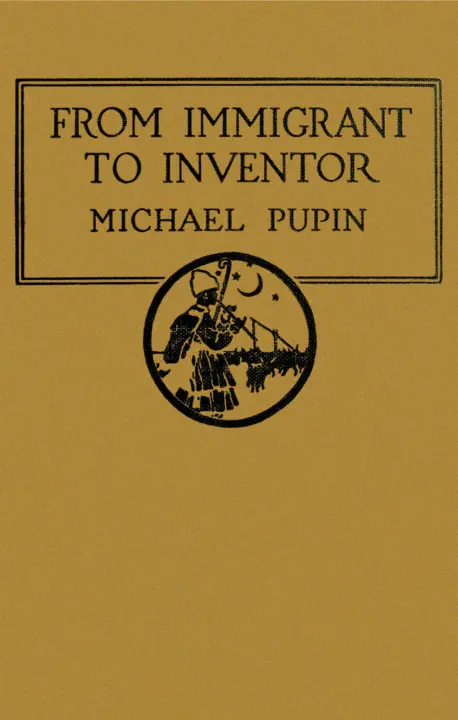
"From Immigrant to Inventor" by Michael Pupin is a memoir written in the early 20th century, reflecting on the author’s remarkable journey from Serbia to becoming a prominent American scientist and inventor. The book chronicles Pupin's early life as an impoverished immigrant who arrives in America with only five cents, his formative experiences in schooling, and the cultural challenges he faced and overcame through perseverance and ingenuity. The opening of the memoir reveals Pupin's arrival in America and his initial struggles. He describes his first experiences as an immigrant, highlighting his confidence despite a lack of financial resources, and it sets the tone for his narrative of growth and adaptation. Pupin conveys the importance of his Serbian heritage and the lessons learned from his mother and the villagers of Idvor, which shaped his character. This portion also touches on the themes of resilience, the immigrant experience, and the pursuit of education amid adversity, foreshadowing his future impact on American science.
Introduction adapted from the source catalogue; source summaries may be automatically generated.
Free to read · English · 130,353 words · No account needed
MAKE TIME FOR A GOOD BOOK
On by default. Untick to stop anonymous reading totals. Each page counts after 10 seconds in view. How this works.
Anonymous counting is on unless you have switched it off.
Bilharz was very moody and for days and days he had nothing to say to anybody, not even to me! Nobody else cared, because nobody understood him, but I did care. When he discovered that I sincerely admired his learning and was interested in his puzzling personality he became more communicative, sometimes almost human. His English accent was excellent, and I asked his opinion about my accent and he assured me with childlike frankness that it was rotten, but that it could be fixed up if I submitted to a course of training prescribed for me by my Vila on the Delaware farm. “I could not be your Vila, deformed as I am,” said he, referring to his crippled fingers and to his awkward walk, “but I will gladly be your satyr and teach you how to imitate not only the sounds of human language but also, if you wish it, the melodies of birds and the chirping of bugs. The satyrs are great in that.” I knew that he could, because many an evening while I was on the dormitory loft of the factory reading the Mayflower Compact, the Declaration of Independence, the American Constitution, Patrick Henry’s and Daniel Webster’s speeches, and Lincoln’s speech at Gettysburg, Bilharz, in another part of the building, would be imitating sounds of all kinds of birds and bugs, after he had grown tired reciting Greek and Latin poetry and singing ecclesiastical songs. That was his only amusement, and he enjoyed it when he was sure that nobody was listening; he made an exception in my case. We finally made the start in what he called my preparation for Nassau Hall. In the course of less than a month I finished reciting to Bilharz the Declaration of Independence, the American Constitution, and Lincoln’s speech at Gettysburg, submitting to many corrections and making many efforts to give each word its proper pronunciation, and finally he accepted my performance as satisfactory. By that time I knew these documents by heart and so did Bilharz, and he, in spite of himself, liked them so well that he accused me of conspiring to make an American out of him. “You are sinking rapidly, my boy, in the whirlpool of American democracy, and you are dragging me down with you,” said Bilharz one evening, when I objected to some of the amendments which he offered in order to harmonize the American theory of freedom with the principles of German socialism. He admitted that he, a loyal Roman Catholic, did not care much for German social democracy, but that he often wondered why the American enthusiasts for democracy did not take German social democracy and save themselves the trouble of writing the Declaration of Independence. I called his attention to the fact that American democracy is much older than German social democracy, and he, somewhat irritated by that suggestion and by my defense of American democracy, as I understood it, suggested that he should resign his position as my teacher and become my pupil. His flippant criticism of American democracy and my stiff defense of it helped me much to see things which otherwise I should have missed, but these discussions threatened the entente cordiale between Bilharz and myself. Finally we compromised and changed our course of reading, dropping things relating to political theories and taking up poetry. Longfellow’s and Bryant’s poetry were my favorites. “The Village Blacksmith” and “Thanatopsis” I knew by heart and enjoyed reciting to Bilharz, who was greatly pleased whenever in these recitations I avoided making a single serious break in my pronunciation. After reading some of Shakespeare’s dramas which Booth and other famous actors like Lawrence Barrett and John McCullough were playing at that time, I visited the theatre often, and from my modest gallery seat I would analyze carefully the articulation of every syllable which Booth and the other actors were reciting. Booth did not have a big voice; it was much smaller than the voice of Lawrence Barrett or of powerful John McCullough, but I understood him better. Bilharz explained it by saying that Booth had a perfect articulation. “Articulation is an art which the Greeks invented; big voice is brute force common among the Russians,” he used to say, protesting whenever he had an opportunity against mere physical strength, which was natural considering his scanty physical resources. He hated both the Russians and the Prussians, because, in his opinion, they both were big brutes. In those days the southern Germans had no love for the Prussians. He never missed a single chance to sing the praises of Greek drama and of the Greek theatre and of everything which flourished during the classical age. He called my attention to the enormous size of Greek theatres and to the necessity of perfect articulation on the part of Greek actors if they were to be heard. “They were great artists,” said he; “our actors are duffers only. We are all duffers! Give me the Greeks, give me Homer, Pindar, Demosthenes, Plato, Praxiteles, Phidias, Sophocles, and hundreds of others who spoke the language of the gods and did things which only the divine spirit in man can do, and you can have your Morse, McCormick, Howe, Ericsson, and the rest of the materialistic crew who ran the show at Philadelphia.” He certainly told many a fine story when he spoke of the great poets, orators, philosophers, and sculptors of Greece, and his stories impressed me much because they were great revelations to me; they were the first to arouse my interest in the great civilization of Greece. They would have impressed me even more if Bilharz had not displayed a glaring tendency to exaggerate, in order to create a strong contrast between what he called the idealism of classical Greece and what he called the realistic materialism of modern America. According to him the first had its seat among the gods on the ethereal top of Mount Olympus and the second one was sinking deeper and deeper through the shafts of coal and iron mines into the dark caverns of material earth. “No action,” said Bilharz, “which needs the assistance of a steam-engine or of any other mechanism can trace its origin to idealism nor can it end in idealism.” I suggested that every animal body is a mechanism and that its continuous evolution seems to indicate that the world is heading for a definite ideal. Bilharz flew up like a hornet when he heard the word evolution.
Your reading position is saved on this browser. Take it to another device with a library code. Reading pages adapt to text, rather than matching a printed edition.
BEHIND THE BOOK
This eBook is for the use of anyone anywhere in the United States and most other parts of the world at no cost and with almost no restrictions whatsoever. You may copy it, give it away or re-use it under the terms of the Project Gutenberg License included with this eBook or online at www.gutenberg.org. If you are not located in the United States, you will have to check the laws of the country where you are located before using this eBook. Read the source licence.
The original source file, including credits and licence, is retained by this library. Request an original-format copy at no charge. Please include the book title and Project Gutenberg identifier #66886.
KEEP YOUR CURIOSITY GOING
John L. Ransom

Herman W. Mudgett

Harriet Monroe
Daniel Dulany Addison
Charles Lanman

Harold Rosher