THE CLASSIC COLLECTION✦Andersonville diaryCLASSIC FREE BOOKS
Andersonville diary
John L. Ransom
THE CLASSIC COLLECTION · 1922
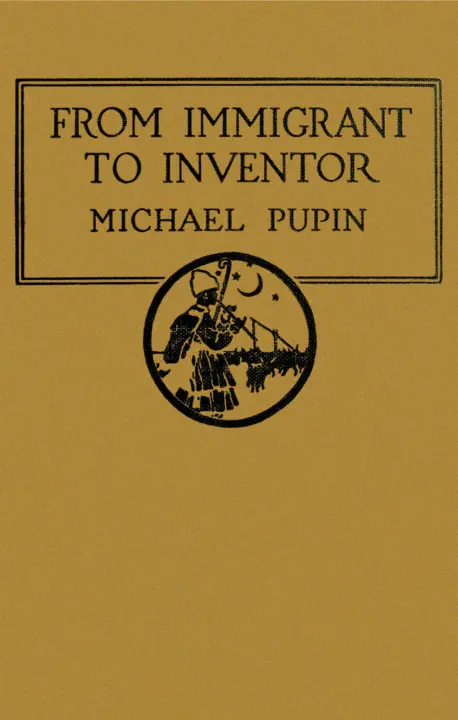
"From Immigrant to Inventor" by Michael Pupin is a memoir written in the early 20th century, reflecting on the author’s remarkable journey from Serbia to becoming a prominent American scientist and inventor. The book chronicles Pupin's early life as an impoverished immigrant who arrives in America with only five cents, his formative experiences in schooling, and the cultural challenges he faced and overcame through perseverance and ingenuity. The opening of the memoir reveals Pupin's arrival in America and his initial struggles. He describes his first experiences as an immigrant, highlighting his confidence despite a lack of financial resources, and it sets the tone for his narrative of growth and adaptation. Pupin conveys the importance of his Serbian heritage and the lessons learned from his mother and the villagers of Idvor, which shaped his character. This portion also touches on the themes of resilience, the immigrant experience, and the pursuit of education amid adversity, foreshadowing his future impact on American science.
Introduction adapted from the source catalogue; source summaries may be automatically generated.
Free to read · English · 130,353 words · No account needed
MAKE TIME FOR A GOOD BOOK
On by default. Untick to stop anonymous reading totals. Each page counts after 10 seconds in view. How this works.
Anonymous counting is on unless you have switched it off.
I confess that when I first arrived in Berlin I brought with me old prejudices, which were annoying, to say the least. The Teutonism in Prague, when I was a schoolboy there, had made lasting impressions upon my young mind; they were with me when I landed at Castle Garden. Early impressions are very persistent and cannot be obliterated by time alone. Christian’s father, the innkeeper of West Street, and his friends, the hardy Friesland sailors who taught me how to handle the paint-brush, drew me closer to the German heart, and I found it much less grasping than I thought it was. But the Frieslander of those days had no great love for the Prussian. Bilharz, the idealist of Cortlandt Street, gave me a more intimate knowledge of the German temper, and helped much to dispel many of my early prejudices. But Bilharz displayed decided dislike for the Prussians. The few German friends whom I had during my “greenhorn” days were southern Germans, and they did not appear to be very friendly to the idea of a united Germany under Prussian hegemony. These early experiences encouraged me in the belief that the Prussians were probably responsible for the Teutonism which I disliked. This belief was strengthened by Bismarck’s anti-Russian and anti-Serbian, but strongly pro-Austrian, policy at the treaty of Berlin in 1878. He protested, I knew, that he would not sacrifice the bones of a single Pomeranian grenadier for all the Balkans; but I did not believe him. Hence the uncomfortable feeling of being in an enemy country, when I first came to and settled down in Berlin.
The Teutonism of Prague, more than anything else, was responsible for it. Racial antipathy is one of the saddest of psychic derangements; and, although it is a repulsive product of modern nationalism, the world does less than nothing to get rid of its insidious poisons. European civilization is being destroyed by it. I suffered from its evil effects during the early days of my life in Berlin. Helmholtz, Koenig, and all the officers in the Physical Institute showed me every kindness and consideration, and that prevented me from turning around and speeding back to Cambridge as soon as the first breath of the atmosphere of Berlin gave me an acute attack of anti-Teutonism. My German landlady and her friends, as well as the German students I met in the lecture-rooms, struck no responsive chord in my heart, because it was out of tune with my surroundings. I remained a stranger in a cold, strange land. A young Scotch friend of mine, a graduate of the University of Glasgow, appeared on the scene, some time after I had become settled in Berlin. He kept his promise, given me at Arran, to join me in Berlin. He stayed at the university for one semester only and heard lectures on Roman law. He looked like a northern Apollo: tall and erect, the pink of youth radiating from his handsome face, and the locks of purest gold adorning a lofty brow, which made you believe that you were looking at a young Sir Walter Scott. His deep-blue eyes knew of no suspicions, and his heart had never been touched by the poison of racial antipathy. He loved the world and the world loved him. His knowledge of German was very poor, and yet everybody loved to talk to him. Even the stern Schutzman (policeman), stirred up to white heat by too noisy a rendering of American and Scotch college songs in the slumbering streets of Berlin, was as gentle as a dove when the blue-eyed young Scot stood in front of him and greeted him with a honey-hearted smile. My landlady, quite an aged person, as well as her young boarders, begged me to bring him to dinner as often as possible. “Yes, do bring him,” said a sarcastic young fräulein; “you look quite human and almost handsome when he is around.” There was much truth in what she said; the poison of racial antipathy did not operate in me when he was present. He made friends on every side among the German students, and when I saw how he warmed up to them and how they warmed up to him I began to thaw out myself. Helmholtz and dear little Koenig were the first persons in Berlin who helped me to forget that Europe was made up of different races who lived in eternal suspicion of each other. After that, following the example of my Scotch friend, I began to rid myself of the poisonous infection which I received from the Teutonism in Prague; but it was a slow process. Helmholtz’s address on Faraday was so warm and so generous to Faraday as well as to Maxwell, and so wonderfully just, that I began to question the justice of my anti-Teutonic prejudices.
Your reading position is saved on this browser. Take it to another device with a library code. Reading pages adapt to text, rather than matching a printed edition.
BEHIND THE BOOK
This eBook is for the use of anyone anywhere in the United States and most other parts of the world at no cost and with almost no restrictions whatsoever. You may copy it, give it away or re-use it under the terms of the Project Gutenberg License included with this eBook or online at www.gutenberg.org. If you are not located in the United States, you will have to check the laws of the country where you are located before using this eBook. Read the source licence.
The original source file, including credits and licence, is retained by this library. Request an original-format copy at no charge. Please include the book title and Project Gutenberg identifier #66886.
KEEP YOUR CURIOSITY GOING
John L. Ransom

Herman W. Mudgett

Harriet Monroe
Daniel Dulany Addison
Charles Lanman

Harold Rosher