THE CLASSIC COLLECTION✦Andersonville diaryCLASSIC FREE BOOKS
Andersonville diary
John L. Ransom
THE CLASSIC COLLECTION · 1922
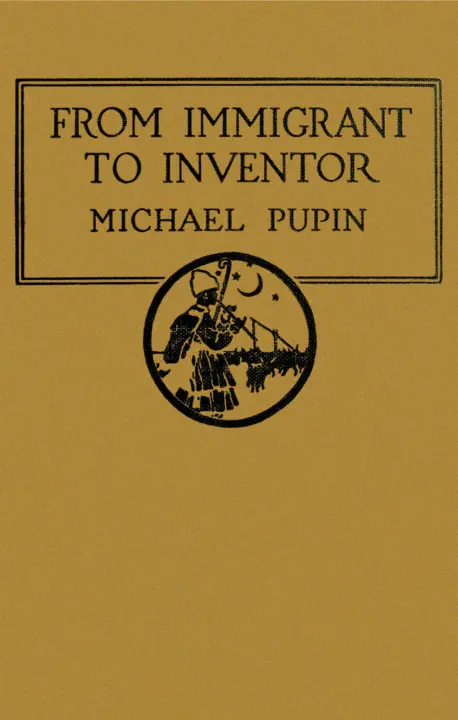
"From Immigrant to Inventor" by Michael Pupin is a memoir written in the early 20th century, reflecting on the author’s remarkable journey from Serbia to becoming a prominent American scientist and inventor. The book chronicles Pupin's early life as an impoverished immigrant who arrives in America with only five cents, his formative experiences in schooling, and the cultural challenges he faced and overcame through perseverance and ingenuity. The opening of the memoir reveals Pupin's arrival in America and his initial struggles. He describes his first experiences as an immigrant, highlighting his confidence despite a lack of financial resources, and it sets the tone for his narrative of growth and adaptation. Pupin conveys the importance of his Serbian heritage and the lessons learned from his mother and the villagers of Idvor, which shaped his character. This portion also touches on the themes of resilience, the immigrant experience, and the pursuit of education amid adversity, foreshadowing his future impact on American science.
Introduction adapted from the source catalogue; source summaries may be automatically generated.
Free to read · English · 130,353 words · No account needed
MAKE TIME FOR A GOOD BOOK
On by default. Untick to stop anonymous reading totals. Each page counts after 10 seconds in view. How this works.
Anonymous counting is on unless you have switched it off.
October 14, 1922.
My dear Doctor Pupin:
I accept with regret your resignation as a member of the National Advisory Committee for Aeronautics. In doing so I want to express to you the thanks of the Government and people of the United States of your services as a member of the National Advisory Committee for Aeronautics since its organization in 1915.
I take this occasion to record recognition and appreciation of the fact that, as Chairman of the Subcommittee on Aircraft Communications, during the World War you undertook to develop a reliable means of communication between aircraft in flight, and that, by virtue of experiments conducted and directed in your own laboratory, you were successful in contributing in an important respect to the development of one of the great marvels of our age, the radio telephone.
I regret that you cannot continue to devote your talents to the scientific study of the problems of flight as a member of the National Advisory Committee for Aeronautics.
Most sincerely yours,
Warren G. Harding
Dr. Michael I. Pupin,
Columbia University,
New York City.
Ideal democracy, if attainable at all, will certainly be attainable in our country, whose traditions are gradually eliminating racial hatreds and suspicions and making them unknown human passions on this blessed continent. If I have ever contributed anything substantial to the progress of this splendid movement, whether as an immigrant or as an inventor, it has been most amply rewarded by the generous spirit of the letter on the opposite page, written by a man whom I had the honor of knowing personally and who to me always represented the ideal type of a genuine American.
These few concluding lines I wrote on the day when this good American breathed his last. His memory will always encourage us in the belief that our blessed country is destined to become the first ideal democracy of the world.
Action and reaction in electricity, 296-299
Adams, John Crouch, 181
Adams, President, 315
Adelphi Academy, Brooklyn, 108-110, 120
Alexander the Liberator, Czar, 8, 9
Alhazan, 204
Alps, travels in, 146-150, 208
Alternating-current theory, 283-289, 294
American Association for the Advancement of Science, 291, 359
American Institute of Electrical Engineers, 283, 337, 348, 359-362
American Institute of Mining and Metallurgical Engineers, 359
American Journal of Science, 299
American Mathematical Society, 352
American Philosophical Society, 363
American Physical Society, 351-353, 358, 360
American scientific progress, 279-384 et passim
American Society of Civil Engineers, 359
American Society of Mechanical Engineers, 359, 364
American Telephone and Telegraph Company, 335, 338-340, 342, 345, 384
Americanization, 318 et passim
Ames, Joseph Sweetman, 256
Ampère, 187, 257
Appel, 257
Arago, 257
Archimedes, 193, 194, 221
Aristides, 92
Aristotle, 20
Armour & Co., 344
Armstrong, Major E. H., 19, 342, 358
Armstrong, Hamilton Fish, 316
Arran (island), 212-217
Aspern (battle), 6
Astronomy and Astrophysics, 293
Atomic structure, 356, 357, 384-386. See also Matter, nature of,
and Electrons
Bacon, Roger, 204
Bagpiper, Serbian, 19 et passim
Your reading position is saved on this browser. Take it to another device with a library code. Reading pages adapt to text, rather than matching a printed edition.
BEHIND THE BOOK
This eBook is for the use of anyone anywhere in the United States and most other parts of the world at no cost and with almost no restrictions whatsoever. You may copy it, give it away or re-use it under the terms of the Project Gutenberg License included with this eBook or online at www.gutenberg.org. If you are not located in the United States, you will have to check the laws of the country where you are located before using this eBook. Read the source licence.
The original source file, including credits and licence, is retained by this library. Request an original-format copy at no charge. Please include the book title and Project Gutenberg identifier #66886.
KEEP YOUR CURIOSITY GOING
John L. Ransom

Herman W. Mudgett

Harriet Monroe
Daniel Dulany Addison
Charles Lanman

Harold Rosher