THE CLASSIC COLLECTION✦Andersonville diaryCLASSIC FREE BOOKS
Andersonville diary
John L. Ransom
THE CLASSIC COLLECTION · 1922
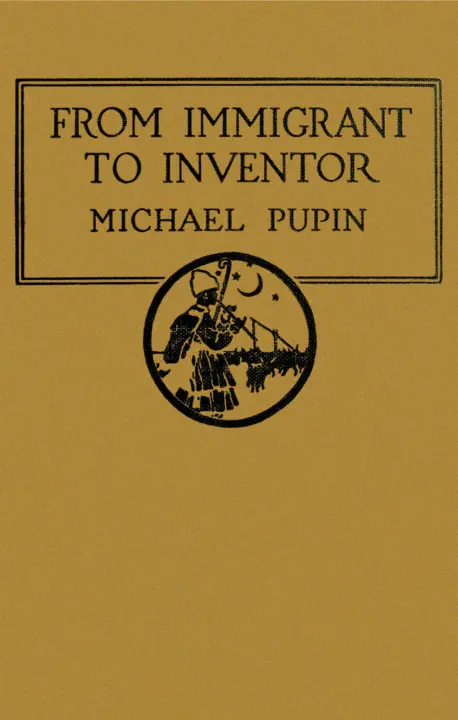
"From Immigrant to Inventor" by Michael Pupin is a memoir written in the early 20th century, reflecting on the author’s remarkable journey from Serbia to becoming a prominent American scientist and inventor. The book chronicles Pupin's early life as an impoverished immigrant who arrives in America with only five cents, his formative experiences in schooling, and the cultural challenges he faced and overcame through perseverance and ingenuity. The opening of the memoir reveals Pupin's arrival in America and his initial struggles. He describes his first experiences as an immigrant, highlighting his confidence despite a lack of financial resources, and it sets the tone for his narrative of growth and adaptation. Pupin conveys the importance of his Serbian heritage and the lessons learned from his mother and the villagers of Idvor, which shaped his character. This portion also touches on the themes of resilience, the immigrant experience, and the pursuit of education amid adversity, foreshadowing his future impact on American science.
Introduction adapted from the source catalogue; source summaries may be automatically generated.
Free to read · English · 130,353 words · No account needed
MAKE TIME FOR A GOOD BOOK
On by default. Untick to stop anonymous reading totals. Each page counts after 10 seconds in view. How this works.
Anonymous counting is on unless you have switched it off.
My physician recommended that during that summer I should settle down in Norfolk, Connecticut, to give the bracing climate of this New England town in the Berkshire hills a chance to rebuild what overwork, under nervous tension, and pneumonia had undermined and torn down. A New York physician, who knew me through my X-ray work, offered to rent me his summer residence, facing Haystack Mountain, the highest peak in Norfolk, and I accepted it. This mountain is really only a hill, hardly one thousand feet higher than the road at its foot, but as I sat on the piazza in front of that little cottage and looked at the so-called observatory, a square frame structure on the top of this hill, from which people caught the distant view of the Housatonic valley, I wondered whether I should ever be strong enough to climb to its top. I recalled my exploits in Switzerland, thirteen years before, and, utterly discouraged by the comparison, I accepted with calm resignation that I had grown old and decrepit in less time than it takes other people to become middle-aged. Whenever I thought of my past, present, or future, I always managed to draw some gloomy conclusion of that kind, and, so far as my cloudy fancy could see, I felt that I had finished my career in dismal failure. People told me that these were queer notions due to mental depression, from which I would soon recover. But, as time went on and there was no relief, I resented it when people tried to console me with, what I considered, empty promises of a brighter future. There suddenly appeared an angel who promised nothing but gave much.
Another New York physician, the well-known Doctor Frederick Shepard Dennis, also an admirer of my X-ray work, had a summer residence at Norfolk. He was practically a native of this quaint New England town, and believed in its great virtues as a resort for convalescents. He was very anxious that my summer vacation there should put me on my feet again, but he saw that my introspective life on the lonely piazza facing Haystack Mountain blocked every road which might lead to my physical and mental restoration. “Professor,” said he one day to me, “if you do not stop thinking about yourself you will never get well.” “But,” said I, “what else is there to think about? I hate to think about that horrible green phosphorescence of vacuum tubes, about the X-rays, fluorescent screens, and skeletons of hands and feet and ribs. Those are the things which haunted incessantly my burning brain during the pneumonia fever, and I shall never think of them again if I can help it. I should like to think about some other problems which are waiting in my laboratory, but what is the use? I have no hope of living long enough to solve them, or that, if I live, I shall have the necessary brain energy to work out their solution. Besides, whenever I begin to think of something pleasant or interesting my heart suddenly gives a violent thump, and sends a cold shiver through my timid veins. I must think of myself, because I am always on my guard against something that might happen at any moment to cut the last thread of my shaky vitality. It is this everlasting fear that keeps me thinking about myself.” The good doctor looked thoughtful, but said nothing; a few days later he drove up in a little yellow runabout, drawn by a pair of cobs of beautiful dark chestnut color, which were a splendid product of his stud farm; they shone like old mahogany. “How do you like them, professor?” asked the doctor, as he scrutinized my admiring gaze. “They are a thing of beauty and a joy forever,” said I, and I meant what I said. The next day the cobs, with wagon and harness, were mine; they were only three years old, and, although broken to harness, they were quite raw and needed training. I got them after pledging my word to the doctor that I would train them. My native Banat is like Kentucky. Everybody raises horses, and everybody knows by intuition how to handle a horse. I was told by experts that I handled those cobs just right. While training them I really trained my own nerves. They needed it more than the cobs did. “Horse sense” has meant to me ever since a sense which enables man to train a horse, and that means to give up your whole heart and soul to the horse. The trainer must never think of himself, but always of his beloved animal. He must be patient and persistent, kind and affectionate, forgiving mistakes and showing full appreciation for even the smallest honest effort. Only by the exercise of these virtues can he succeed in developing in the horse the habit of being a splendid horse. Doctor Dennis was a great lover of horses, and he knew all that, and thought, as he told me later, that it was the best medicine for me.
Your reading position is saved on this browser. Take it to another device with a library code. Reading pages adapt to text, rather than matching a printed edition.
BEHIND THE BOOK
This eBook is for the use of anyone anywhere in the United States and most other parts of the world at no cost and with almost no restrictions whatsoever. You may copy it, give it away or re-use it under the terms of the Project Gutenberg License included with this eBook or online at www.gutenberg.org. If you are not located in the United States, you will have to check the laws of the country where you are located before using this eBook. Read the source licence.
The original source file, including credits and licence, is retained by this library. Request an original-format copy at no charge. Please include the book title and Project Gutenberg identifier #66886.
KEEP YOUR CURIOSITY GOING
John L. Ransom

Herman W. Mudgett

Harriet Monroe
Daniel Dulany Addison
Charles Lanman

Harold Rosher