THE CLASSIC COLLECTION✦Andersonville diaryCLASSIC FREE BOOKS
Andersonville diary
John L. Ransom
THE CLASSIC COLLECTION · 1922
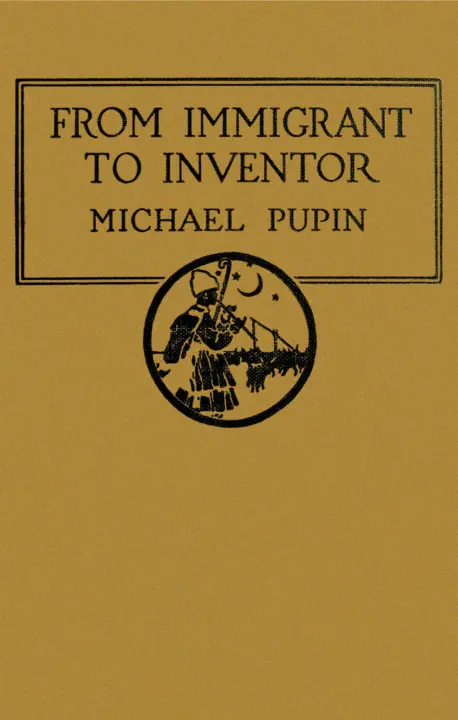
"From Immigrant to Inventor" by Michael Pupin is a memoir written in the early 20th century, reflecting on the author’s remarkable journey from Serbia to becoming a prominent American scientist and inventor. The book chronicles Pupin's early life as an impoverished immigrant who arrives in America with only five cents, his formative experiences in schooling, and the cultural challenges he faced and overcame through perseverance and ingenuity. The opening of the memoir reveals Pupin's arrival in America and his initial struggles. He describes his first experiences as an immigrant, highlighting his confidence despite a lack of financial resources, and it sets the tone for his narrative of growth and adaptation. Pupin conveys the importance of his Serbian heritage and the lessons learned from his mother and the villagers of Idvor, which shaped his character. This portion also touches on the themes of resilience, the immigrant experience, and the pursuit of education amid adversity, foreshadowing his future impact on American science.
Introduction adapted from the source catalogue; source summaries may be automatically generated.
Free to read · English · 130,353 words · No account needed
MAKE TIME FOR A GOOD BOOK
On by default. Untick to stop anonymous reading totals. Each page counts after 10 seconds in view. How this works.
Anonymous counting is on unless you have switched it off.
In this book Tyndall drew the same picture of Faraday which Campbell had given me of Maxwell. One can imagine what it meant to the world to bring these two spiritual and intellectual giants into personal contact during the period of 1860-1865, when Maxwell was professor at King’s College, London, and Faraday was at the Royal Institution, where he had been for nearly sixty years. It was significant that at the close of that period, that is, in January, 1865, Maxwell, in a letter to an intimate friend, said this:
“I have a paper afloat, with an electromagnetic theory of light, which, till I am convinced to the contrary, I hold to be great guns.”
A very strong claim made by the most modest of men! The paper was presented during that year to the Royal Society and was “great guns.” It marks, like Newton’s discovery of the law of gravitation and his formulation of the laws of dynamics, a new epoch in science. In Maxwell I saw a Newton of the electrical science, but I confess that in those days nothing more substantial than my youthful enthusiasm justified me in that opinion. I was aware that my knowledge of Faraday’s discoveries and of Maxwell’s interpretation of them was quite hazy, and I made up my mind to get more light before I started out for Berlin.
The summer vacation was on and I decided to take Faraday’s “Electrical Researches” to Scotland, the land of Maxwell. In the preface to his great--and to me, at that time, enigmatic--electrical treatise Maxwell modestly had stated that he was an interpreter, only, of Faraday. But I was delighted when I heard Tyndall’s suggestion that Faraday would help me to interpret Maxwell. Perhaps, thought I, the invigorating air of Maxwell’s native Scotland would help me to catch some of the ideas which Maxwell had caught when he was reading Faraday. I selected what I thought would be a quiet and secluded spot, the island of Arran. It belonged to the Duke of Hamilton, and I was told that his grace had imposed so many restrictions upon his tenants that the island had become an ideal spot for those who sought seclusion. I found there a neat little inn at Corrie. It was surrounded by several tiny cottages for summer visitors who took their meals at the inn. It was popular with people from Glasgow, Greenock, and Paisley. Every one of the visiting families was blessed with numerous daughters. They were very athletic and played tennis from early morning till late in the afternoon, interrupted now and then by swimming contests in the frigid waters of the Firth of Clyde. In the evening there was lively dancing--not easy-going waltzing, but the real fling and reel of the strenuous Highland type. “What a sturdy race this is,” I said to myself, as I watched the dancers working themselves up into a frenzy of rhythmic movements, one hand resting upon the hip, the other raised high up in the air, while their joyful limbs were pumping up and down in perfect rhythm as if they were busy pulling up from mother earth all the earthly joys stored up there for mortal man. The whole scene was particularly thrilling to me when a piper came along and furnished the music. The bagpipes reminded me of my native Idvor, and made me feel at home in bonny Scotland before I had been much over a week in Arran. The Scotch and the Serbs have many things in common, and I always believed that somewhere back in the history of Iran they must have belonged to the same tribe. I am told that at the Macedonian front the Scotch and the Serbian soldiers got along beautifully, as if they had known each other from time immemorial, and they had little use for the other races assembled there. I got along at Corrie as if I had known the Scotch all my life. But that had its disadvantages also. I came to Corrie looking for seclusion where, undisturbed, I could communicate with Faraday. But the lively lassies from Glasgow, Greenock, and Paisley, the tennis and the swimming contests, the fascinating sound of the bagpipes accompanying the stirring Highland dances--all these things whispered into my ear: “Faraday can wait, but your friends here cannot.” Then I remembered a passage in one of Maxwell’s letters, given in Campbell’s life of Maxwell, which said: “Well, work is good and reading is good, but friends are better.” What a splendid excuse for joining the lassies and the lads at Corrie and revelling in the healthful pursuits of their youthful exuberance! Besides, said I to myself, have I not accomplished enough during my eighteen months’ drilling under Routh, Maxwell, La Grange, Rayleigh, Stokes, and Tyndall to deserve a complete change of mental and physical activity? When a person looks for an excuse to do what he or she likes to do a splendid excuse can always be found, and so I bade a temporary farewell to Faraday’s “Electrical Researches,” and joined the playful activities of my Corrie friends, challenging them to go the limit. In tennis and swimming I held my own, but the Highland reels floored me every time, until Madge, one of the sturdy lassies from Greenock, by persistent private instruction finally succeeded in initiating me into the mysteries of the Highland rhythm. Glen Sannox, near Corrie, with its rich bed of heather, watched me often by the hour making many futile efforts to catch this rhythm and make my limbs obey it. Nobody else watched these efforts in lonely Glen Sannox excepting Madge, and she, I told her, had more fun than a Bosnian gypsy training his bear. I can still hear the slopes of Glen Sannox echoing the clear notes of her ringing laughter, whenever I made an awkward and clumsy movement in my persistent efforts to master the Highland fling or reel. She could not help it, and I did not mind it, because I had made up my mind to do the trick or die. Finally I did it, not very well, but well enough for a fellow who was not a Scotchman, and Madge presented me with my portrait in pencil, which she drew during the intermissions between my efforts to master the art of the Highland dances. That was my reward and it was a very good one; she was a most promising young artist who had won several prizes in the Greenock art school. The memory of this experience always recalled to my mind the thoughts which went through my head at that time--the thoughts, namely, that Scotch originality, individuality, and sturdiness are hard to follow, not only when a foreigner meets these wonderful qualities in the mental activity of a Scot, like the mental activity of a Maxwell, but also in physical activity like that displayed in the national dances of Scotland. One does not appreciate fully the wonderful qualities of the Scot until he tries to master the theory and the practice of the Highland fling or reel. Maxwell’s electrical theory, I thought, might be just as different from other electrical theories as the Highland dances are different from the dances of other nations. I found out later that my guess was not very far from the truth.
Your reading position is saved on this browser. Take it to another device with a library code. Reading pages adapt to text, rather than matching a printed edition.
BEHIND THE BOOK
This eBook is for the use of anyone anywhere in the United States and most other parts of the world at no cost and with almost no restrictions whatsoever. You may copy it, give it away or re-use it under the terms of the Project Gutenberg License included with this eBook or online at www.gutenberg.org. If you are not located in the United States, you will have to check the laws of the country where you are located before using this eBook. Read the source licence.
The original source file, including credits and licence, is retained by this library. Request an original-format copy at no charge. Please include the book title and Project Gutenberg identifier #66886.
KEEP YOUR CURIOSITY GOING
John L. Ransom

Herman W. Mudgett

Harriet Monroe
Daniel Dulany Addison
Charles Lanman

Harold Rosher