THE CLASSIC COLLECTION✦Accepting the universeCLASSIC FREE BOOKS
Accepting the universe
John Burroughs
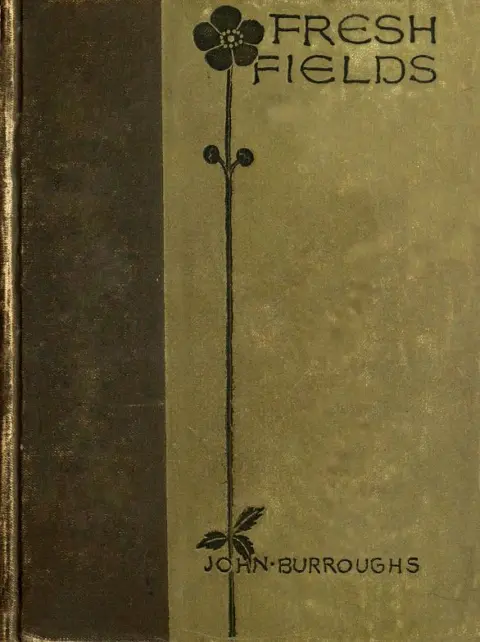
THE CLASSIC COLLECTION · 1884
"Fresh Fields" by John Burroughs is a travel narrative written in the late 19th century. The book primarily explores the author’s impressions of nature across England and Scotland, offering insights into the scenery, flora, fauna, and cultural landmarks, intertwining personal reflections with vivid descriptions. The opening of the narrative sets the tone for a reflective and sensory journey, as the author begins his travels by describing the intoxicating scent of peat in Ireland, which evokes a sense of nostalgia. Upon arriving in Scotland, he expresses a deep appreciation for the lush, verdant landscapes, contrasting them with the more rugged terrains of America. He vividly paints a picture of the pastoral charm found along the Clyde River, where he observes the harmonious coexistence of nature and industry. Burroughs reflects on various experiences, such as his encounters with local wildlife and the beauty of the English countryside, capturing not just the sights, but also the emotions and memories they evoke within him. The opening thus introduces readers to a work rich in nature writing, emphasizing the personal connection between the observer and the observed.
Introduction adapted from the source catalogue; source summaries may be automatically generated.
Free to read · English · 73,636 words · No account needed
MAKE TIME FOR A GOOD BOOK
On by default. Untick to stop anonymous reading totals. Each page counts after 10 seconds in view. How this works.
Anonymous counting is on unless you have switched it off.
If all the people of whom I inquired for nightingales in England could have been together and compared notes, they probably would not have been long in deciding that there was at least one crazy American abroad.
I proposed to be up and off at five o'clock in the morning, which seemed greatly to puzzle mine host. At first he thought it could not be done, but finally saw his way out of the dilemma, and said he would get up and undo the door for me himself. The morning was cloudy and misty, though the previous night had been of the fairest. There is one thing they do not have in England that we can boast of at home, and that is a good masculine type of weather: it is not even feminine; it is childish and puerile, though I am told that occasionally there is a full-grown storm. But I saw nothing but petulant little showers and prolonged juvenile sulks. The clouds have no reserve, no dignity; if there is a drop of water in them (and there generally are several drops), out it comes. The prettiest little showers march across the country in summer, scarcely bigger than a street watering-cart; sometimes by getting over the fence one can avoid them, but they keep the haymakers in a perpetual flurry. There is no cloud scenery, as with us, no mass and solidity, no height nor depth. The clouds seem low, vague, and vapory,--immature, indefinite, inconsequential, like youth.
The walk to Selborne was through mist and light rain. Few bird voices, save the cries of the lapwing and the curlew, were heard. Shortly after leaving Liphook the road takes a straight cut for three or four miles through a level, black, barren, peaty stretch of country, with Wolmer Forest a short distance on the right. Under the low-hanging clouds the scene was a dismal one,--a black earth beneath and a gloomy sky above. For miles the only sign of life was a baker's cart rattling along the smooth, white road. At the end of this solitude I came to cultivated fields, and a little hamlet and an inn. At this inn (for a wonder!) I got some breakfast. The family had not yet had theirs, and I sat with them at the table, and had substantial fare. From this point I followed a footpath a couple of miles through fields and parks. The highways for the most part seemed so narrow and exclusive, or inclusive, such penalties seemed to attach to a view over the high walls and hedges that shut me in, that a footpath was always a welcome escape to me. I opened the wicket or mounted the stile without much concern as to whether it would further me on my way or not. It was like turning the flank of an enemy. These well-kept fields and lawns, these cozy nooks, these stately and exclusive houses that had taken such pains to shut out the public gaze,--from the footpath one had them at an advantage, and could pluck out their mystery. On striking the highway again, I met the postmistress, stepping briskly along with the morning mail. Her husband had died, and she had taken his place as mail-carrier. England is so densely populated, the country is so like a great city suburb, that your mail is brought to your door everywhere, the same as in town. I walked a distance with a boy driving a little old white horse with a cart-load of brick. He lived at Hedleigh, six miles distant; he had left there at five o'clock in the morning, and had heard a nightingale. He was sure; as I pressed him, he described the place minutely. "She was in the large fir-tree by Tom Anthony's gate, at the south end of the village." Then, I said, doubtless I shall find one in some of Gilbert White's haunts; but I did not. I spent two rainy days at Selborne; I passed many chilly and cheerless hours loitering along those wet lanes and dells and dripping hangers, wooing both my bird and the spirit of the gentle parson, but apparently without getting very near to either. When I think of the place now, I see its hurrying and anxious haymakers in the field of mown grass, and hear the cry of a child that sat in the hay back of the old church, and cried by the hour while its mother was busy with her rake not far off. The rain had ceased, the hay had dried off a little, and scores of men, women, and children, but mostly women, had flocked to the fields to rake it up. The hay is got together inch by inch, and every inch is fought for. They first rake it up into narrow swaths, each person taking a strip about a yard wide. If they hold the ground thus gained, when the hay dries an hour or two longer, they take another hitch, and thus on till they get it into the cock or "carry" it from the windrow. It is usually nearly worn out with handling before they get it into the rick.
Your reading position is saved on this browser. Take it to another device with a library code. Reading pages adapt to text, rather than matching a printed edition.
John Burroughs

John Burroughs
John Burroughs
John Burroughs
BEHIND THE BOOK
This eBook is for the use of anyone anywhere in the United States and most other parts of the world at no cost and with almost no restrictions whatsoever. You may copy it, give it away or re-use it under the terms of the Project Gutenberg License included with this eBook or online at www.gutenberg.org. If you are not located in the United States, you will have to check the laws of the country where you are located before using this eBook. Read the source licence.
The original source file, including credits and licence, is retained by this library. Request an original-format copy at no charge. Please include the book title and Project Gutenberg identifier #44127.
KEEP YOUR CURIOSITY GOING
Wilfrid Scawen Blunt
Wilfrid Scawen Blunt
E. W. (Edgar Watson) Howe
Cécile Tormay

Moritz Busch
John L. Ransom