THE CLASSIC COLLECTION✦Accepting the universeCLASSIC FREE BOOKS
Accepting the universe
John Burroughs
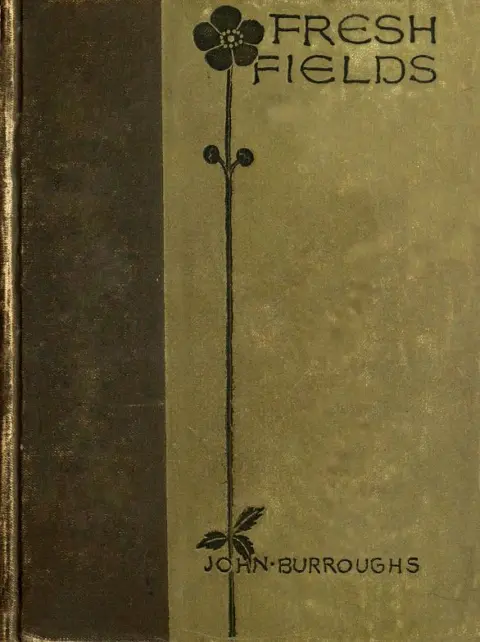
THE CLASSIC COLLECTION · 1884
"Fresh Fields" by John Burroughs is a travel narrative written in the late 19th century. The book primarily explores the author’s impressions of nature across England and Scotland, offering insights into the scenery, flora, fauna, and cultural landmarks, intertwining personal reflections with vivid descriptions. The opening of the narrative sets the tone for a reflective and sensory journey, as the author begins his travels by describing the intoxicating scent of peat in Ireland, which evokes a sense of nostalgia. Upon arriving in Scotland, he expresses a deep appreciation for the lush, verdant landscapes, contrasting them with the more rugged terrains of America. He vividly paints a picture of the pastoral charm found along the Clyde River, where he observes the harmonious coexistence of nature and industry. Burroughs reflects on various experiences, such as his encounters with local wildlife and the beauty of the English countryside, capturing not just the sights, but also the emotions and memories they evoke within him. The opening thus introduces readers to a work rich in nature writing, emphasizing the personal connection between the observer and the observed.
Introduction adapted from the source catalogue; source summaries may be automatically generated.
Free to read · English · 73,636 words · No account needed
MAKE TIME FOR A GOOD BOOK
On by default. Untick to stop anonymous reading totals. Each page counts after 10 seconds in view. How this works.
Anonymous counting is on unless you have switched it off.
Caroline Fox, in her "Memoirs of Old Friends," reports a smart saying about Carlyle, current in her time, which has been current in some form or other ever since; namely, that he had a large capital of faith uninvested,--carried it about him as ready money, I suppose, working capital. It is certainly true that it was not locked up in any of the various social and religious safe-deposits. He employed a vast deal of it in his daily work. It took not a little to set Cromwell up, and Frederick. Indeed, it is doubtful if among his contemporaries there was a man with so active a faith,--so little invested in paper securities. His religion, as a present living reality, went with him into every question. He did not believe that the Maker of this universe had retired from business, or that he was merely a sleeping partner in the concern. "Original sin," he says, "and such like are bad enough, I doubt not; but distilled sin, dark ignorance, stupidity, dark corn-law, bastile and company, what are they?" For creeds, theories, philosophies, plans for reforming the world, etc., he cared nothing, he would not invest one moment in them; but the hero, the worker, the doer, justice, veracity, courage, these drew him,--in these he put his faith. What to other people were mere obstructions were urgent, pressing realities to Carlyle. Every truth or fact with him has a personal inclination, points to conduct, points to duty. He could not invest himself in creeds and formulas, but in that which yielded an instant return in force, justice, character. He has no philosophical impartiality. He has been broken up; there have been moral convulsions; the rock stands on end. Hence the vehement and precipitous character of his speech,--its wonderful picturesqueness and power. The spirit of gloom and dejection that possesses him, united to such an indomitable spirit of work and helpfulness, is very noteworthy. Such courage, such faith, such unshaken adamantine belief in the essential soundness and healthfulness that lay beneath all this weltering and chaotic world of folly and evil about him, in conjunction with such pessimism and despondency, was never before seen in a man of letters. I am reminded that in this respect he was more like a root of the tree of Igdrasil than like a branch; one of the central and master roots, with all that implies, toiling and grappling in the gloom, but full of the spirit of light. How he delves and searches; how much he made live and bloom again; how he sifted the soil for the last drop of heroic blood! The Fates are there, too, with water from the sacred well. He is quick, sensitive, full of tenderness and pity; yet he is savage and brutal when you oppose him, or seek to wrench him from his holdings. His stormy outbursts always leave the moral atmosphere clear and bracing; he does not communicate the gloom and despondency he feels, because he brings us so directly and unfailingly in contact with the perennial sources of hope and faith, with the life-giving and the life-renewing. Though the heavens fall, the orbs of truth and justice fall not. Carlyle was like an unhoused soul, naked and bare to every wind that blows. He felt the awful cosmic chill. He could not take shelter in the creed of his fathers, nor in any of the opinions and beliefs of his time. He could not and did not try to fend himself against the keen edge of the terrible doubts, the awful mysteries, the abysmal questions and duties. He lived and wrought on in the visible presence of God. This was no myth to him, but a terrible reality. How the immensities open and yawn about him! He was like a man who should suddenly see his relations to the universe, both physical and moral, in gigantic perspective, and never through life lose the awe, the wonder, the fear, the revelation inspired. The veil, the illusion of the familiar, the commonplace, is torn away. The natural becomes the supernatural. Every question, every character, every duty, was seen against the immensities, like figures in the night against a background of fire, and seen as if for the first time. The sidereal, the cosmical, the eternal,--we grow familiar with these or lose sight of them entirely. But Carlyle never lost sight of them; his sense of them became morbidly acute, preternaturally developed, and it was as if he saw every movement of the hand, every fall of a leaf, as an emanation of solar energy. A "haggard mood of the imagination" (his own phrase) was habitual with him. He could see only the tragical in life and in history. Events were imminent, poised like avalanches that a word might loosen. We see Jeffries perpetually amazed at his earnestness, the gradations in his mind were so steep; the descent from the thought to the deed was so swift and inevitable that the witty advocate came to look upon him as a man to be avoided.
Your reading position is saved on this browser. Take it to another device with a library code. Reading pages adapt to text, rather than matching a printed edition.
John Burroughs
John Burroughs
John Burroughs
John Burroughs
BEHIND THE BOOK
This eBook is for the use of anyone anywhere in the United States and most other parts of the world at no cost and with almost no restrictions whatsoever. You may copy it, give it away or re-use it under the terms of the Project Gutenberg License included with this eBook or online at www.gutenberg.org. If you are not located in the United States, you will have to check the laws of the country where you are located before using this eBook. Read the source licence.
The original source file, including credits and licence, is retained by this library. Request an original-format copy at no charge. Please include the book title and Project Gutenberg identifier #44127.
KEEP YOUR CURIOSITY GOING
Wilfrid Scawen Blunt
Wilfrid Scawen Blunt
E. W. (Edgar Watson) Howe
Cécile Tormay

Moritz Busch
John L. Ransom