THE CLASSIC COLLECTION✦Accepting the universeCLASSIC FREE BOOKS
Accepting the universe
John Burroughs
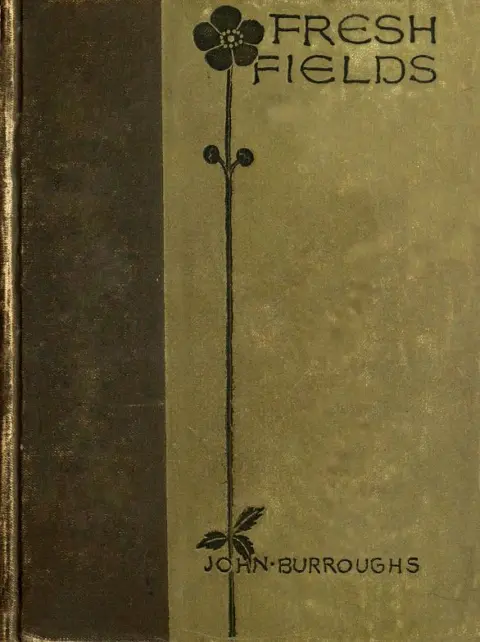
THE CLASSIC COLLECTION · 1884
"Fresh Fields" by John Burroughs is a travel narrative written in the late 19th century. The book primarily explores the author’s impressions of nature across England and Scotland, offering insights into the scenery, flora, fauna, and cultural landmarks, intertwining personal reflections with vivid descriptions. The opening of the narrative sets the tone for a reflective and sensory journey, as the author begins his travels by describing the intoxicating scent of peat in Ireland, which evokes a sense of nostalgia. Upon arriving in Scotland, he expresses a deep appreciation for the lush, verdant landscapes, contrasting them with the more rugged terrains of America. He vividly paints a picture of the pastoral charm found along the Clyde River, where he observes the harmonious coexistence of nature and industry. Burroughs reflects on various experiences, such as his encounters with local wildlife and the beauty of the English countryside, capturing not just the sights, but also the emotions and memories they evoke within him. The opening thus introduces readers to a work rich in nature writing, emphasizing the personal connection between the observer and the observed.
Introduction adapted from the source catalogue; source summaries may be automatically generated.
Free to read · English · 73,636 words · No account needed
MAKE TIME FOR A GOOD BOOK
On by default. Untick to stop anonymous reading totals. Each page counts after 10 seconds in view. How this works.
Anonymous counting is on unless you have switched it off.
In more primitive times, and amid more rudely organized communities, the hero, the strong man, could step to the front and seize the leadership like the buffalo of the plains or the wild horse of the pampas; but in our time, at least among English-speaking races, he must be more or less called by the suffrage of the people. It is quite certain that, had there been a seventeenth or eighteenth century Carlyle he would not have seen the hero in Cromwell, or in Frederick, that the nineteenth century Carlyle saw in each. In any case, in any event, the dead rule us more than the living; we cannot escape the past. It is not merely by virtue of the sunlight that falls now, and the rain and dew that it brings, that we continue here; but by virtue of the sunlight of æons of past ages.
"This land of England has its conquerors, possessors, which change from epoch to epoch, from day to day; but its real conquerors, creators, and eternal proprietors are these following and their representatives, if you can find them: all the Heroic Souls that ever were in England, each in their degree; all the men that ever cut a thistle, drained a puddle out of England, contrived a wise scheme in England, did or said a true and valiant thing in England." "Work? The quantity of done and forgotten work that lies silent under my feet in this world, and escorts and attends me and supports and keeps me alive, wheresoever I walk or stand, whatsoever I think or do, gives rise to reflections!" In our own politics, has our first President ever ceased to be President? Does he not still sit there, the stern and blameless patriot, uttering counsel?
Carlyle had no faith in the inherent tendency of things to right themselves, to adjust themselves to their own proper standards; the conservative force of Nature, the checks and balances by which her own order and succession is maintained; the Darwinian principle, according to which the organic life of the globe has been evolved, the higher and more complex forms mounting from the lower, the true palingenesia, the principle or power, name it Fate, name it Necessity, name it God, or what you will, which finally lifts a people, a race, an age, and even a community above the reach of choice, of accident, of individual will, into the region of general law. So little is life what we make it, after all; so little is the course of history, the destiny of nations, the result of any man's purpose, or direction, or will, so great is Fate, so insignificant is man! The human body is made up of a vast congeries or association of minute cells, each with its own proper work and function, at which it toils incessantly night and day, and thinks of nothing beyond. The shape, the size, the color of the body, its degree of health and strength, etc.,--no cell or series of cells decides these points; a law above and beyond the cell determines them. The final destiny and summing up of a nation is, perhaps, as little within the conscious will and purpose of the individual citizens. When you come to large masses, to long periods, the law of nature steps in. The day is hot or the day is cold, the spring is late or the spring is early; but the inclination of the earth's axis makes the winter and summer sure. The wind blows this way and blows that, but the great storms gyrate and travel in one general direction. There is a wind of the globe that never varies, and there is the breeze of the mountain that is never two days alike. The local hurricane moves the waters of the sea to a depth of but a few feet, but the tidal impulse goes to the bottom. Men and communities in this world are often in the position of arctic explorers, who are making great speed in a given direction while the ice-floe beneath them is making greater speed in the opposite direction. This kind of progress has often befallen political and ecclesiastical parties in this country. Behind mood lies temperament; back of the caprice of will lies the fate of character; back of both is the bias of family; back of that, the tyranny of race; still deeper, the power of climate, of soil, of geology, the whole physical and moral environment. Still we are free men only so far as we rise above these. We cannot abolish fate, but we can in a measure utilize it. The projectile force of the bullet does not annul or suspend gravity; it uses it. The floating vapor is just as true an illustration of the law of gravity as the falling avalanche.
Your reading position is saved on this browser. Take it to another device with a library code. Reading pages adapt to text, rather than matching a printed edition.
John Burroughs
John Burroughs
John Burroughs
John Burroughs
BEHIND THE BOOK
This eBook is for the use of anyone anywhere in the United States and most other parts of the world at no cost and with almost no restrictions whatsoever. You may copy it, give it away or re-use it under the terms of the Project Gutenberg License included with this eBook or online at www.gutenberg.org. If you are not located in the United States, you will have to check the laws of the country where you are located before using this eBook. Read the source licence.
The original source file, including credits and licence, is retained by this library. Request an original-format copy at no charge. Please include the book title and Project Gutenberg identifier #44127.
KEEP YOUR CURIOSITY GOING
Wilfrid Scawen Blunt
Wilfrid Scawen Blunt
E. W. (Edgar Watson) Howe
Cécile Tormay

Moritz Busch
John L. Ransom