The orchestra and its instruments
Esther Singleton
THE CLASSIC COLLECTION · 1903
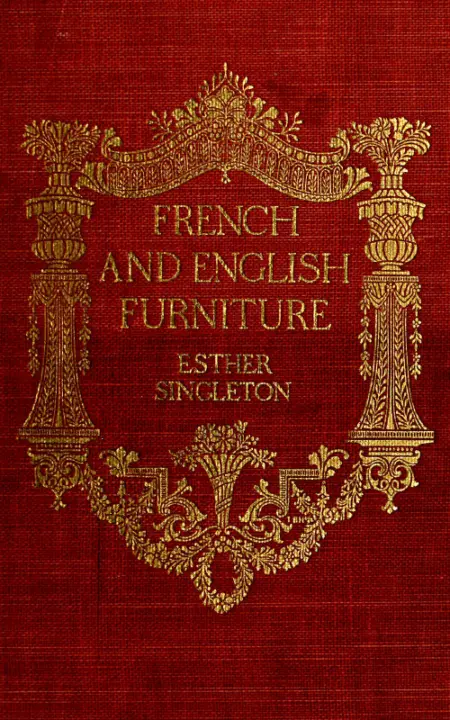
"French and English Furniture" by Esther Singleton is a historical account written in the early 20th century. The work provides an in-depth exploration of furniture styles and decorative arts from the French Renaissance to various English decorative periods, focusing on distinctive characteristics, functions, and historical contexts. Singleton aims to serve collectors, students, and interior decorators by offering a comprehensive guide to furnishing rooms in any given style. The opening of the text reveals Singleton's purpose of providing an extensive overview of French and English furniture from the Renaissance onward. She emphasizes the lack of comparable works that effectively describe and illustrate various styles, asserting that her book aims to enable readers to understand how to appropriately furnish rooms in specific historical styles, such as Louis XV or Heppelwhite. The preface also discusses the intricate details of the furniture, including upholstery, cabinetry, and decorative elements, highlighting the artistic achievements and evolution in taste from one period to another. Additionally, she mentions the inclusion of illustrations sourced from contemporary materials and designers to enrich the reader's understanding.
Introduction adapted from the source catalogue; source summaries may be automatically generated.
Free to read · English · 96,415 words · No account needed
MAKE TIME FOR A GOOD BOOK
On by default. Untick to stop anonymous reading totals. Each page counts after 10 seconds in view. How this works.
Anonymous counting is on unless you have switched it off.
“We again repeat that no classification exists that is not defective; between the end of the reign of Louis XV. and the beginning of that of Louis XVI. there is certainly no marked transition; the sobered furniture in the style à la reine is still seen with its chequered marquetry and delicately chased bronzes. Louis XV., the founder of the Porcelain manufactory of France, no doubt caused Sèvres plaques with bouquets, bordered with turquoise blue to be inlaid in the furniture he had around him, or which he offered as gifts. And yet it is more particularly in the reign of Louis XVI. and at the time when Amboyna wood and spotted mahogany were replacing marquetry mosaic, that porcelain and Wedgwood cameos were incrusted in panels, friezes, and the drawers of furniture; it may be permitted, therefore, for the sake of clearness, to call the overlaying of furniture with china by the name of the sovereign who so especially admired and patronized it. In fact, the period of Louis XVI. is that in which cabinet-making employed its resources most largely and multiplied its styles.”
Among the designers who are classed under the epoch of Louis XVI., but whose works are a mixture of Louis XV. and Louis XVI. styles, are Roubo, Lucotte, Watelet, Jean Baptiste Pierre, Dumont, Demontigny, Charles de Wailly, Le Lorrain, Choffart and Neufforge. The latter, a native of Liège, was one of the most prolific designers of the age. His eight books of architecture with supplement give examples of interior decorations. The fifth volume, which appeared in 1763, is devoted exclusively to mantel-pieces, ceilings, tables, stoves, commodes, parquet floors, vases and other furniture; and many designs of sofas, cabinets, buffets, armoires, clocks, consoles and commodes are included in the eighth volume published in 1768. Although Neufforge published all his designs during the reign of Louis XV., they form a complete illustration of both the exterior and interior decoration of houses of the Louis XVI. style. However, Neufforge did also produce some designs in the style Louis XV. A mirror by Neufforge appears on Plate XLVII., No. 2.
The most important designers of the Louis XVI. period are: Delafosse, Ranson, Forty, De Lalonde, Salembier, Fragonard, Boucher fils, de Cuvilliés fils, Marillier, Moreau le jeune, Prieur, Petitot, Cauvet, Fay and Le Canu. Others of reputation include: Boulanger, Simon Challe, Houel, Bellicart, Saint Non, LePrince, Bachelier, Liard, Robert, St. Aubin, Renard, Queverdo, Fonlanieu, Pariset, Moreau, Houdan, Beauvais, Le Geay, Bertren, Janel, LaRue, Parizeau, Bonnet, Duplessis fils, Fossier, Huet, Demarteau, Percenet, Pouget, Tibesar, Gardette Ponce, Moithey, Panseron, Desvoyes, Taraval, Charton, Aubert Parent, and Normand.
Your reading position is saved on this browser. Take it to another device with a library code. Reading pages adapt to text, rather than matching a printed edition.
Esther Singleton
Esther Singleton
Esther Singleton
Esther Singleton
BEHIND THE BOOK
This eBook is for the use of anyone anywhere in the United States and most other parts of the world at no cost and with almost no restrictions whatsoever. You may copy it, give it away or re-use it under the terms of the Project Gutenberg License included with this eBook or online at www.gutenberg.org. If you are not located in the United States, you will have to check the laws of the country where you are located before using this eBook. Read the source licence.
The original source file, including credits and licence, is retained by this library. Request an original-format copy at no charge. Please include the book title and Project Gutenberg identifier #54866.
KEEP YOUR CURIOSITY GOING
Cécile Tormay

Moritz Busch
John L. Ransom
Frances Wright
Cécile Tormay

Mabel Potter Daggett