THE CLASSIC COLLECTION✦My diaries, being a personal narrative of events 1888-1914, Part 2 (1900-1914)CLASSIC FREE BOOKS
My diaries, being a personal narrative of events 1888-1914, Part 2 (1900-1914)
Wilfrid Scawen Blunt
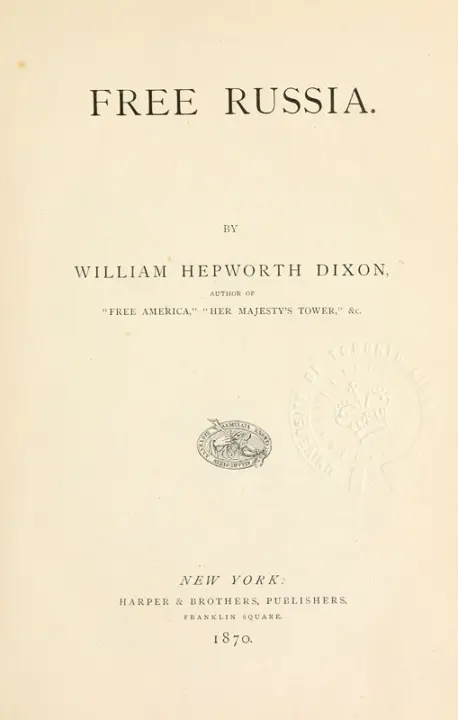
THE CLASSIC COLLECTION · 1870
"Free Russia" by William Hepworth Dixon is a historical account written in the late 19th century. It explores the transition of Russia into a new era following the Crimean War, presenting a vivid portrayal of the country's cultural, social, and religious life. The book captures the essence of a nation striving for freedom and reform, delving into the experiences of various groups, including monks, pilgrims, and rural communities. The opening of "Free Russia" introduces readers to the harsh yet breathtaking landscape of the northern regions, touching on the lives of indigenous peoples such as the Lapps and Samoyeds. Dixon shares observations from his extensive travels, detailing the adaptation of these communities and their customs in response to the changing political and social landscape. Through vivid descriptions and anecdotes, he sets the scene for a deeper exploration of the human forces shaping the reformation of Russia, making it clear that this work will weave together personal narratives and historical context to highlight the complexities of Russian identity in a time of transformation.
Introduction adapted from the source catalogue; source summaries may be automatically generated.
Free to read · English · 142,449 words · No account needed
MAKE TIME FOR A GOOD BOOK
On by default. Untick to stop anonymous reading totals. Each page counts after 10 seconds in view. How this works.
Anonymous counting is on unless you have switched it off.
A lady, who knows the country, puts up in a crate such things as a pilgrim may chance to need in a monastic cell--good tea, calf's tongue, fresh butter, cheese, roast beef, and indispensable white bread. These dainties being piled on a drojki, propped on pillows and covered with quilts--my bedding in the convent and the boat--we rattle away to the Pilgrim's Wharf.
Yes, there it is, an actual wharf--the only wharf in Archangel along
which boats can lie, and land their passengers by a common sea-side
plank!
Moored to the capstan by a rope, lies the pretty craft; a gilt cross on her foremast, a saintly pennant on her main. Four large gold letters tell her name:
(pronounced Verra), and meaning Faith. Father John is standing on his bridge, giving orders in a low voice to his officers and crew, many of whom are monks--mate, steward, cook, and engineer--each and all arrayed in the cowl and frock.
On the Pilgrim's Wharf, which lies in a yard cut off by gates from the street, and paved with chips and shavings to form a dry approach, stands a new pile of monastic buildings; chapels, cells, store-rooms, offices, stalls, dormitories; in fact, a new Pilgrim's Court. A steamer can not reach the port in the upper town, where the original Pilgrim's Court was built; and the fathers, keeping pace with the times, have let their ancient lodgings in the town, and built a new house lower down the stream.
Crowds of men and women--pilgrims, tramps, and soldiers--strew the wharf with a litter of baskets, tea-pots, beds, dried-fish, felt boots, old rugs and furs, salt-girkins, black bread; through which the monks step softly and sadly; helping a child to trot on board, getting a free pass for a beggar, buying rye-loaves for a lame wretch, and otherwise aiding the poorest of these poor creatures in their need. For, even though the season is now far spent, nearly two hundred pilgrims are in waiting on the Pilgrim's Wharf; all hoping to get over to the Holy Isles. Most of these men have money to pay their fare; and some among the groups are said to be rich. A dozen of the better sort, natives of Archangel, too busy to pass over the sea in June, when their river was full of ships, are taking advantage of the lull in trade, and of the extra boat. Each man brings with him a basket of bread and fish, a box of tea, a thick quilt, and a pair of felt leggings, to be worn over his boots at night. These local pilgrims carry a staff; but in place of the leathern belt and water-bottle, they carry a teapot and a cup. One man wears a cowl and gown, who is not of the crew; a jolly, riotous monk, going back to his convent as a prisoner. "What has he been doing?" "Women and drink," says Father John. The fares are low: first-class, six rubles (fifteen shillings); second-class, four rubles. Third-class, three rubles. This tariff covers the cost of going out and coming back--a voyage of four hundred miles--with lodgings in the guest-house, and rations at the common tables, during a stay of five or six days. A dozen of these poor pilgrims have no rubles in their purse, and the question rises on the wharf, whether these paupers shall be left behind. Father John and his fellow-skipper have a general rule; they must refuse no man, however poor, who asks them for a passage to Solovetsk in the name of God.
Your reading position is saved on this browser. Take it to another device with a library code. Reading pages adapt to text, rather than matching a printed edition.
BEHIND THE BOOK
This eBook is for the use of anyone anywhere in the United States and most other parts of the world at no cost and with almost no restrictions whatsoever. You may copy it, give it away or re-use it under the terms of the Project Gutenberg License included with this eBook or online at www.gutenberg.org. If you are not located in the United States, you will have to check the laws of the country where you are located before using this eBook. Read the source licence.
The original source file, including credits and licence, is retained by this library. Request an original-format copy at no charge. Please include the book title and Project Gutenberg identifier #51117.
KEEP YOUR CURIOSITY GOING
Wilfrid Scawen Blunt
Wilfrid Scawen Blunt

E. W. (Edgar Watson) Howe

David Patterson (Spirit) Hatch

David Patterson (Spirit) Hatch

David Patterson (Spirit) Hatch