THE CLASSIC COLLECTION✦Frank Merriwell’s dangerCLASSIC FREE BOOKS
Frank Merriwell’s danger
Burt L. Standish
THE CLASSIC COLLECTION · 1899
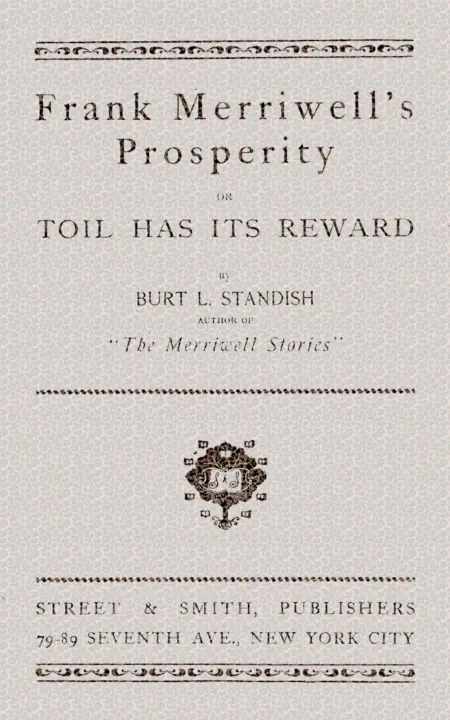
"Frank Merriwell's Prosperity; or, Toil Has Its Reward" by Burt L. Standish is a novel written in the late 19th century. The story follows the main character, Frank Merriwell, a dedicated and principled writer and actor, navigating the complexities of friendship, loyalty, and the consequences of one’s actions within the backdrop of the theater world. The narrative delves into the struggles faced by Merriwell’s friend Bart Hodge, whose impulsive decisions lead to a spiral of conflict, eventual betrayal, and a desperate quest for redemption. The opening of the novel introduces readers to the stage of the Star Theater in Atchison, Kansas, as Frank Merriwell's company prepares for a performance of the play "True Blue." Tension arises when Bart Hodge, a talented but hot-headed actor, exhibits insubordination during rehearsal, leading to a confrontation with stage manager Roscoe Havener. This conflict ignites a deeper rift between Frank and Bart, as Frank attempts to mediate and understand Bart’s frustrations, which stem from a combination of personal pride and recent failures. Ultimately, Bart's emotional outburst culminates in his departure from the company, taking with him a significant amount of Frank's money. The stage is set for a gripping tale of loyalty tested through betrayal and the journey to restore one's honor.
Introduction adapted from the source catalogue; source summaries may be automatically generated.
Free to read · English · 60,199 words · No account needed
MAKE TIME FOR A GOOD BOOK
On by default. Untick to stop anonymous reading totals. Each page counts after 10 seconds in view. How this works.
Anonymous counting is on unless you have switched it off.
Frank sat still some seconds, staring at Bart. Then he rose to his feet, and the look on his face caused Hodge to rise to his elbow and cry:
“What is it? What is the matter, Merriwell?”
“Bart,” said Frank, slowly, “every dollar I had in that grip was gone when I looked for it after your departure.”
That brought Hodge out of bed.
“Gone?” he gasped, in horror. “Gone? Why, how could that be?”
“I don’t know.”
“Frank—Frank, you don’t think I took that money? My God! you don’t think I took it? I have fallen pretty low, but you don’t think I would rob you—you who have been the only true friend I had in all the world? Why, Merry, I’d starve—I’d suffer the tortures of hell before I’d do such a thing!”
Frank did not doubt him then; he felt in his heart that Bart spoke the truth. And Merry’s heart leaped with joy and triumph. Hodge was not guilty!
Who was?
But Bart was completely “broken up” by what he had heard. Never had Frank seen him look so overcome by horror.
“Merry, Merry!” he gasped, “did you think I had stolen your money? Was that why you followed me?”
“No!” cried Frank. “That was not why I followed you, Hodge. I followed because I hoped to overtake you and bring you back—because I wished to save you from the consequences of your folly.”
“But you thought I had taken the money?”
“I hoped not.”
“Still, you thought I had! Oh, heavens! Frank, Frank, this is enough to break a fellow’s heart!”
He dropped down on the bed, burying his face in his hands and shaking
all over.
Frank’s distress was great, but it was mingled with a feeling of
triumph.
“Bart,” he said, speaking swiftly, “I could not account for the loss of the money. It was gone, and on the little table was your note, in which you said you had taken enough to meet your needs. What was I to think? It was your handwriting—I knew that. How could I account for the disappearance of the money?”
“How can you account for it now?” groaned Hodge. “Frank, are you sure it was gone—are you sure you made no mistake?”
“Yes, sure.”
“It doesn’t seem possible!” panted Hodge.
Then he caught sight of Frank’s grip, sprang for it, caught it up.
“Open it, Frank!” he cried—“open it and let me see! I shall not be satisfied till I look!”
“It is no use,” said Merry. “The money is gone.”
“Open it!” Hodge shouted.
Your reading position is saved on this browser. Take it to another device with a library code. Reading pages adapt to text, rather than matching a printed edition.
Burt L. Standish
Burt L. Standish

Burt L. Standish

Burt L. Standish
BEHIND THE BOOK
This eBook is for the use of anyone anywhere in the United States and most other parts of the world at no cost and with almost no restrictions whatsoever. You may copy it, give it away or re-use it under the terms of the Project Gutenberg License included with this eBook or online at www.gutenberg.org. If you are not located in the United States, you will have to check the laws of the country where you are located before using this eBook. Read the source licence.
The original source file, including credits and licence, is retained by this library. Request an original-format copy at no charge. Please include the book title and Project Gutenberg identifier #64347.
KEEP YOUR CURIOSITY GOING
Coulson Kernahan

Maurice Baring
Frances Wright
Cécile Tormay

Frederic Jesup Stimson

W. H. P. (William Henry Pope) Jarvis