THE CLASSIC COLLECTION✦Frank Merriwell’s dangerCLASSIC FREE BOOKS
Frank Merriwell’s danger
Burt L. Standish
THE CLASSIC COLLECTION · 1899
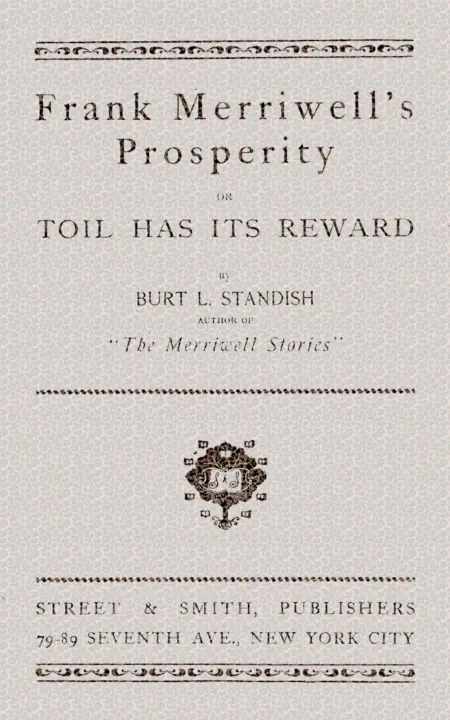
"Frank Merriwell's Prosperity; or, Toil Has Its Reward" by Burt L. Standish is a novel written in the late 19th century. The story follows the main character, Frank Merriwell, a dedicated and principled writer and actor, navigating the complexities of friendship, loyalty, and the consequences of one’s actions within the backdrop of the theater world. The narrative delves into the struggles faced by Merriwell’s friend Bart Hodge, whose impulsive decisions lead to a spiral of conflict, eventual betrayal, and a desperate quest for redemption. The opening of the novel introduces readers to the stage of the Star Theater in Atchison, Kansas, as Frank Merriwell's company prepares for a performance of the play "True Blue." Tension arises when Bart Hodge, a talented but hot-headed actor, exhibits insubordination during rehearsal, leading to a confrontation with stage manager Roscoe Havener. This conflict ignites a deeper rift between Frank and Bart, as Frank attempts to mediate and understand Bart’s frustrations, which stem from a combination of personal pride and recent failures. Ultimately, Bart's emotional outburst culminates in his departure from the company, taking with him a significant amount of Frank's money. The stage is set for a gripping tale of loyalty tested through betrayal and the journey to restore one's honor.
Introduction adapted from the source catalogue; source summaries may be automatically generated.
Free to read · English · 60,199 words · No account needed
MAKE TIME FOR A GOOD BOOK
On by default. Untick to stop anonymous reading totals. Each page counts after 10 seconds in view. How this works.
Anonymous counting is on unless you have switched it off.
“Great ginger!”
“Holy smoke!”
“Did yer see that!”
“It’s dr’amin’ Oi am!”
“The young feller kicked the slugger out!”
“That’s what he did!”
“And it’s the first time anything like that ever happened to the
slugger.”
“McGinty’ll come back for his gore!”
“Young chap, you’d better skip out by the other door, or he’ll kill
you.”
“Thank you,” said Frank, quietly, his eyes flashing. “I am minding my business, and I shall not run away from that tough. If he bothers me again I’ll kick him so hard he won’t be able to walk for a week.”
“That’s the stuff!” roared Col. McGraw of Topeka. “The boy is all right! He’s no baby, and anybody who thinks he is makes a mistake. What’ll you have, young man? If I have been touched, I’ve got enough red money left to buy the drinks, and you can have anything you want.”
“I never drink, sir,” answered Frank, calmly.
“Wh-wh-what?” exploded the colonel. “Never drink?—and you kicked McGinty? Oh, say——”
But Frank could not be induced to drink.
“What do you think of that, Kelley?” asked the Topeka man, in apparent disdain, addressing one of the barkeepers.
The man spoken to seemed so busy that he paid no attention to the
question.
“Kelley! Kelley!” Frank mentally exclaimed, taking good note of the man who had been called that. “This must be the Kelley Rafferty directed Hodge to see.”
He felt that the scent was growing hot.
McGinty did not return, and two or three men went out to see what had become of him. They came back carrying the man Frank had kicked through the door.
“He’s done,” one of them said. “Found him lying outside, and he said he couldn’t get up.”
“Well, why in blazes did you bring him in here?” shouted one of the barkeepers. “Take him into the back room, now.”
As McGinty was carried along he saw Frank.
“Say, young fellow,” he feebly asked, “do your legs run by steam? I was kicked by a mule once, but that wasn’t a patch to this!”
Then they bore him into the back room.
Much to his dismay, Frank found that this little incident had sufficed to draw attention to him. Again and again he was urged to drink. At length, in order to get up to the bar and find a chance to speak to Kelley, he consented to take a plain seltzer.
He reached the end of the bar and Kelley served him. As he did so, Frank thrust a five-dollar bill over the bar, saying:
“Upper cut.”
Your reading position is saved on this browser. Take it to another device with a library code. Reading pages adapt to text, rather than matching a printed edition.
Burt L. Standish
Burt L. Standish

Burt L. Standish

Burt L. Standish
BEHIND THE BOOK
This eBook is for the use of anyone anywhere in the United States and most other parts of the world at no cost and with almost no restrictions whatsoever. You may copy it, give it away or re-use it under the terms of the Project Gutenberg License included with this eBook or online at www.gutenberg.org. If you are not located in the United States, you will have to check the laws of the country where you are located before using this eBook. Read the source licence.
The original source file, including credits and licence, is retained by this library. Request an original-format copy at no charge. Please include the book title and Project Gutenberg identifier #64347.
KEEP YOUR CURIOSITY GOING
Coulson Kernahan

Maurice Baring
Frances Wright
Cécile Tormay

Frederic Jesup Stimson

W. H. P. (William Henry Pope) Jarvis