THE CLASSIC COLLECTION✦Frank Merriwell’s dangerCLASSIC FREE BOOKS
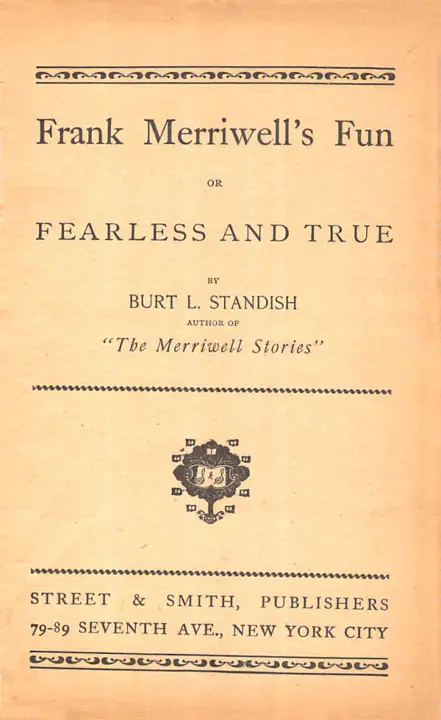
Frank Merriwell’s danger
Burt L. Standish
THE CLASSIC COLLECTION · 1899
"Frank Merriwell's Fun; Or, Fearless and True" by Burt L. Standish is a novel written in the late 19th century. The book follows the adventures of Frank Merriwell, a quintessentially American young man characterized by his integrity and determination to do right, as he navigates the challenges of college life and relationships, particularly with peers who harbor different values. The story addresses themes of friendship, loyalty, and the struggle against prejudgment, particularly as it regards those marginalized in society. The opening portion introduces a scenario at Yale University where Frank Merriwell is observed by a group of fellow students who ridicule him while he passes by with his friends. One student, Gene Skelding, harbors animosity towards Merriwell and is intent on undermining him. The narrative hints at Jim Hooker, a socially ostracized student with a troubled familial background, suggesting that he may be involved in theft due to his father’s criminal past. Frank takes immediate interest in Hooker, challenging his peers for their cruelty and vowing to befriend the outcast. This sets up the central conflict of the narrative, as Frank strives to support Hooker against the prejudices of their society while contending with the mystery surrounding the outcast's character. The opening effectively establishes the morality and social dynamics that will play a central role in the characters' development throughout the story.
Introduction adapted from the source catalogue; source summaries may be automatically generated.
Free to read · English · 49,369 words · No account needed
MAKE TIME FOR A GOOD BOOK
On by default. Untick to stop anonymous reading totals. Each page counts after 10 seconds in view. How this works.
Anonymous counting is on unless you have switched it off.
The indignation meeting did not take place. Directly after noon Frank Merriwell was waited on by several members of the football committee, who expressed regret at what had taken place, and invited and urged him to come out for practise that afternoon, as usual.
Merry did not show exultation over this turn of affairs, but he agreed to be on the field. Therefore, there was no little astonishment when he went out to practise, as usual. His enemies started in by stating he had nerve to show up, but they were silenced by the information that he had been urged to do so by the committee. But, instead of being used on the regulars, Frank was placed on the first scrub, which was very significant.
He played with all his usual skill and enthusiasm. Two brief halves were played, and he was captain of the scrub in the last half. While the scrub did not score in this half, neither did the regulars, and four times was the goal of the regulars in danger, while not once was the fighting carried far into the territory of the scrub team. This was in great contrast to the first half, when the regulars had scored twenty-four points with ease.
“It’s all through the way Merriwell handled the team,” declared more than one. “Give him command of the regulars, and he’d drive Harvard into the earth.”
But there was no certainty that Merriwell would even play on the regulars. His friends scented trickery. It is probable that Frank also tumbled to the little game, but he said nothing.
Back at college after practise, when Merry had taken a bath, a rub, and donned his clothes, a number of his friends came pouring into his room, headed by Hodge.
“Welcome, fellows!” cried Frank.
“Look here, Merriwell,” said Bart, “we’ve come to see about it.”
“About what?”
“Well, if you’re not onto the dirty trick, it’s time you dug your eyes open!” grated Bart, in language that was expressive, though not very elegant.
“What trick?” asked Frank.
“Don’t you see that you have been fooled?”
“How?”
“Why, about this football business.”
“Sit down, Hodge, and explain.”
“I won’t sit down! I can’t sit down! I’m too mad to sit down!”
“Then stand up and explain it.”
“I hear,” said Bart, “that Lorrimer was seen coming here to-day.”
“Well?”
“Did he come to see you?”
“Yes.”
“About what?”
“He came to see if I’d object to the indignation meeting which he informed me my friends were to hold this evening.”
“Well, that’s what I call pure, unadulterated gall!” snarled Bart.
Your reading position is saved on this browser. Take it to another device with a library code. Reading pages adapt to text, rather than matching a printed edition.
Burt L. Standish
Burt L. Standish

Burt L. Standish

Burt L. Standish
BEHIND THE BOOK
This eBook is for the use of anyone anywhere in the United States and most other parts of the world at no cost and with almost no restrictions whatsoever. You may copy it, give it away or re-use it under the terms of the Project Gutenberg License included with this eBook or online at www.gutenberg.org. If you are not located in the United States, you will have to check the laws of the country where you are located before using this eBook. Read the source licence.
The original source file, including credits and licence, is retained by this library. Request an original-format copy at no charge. Please include the book title and Project Gutenberg identifier #63537.
KEEP YOUR CURIOSITY GOING
Coulson Kernahan

Maurice Baring
Frances Wright
Cécile Tormay

Frederic Jesup Stimson

W. H. P. (William Henry Pope) Jarvis