THE CLASSIC COLLECTION✦Frank Merriwell’s dangerCLASSIC FREE BOOKS
Frank Merriwell’s danger
Burt L. Standish
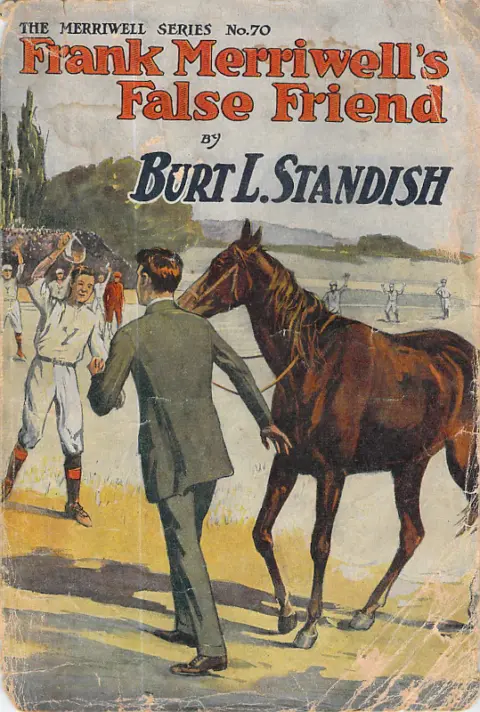
THE CLASSIC COLLECTION · 1901
"Frank Merriwell's False Friend; Or, An Investment in Human Nature" by Burt L. Standish is a fictional novel written in the early 20th century. This story follows the titular character, Frank Merriwell, a respected and successful student athlete at Yale, who suddenly goes missing, causing concern among his friends and teammates. As the plot unfolds, themes of loyalty, rivalry, and moral integrity come to the forefront, with Merriwell's character serving as a beacon of virtue amid the chaos. The opening of the novel sets the stage for a dramatic situation at Yale, where the absence of Frank Merriwell creates upheaval among the baseball team as they prepare for an important trip. His friends express their worries, and the tension escalates when rumors about his sudden departure begin to circulate, hinting at potential scandal. As various characters react to Frank’s absence, we are introduced to Dade Morgan, an ambitious freshman who is determined to make a mark on the team, and Bart Hodge, who fiercely defends his friend’s honor. The narrative unfolds amidst a backdrop of college athletics and personal struggles, suggesting that the story will delve into both sporting rivalries and deeper issues of friendship and integrity.
Introduction adapted from the source catalogue; source summaries may be automatically generated.
Free to read · English · 72,455 words · No account needed
MAKE TIME FOR A GOOD BOOK
On by default. Untick to stop anonymous reading totals. Each page counts after 10 seconds in view. How this works.
Anonymous counting is on unless you have switched it off.
If possible, Roland Packard was more disappointed in the result of the fencing-bout than was Brian Hawkins. At least, the youth of the scarred face was able to better repress and hide his feelings. Packard’s face was white and drawn, lines of anger and disappointment marking it plainly.
“It’s always the way!” he thought. “Now I know Satan helps that fellow
Merriwell!”
Hodge came forward, speaking to Packard.
“Mr. Merriwell will permit you to name the style of wrestling,” he said.
“Allow us a few moments,” bowed Packard, attempting to be coolly polite.
“Certainly,” said Hodge, with something like a grim smile playing about
his mouth.
Packard stepped over to Hawkins, who was standing with folded arms at one side of the mat. After a brief conference between them, Packard came back to Bart, observing:
“Mr. Hawkins says he prefers to wrestle catch-as-catch-can, the winner to be the one who throws his antagonist twice out of three times. Is that satisfactory?”
“Anything is satisfactory to Mr. Merriwell,” declared Bart, who well knew that Frank was particularly skilful at that style of wrestling, being successful in getting an advantageous hold on his opponent, or having a way of turning what seemed weak holds to his advantage.
If Frank was pleased, he made no display of it, and two minutes later the antagonists were crouching, facing each other at opposite sides of the mat. Then they began to work swiftly round, each one moving to the right, after the style of boxers, both watching for an opening.
The spectators scarcely breathed. It was a picture worthy of the brush of an artist. Those youthful athletes were like crouching panthers, their eyes shining, their muscles taut, their nerves on edge.
Merriwell’s jaw seemed square and firmer than usual; his mouth was firmly closed and his lips pressed together; his nostrils were distended, and his look before the struggle began was that of the determined conqueror.
The look on the scarred face of Merriwell’s antagonist cannot be described. It was savage and terrible enough to daunt a timid person.
Of a sudden, with one great spring at each other, they closed.
“Fair hold and no advantage!” cried Jack Ready, as he saw they had closed evenly, chest to chest, each man having his chin over his opponent’s right shoulder, while there was no advantage of either one having a low hold with both arms.
Such a hold as this is seldom obtained in the catch-as-catch-can style of wrestling, and it seemed to indicate that both men were alert and skilful, neither having permitted the other the slightest advantage.
Your reading position is saved on this browser. Take it to another device with a library code. Reading pages adapt to text, rather than matching a printed edition.
Burt L. Standish
Burt L. Standish

Burt L. Standish

Burt L. Standish
BEHIND THE BOOK
This eBook is for the use of anyone anywhere in the United States and most other parts of the world at no cost and with almost no restrictions whatsoever. You may copy it, give it away or re-use it under the terms of the Project Gutenberg License included with this eBook or online at www.gutenberg.org. If you are not located in the United States, you will have to check the laws of the country where you are located before using this eBook. Read the source licence.
The original source file, including credits and licence, is retained by this library. Request an original-format copy at no charge. Please include the book title and Project Gutenberg identifier #61853.
KEEP YOUR CURIOSITY GOING
Coulson Kernahan

Maurice Baring
Frances Wright
Cécile Tormay

Frederic Jesup Stimson

W. H. P. (William Henry Pope) Jarvis