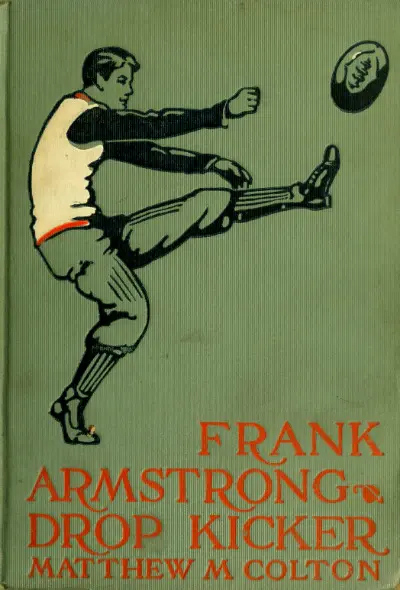
Frank Armstrong, Drop Kicker
Matthew M. Colton
THE CLASSIC COLLECTION · 1911
"Frank Armstrong at Queens" by Matthew M. Colton is a schoolboy novel written in the early 20th century. The story follows Frank Armstrong, a fourteen-year-old boy who has just arrived at Queen's School, where he faces the challenges of fitting in, dealing with bullies, and navigating the complexities of adolescence, all while participating in sports such as football and swimming. At the start of the narrative, Frank encounters an aggressive student named Chip Dixon who tries to bully him upon his arrival. This instigates a physical altercation, which sets the stage for Frank's journey within the school. He is welcomed by Mr. Parks, an assistant master, and later befriends classmates like Jimmy and "Wee Willie," who introduce him to the social dynamics and rivalries of Queen's. The opening portion establishes Frank's determination to make a mark in the new environment, hints at athletic competition, and introduces the themes of friendship, rivalry, and self-discovery that are central to the story.
Introduction adapted from the source catalogue; source summaries may be automatically generated.
Free to read · English · 60,856 words · No account needed
MAKE TIME FOR A GOOD BOOK
On by default. Untick to stop anonymous reading totals. Each page counts after 10 seconds in view. How this works.
Anonymous counting is on unless you have switched it off.
David's strength of arm was in evidence one day at the gymnasium when the four friends, David, Frank, Jimmy and Lewis, were on the floor. A certain amount of physical work in the gym was called for by the school requirements, or, at least, a certain time had to be spent in some kind of exercise. Boys who took part in any of the outdoor sports were not called upon to do work on the floor during the period of practice of the teams they represented. To Lewis, who was indolent of body, the hour in the gym was the hardest of the day, but he made his task as light as it could be. His way of exercise was to stroll over to a chest-weight and give it two or three pulls with the lightest loads he could find for it, and then walk to the other end of the gym for two or three pulls at some other piece of apparatus. Patsy kept after him, but athletic work for Lewis was like pulling teeth.
On the day in question, the four boys had just about finished their work and stopped by the end of the parallel bars.
"How many times can you dip?" said Jimmy. Dipping, as of course every one knows, consists in raising oneself up and down from a bent position of the arms to a straight position, the weight of the body being carried entirely on the arms during the raise and drop.
"I don't know," said Frank, "never tried."
"Go on and show your speed," said Jimmy, "it will be good practice
for your pitching arm. All good pitchers have lots of muscle, you
know."
"Yes, go ahead," said David, "we'll all try."
Frank, thus urged, swung up on the end of the bars. "Count for me," he said, as he let himself down between the bars and straightened up; "I'll need all the wind I've got."
Jimmy began, "One, two, three, four, five, six, good boy, keep a-going--seven, eight,--getting pretty heavy, eh? Nine, ten--eleven, twelve--going, going, gone;--no, he has one more in him,--thirteen--don't stop there, it's unlucky." But Frank had stuck. He got down all right on the fourteenth dip, but could not straighten up. He dropped off, puffing. "Gee, that's work," he said, "Go ahead, you try," indicating Jimmy.
"No," said that individual, "I want to see Lewis try it."
"Oh, I'm not feeling very strong to-day," said Lewis, "I'll do it
some other day."
"Here, here, no shystering," said all hands. "We all agreed to do it.
Take your turn."
Your reading position is saved on this browser. Take it to another device with a library code. Reading pages adapt to text, rather than matching a printed edition.
BEHIND THE BOOK
This eBook is for the use of anyone anywhere in the United States and most other parts of the world at no cost and with almost no restrictions whatsoever. You may copy it, give it away or re-use it under the terms of the Project Gutenberg License included with this eBook or online at www.gutenberg.org. If you are not located in the United States, you will have to check the laws of the country where you are located before using this eBook. Read the source licence.
The original source file, including credits and licence, is retained by this library. Request an original-format copy at no charge. Please include the book title and Project Gutenberg identifier #48848.
KEEP YOUR CURIOSITY GOING
Coulson Kernahan

Maurice Baring
Frances Wright
Cécile Tormay

Frederic Jesup Stimson

W. H. P. (William Henry Pope) Jarvis