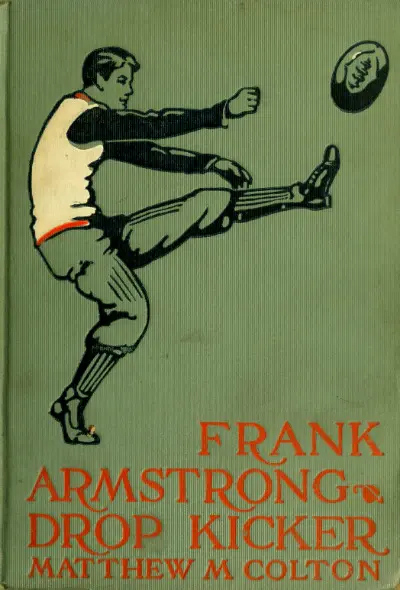
Frank Armstrong, Drop Kicker
Matthew M. Colton
THE CLASSIC COLLECTION · 1911
"Frank Armstrong at Queens" by Matthew M. Colton is a schoolboy novel written in the early 20th century. The story follows Frank Armstrong, a fourteen-year-old boy who has just arrived at Queen's School, where he faces the challenges of fitting in, dealing with bullies, and navigating the complexities of adolescence, all while participating in sports such as football and swimming. At the start of the narrative, Frank encounters an aggressive student named Chip Dixon who tries to bully him upon his arrival. This instigates a physical altercation, which sets the stage for Frank's journey within the school. He is welcomed by Mr. Parks, an assistant master, and later befriends classmates like Jimmy and "Wee Willie," who introduce him to the social dynamics and rivalries of Queen's. The opening portion establishes Frank's determination to make a mark in the new environment, hints at athletic competition, and introduces the themes of friendship, rivalry, and self-discovery that are central to the story.
Introduction adapted from the source catalogue; source summaries may be automatically generated.
Free to read · English · 60,856 words · No account needed
MAKE TIME FOR A GOOD BOOK
On by default. Untick to stop anonymous reading totals. Each page counts after 10 seconds in view. How this works.
Anonymous counting is on unless you have switched it off.
"Now, they'll get it for fair," observed the Wee One as the coach went striding down the field, following the scattered members of the First eleven who jogged sulkily down to the goal; and get it they did.
"I'm ashamed of you, Hillard," burst out Horton. "You've been playing two years on this team, and you can't hang onto a ball yet. If any one crosses his fingers in front of you, you lose the ball. Go and sit down." Hillard turned and walked slowly toward the side of the field, with head hanging. He was a good back, but had the fatal habit of fumbling. He was so clever at dodging and so fast on his feet, however, that the coach, knowing well his failing, was still tempted to put him in the line-up,--and, besides, he belonged to the powerful Gamma Tau.
"Tucker, you take Hillard's place, and see if we can't do something. Here we are, only three weeks from our last game, and you are playing like a perfectly lovely eleven from the Mount Hope Female Seminary. Think a little about the game, and squeeze that ball, PLEASE."
The coach took the ball from Tompkins, and started up the field, the whole crowd of players straggling along behind him, the First eleven sour in face and heavy in step, the Second grinning broadly.
"There, now," said Horton, putting the ball down at midfield again with a good deal more force than was necessary. "Let's have some football. First eleven's ball. Make it go. You've got to carry it from here, don't kick it, carry it. Make it go," and he jumped out of the way as the two lines crashed together.
"That's something like it. Second down, two yards to go. Some more
like that."
"Big Dutton carried it that time," said Patterson to Frank. "That big fellow with the light hair. He's the best plunger on the field, but he's something of a bonehead, and he can't remember the signals. Poor Horton has his own worries with him. There he goes again."
"First down," yelled Horton from the field. "That's going. Squeeze that ball, Dutton. Steady in the line there and keep on side. Wait till the ball is snapped, Burnham. Wait till the ball is snapped--there, what did I tell you?" as Burnham, the right tackle, anticipating the signal, plunged ahead. Little Hopkinson, quarter of the Second, had his hand up and was yelling for the penalty, which he got.
"Now, First team, you've got to make that loss up this time." Harding, the captain, stepped out of his place at guard, in the line, and conferred with Dixon a minute.
Your reading position is saved on this browser. Take it to another device with a library code. Reading pages adapt to text, rather than matching a printed edition.
BEHIND THE BOOK
This eBook is for the use of anyone anywhere in the United States and most other parts of the world at no cost and with almost no restrictions whatsoever. You may copy it, give it away or re-use it under the terms of the Project Gutenberg License included with this eBook or online at www.gutenberg.org. If you are not located in the United States, you will have to check the laws of the country where you are located before using this eBook. Read the source licence.
The original source file, including credits and licence, is retained by this library. Request an original-format copy at no charge. Please include the book title and Project Gutenberg identifier #48848.
KEEP YOUR CURIOSITY GOING
Coulson Kernahan

Maurice Baring
Frances Wright
Cécile Tormay

Frederic Jesup Stimson

W. H. P. (William Henry Pope) Jarvis