THE CLASSIC COLLECTION✦My diaries, being a personal narrative of events 1888-1914, Part 2 (1900-1914)CLASSIC FREE BOOKS
My diaries, being a personal narrative of events 1888-1914, Part 2 (1900-1914)
Wilfrid Scawen Blunt
THE CLASSIC COLLECTION · 1886
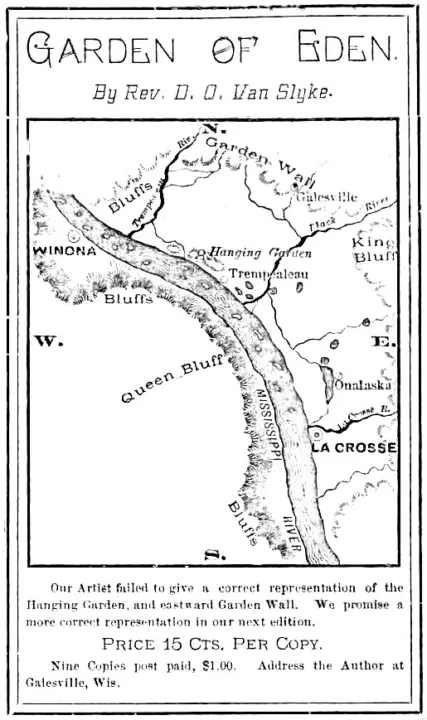
"Found at Last: the Veritable Garden of Eden" by Rev. D. O. Van Slyke is a unique exploration that combines elements of religious interpretation and geography, written in the late 19th century. This book puts forth the controversial assertion that the Garden of Eden, as described in the Bible, is located on the eastern bank of the Mississippi River between La Crosse, Wisconsin, and Winona, Minnesota. The author argues that the landscape and geographic features of this region align more closely with biblical descriptions than any other location previously proposed. In the book, Van Slyke lays out a detailed argument supporting his claim, reflecting both reverence for biblical accounts and a deep appreciation for the natural splendor of the American landscape. He meticulously describes the topography, including the rivers, bluffs, and fertile valleys, positing that this region has the necessary ecological qualities to sustain a populous civilization. He emphasizes the moral and spiritual dimensions of the area, asserting that it is a place for intellectual and moral development, echoing the idyllic characteristics of Eden. Throughout, Van Slyke invites readers to 'come and see,' encouraging exploration and personal observation of the landscapes he describes as a literal paradise on earth.
Introduction adapted from the source catalogue; source summaries may be automatically generated.
Free to read · English · 9,896 words · No account needed
MAKE TIME FOR A GOOD BOOK
On by default. Untick to stop anonymous reading totals. Each page counts after 10 seconds in view. How this works.
Anonymous counting is on unless you have switched it off.
“A land flowing with milk and honey.” Yes, and that we have the place we hope to make appear by a few extracts from a speech delivered by T. D. Lewis, before the Wisconsin Dairymen’s Association, at Arcadia, Trempealeau County, Wisconsin, February, 1885, published by the Dairymen’s Association. Mr. Lewis, not knowing of our garden and Palestine, spoke only in reference to what is beginning to be recognized, and well known facts in relation to the dairying interests of this region. Commencing on page 76: “As good, natural grasses and plenty of the right kind of water are the material requisites necessary to successful dairying or stock-growing generally, I propose to discuss in a brief manner, and for the first time, call the attention of the public to the peculiar quality of the soil in this section, and its adaptability for successful grass growing, especially clover, and of its action, through the grasses and water, in producing a superior quality of butter. * * * * It is now, I believe, generally conceded by all stock growers that there is no known plant grown that requires so small an outlay of labor and expense generally, and furnishes so great an amount of plant food of just the right kind for producing the best butter, cheese, and good, quickly fattened beef, as clover, where it can be grown with anything near success. * * * * * * My attention was first attracted to this subject some eight or ten years ago, by noticing spots along the roads where clover had sprung up in small patches, in soil either wild, or but, at the most, partially subdued. I observed that it grew in the most luxuriant manner, and spread rapidly, did not winter kill; in fact, looked just as if it had come to stay. I then began a thorough examination of the soil that I have not yet entirely completed, but have ascertained enough to warrant me in saying, that through the agency of the decomposition of an ancient stratum of rock, of which the most of our argillaceous clays are composed in this vicinity, I find we have a soil peculiarly adapted to the growth of clover. * * * * * * What were the reasons, do you suppose, why the Arcadia creamery butter took the first, and the Alma creamery the second premium at the fair held at St. Louis last fall? This was from butter made in Arcadia the second, and in Alma the first season of their opperation. You could not believe, for a moment, that the butter makers employed in these two creameries were so much better than all the others that exhibited butter at that time, that this was the cause of obtaining the premiums? I find, also, that the Arcadia butter, when placed upon the Elgin market of Illinois, is considered superior to the other butter, in all the qualities that go to make up a first-class article, and that is the largest butter market, outside of Chicago, in the state. You would most certainly assign this cause to other and more correct reasons, and, by an investigation into the facts, would find it was produced through the effects of this peculiar chemical material, in its action through the grasses and water of this region. * * * *Any one looking on Prof. Owens’ geological chart of his government survey of this state and Minnesota, will see a small area, colored and marked metamorphic shades. It is no great extent of territory, includes this and Buffalo county, and a portion of Jackson, and about us much in Minnesota. It has been badly cut up through the agencies of erosion, corrosion, and denudation, and probably one-fourth of this area is now composed of arenaceious valleys, practically inexhaustible.” Clover fields, “flowing with milk and honey,” how appropriate. A Wisconsin Dairyman took the first premium on butter at the Worlds fair, at Philedelphia, in 1876; at the World’s Exposition at New Orleans, in 1880, in dairy products, Wisconsin, Iowa and Minnesota stands at the head; and the head centre of which, when once developed, is our palestine. In cheese products, at New Orleans, out of 84 premiums, Wisconsin took 71, amounting to $2,838. On butter, out of 69 premiums, Iowa, Minnesota and Wisconsin took 54, amounting to $3,364, thus leading the world.
Your reading position is saved on this browser. Take it to another device with a library code. Reading pages adapt to text, rather than matching a printed edition.
BEHIND THE BOOK
This eBook is for the use of anyone anywhere in the United States and most other parts of the world at no cost and with almost no restrictions whatsoever. You may copy it, give it away or re-use it under the terms of the Project Gutenberg License included with this eBook or online at www.gutenberg.org. If you are not located in the United States, you will have to check the laws of the country where you are located before using this eBook. Read the source licence.
The original source file, including credits and licence, is retained by this library. Request an original-format copy at no charge. Please include the book title and Project Gutenberg identifier #40051.
KEEP YOUR CURIOSITY GOING
Wilfrid Scawen Blunt
Wilfrid Scawen Blunt

E. W. (Edgar Watson) Howe

David Patterson (Spirit) Hatch

David Patterson (Spirit) Hatch

David Patterson (Spirit) Hatch