THE CLASSIC COLLECTION✦My diaries, being a personal narrative of events 1888-1914, Part 2 (1900-1914)CLASSIC FREE BOOKS
My diaries, being a personal narrative of events 1888-1914, Part 2 (1900-1914)
Wilfrid Scawen Blunt
THE CLASSIC COLLECTION · 1886
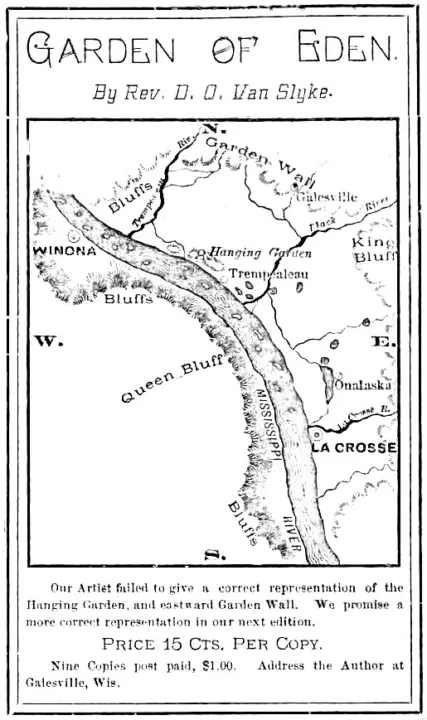
"Found at Last: the Veritable Garden of Eden" by Rev. D. O. Van Slyke is a unique exploration that combines elements of religious interpretation and geography, written in the late 19th century. This book puts forth the controversial assertion that the Garden of Eden, as described in the Bible, is located on the eastern bank of the Mississippi River between La Crosse, Wisconsin, and Winona, Minnesota. The author argues that the landscape and geographic features of this region align more closely with biblical descriptions than any other location previously proposed. In the book, Van Slyke lays out a detailed argument supporting his claim, reflecting both reverence for biblical accounts and a deep appreciation for the natural splendor of the American landscape. He meticulously describes the topography, including the rivers, bluffs, and fertile valleys, positing that this region has the necessary ecological qualities to sustain a populous civilization. He emphasizes the moral and spiritual dimensions of the area, asserting that it is a place for intellectual and moral development, echoing the idyllic characteristics of Eden. Throughout, Van Slyke invites readers to 'come and see,' encouraging exploration and personal observation of the landscapes he describes as a literal paradise on earth.
Introduction adapted from the source catalogue; source summaries may be automatically generated.
Free to read · English · 9,896 words · No account needed
MAKE TIME FOR A GOOD BOOK
On by default. Untick to stop anonymous reading totals. Each page counts after 10 seconds in view. How this works.
Anonymous counting is on unless you have switched it off.
As everything in creation was full and perfect, God wisely placed the earth in the summer solstice point of its orbit, and this continent facing the sun, so that when he placed man upon it, as to give him the benefit of harvest, and correct time, and all of which is proved by the change, God ordered, from original reckoning of time, when Israel left Egypt, Ex. 12, 2, “This month [Abib, the 7th month] shall be unto you the beginning of months, it shall be the first month of the year to you.” Thus changing the beginning of the year from mid-summer to mid-winter. The commencing of the reckoning of the day has also been changed from mid-day to midnight. That the original first month, now the 7th month, was harvest time, is proved from Lev. 23, 9-39; and that the seasons, of summer and winter, were then as now, is also proven by Gen. 1, 14, and the history of the clothing of the first pair, first aprons, then skins and furs.
The names given to the rivers and places, in connection with the original habitation of man, were naturally washed out by the flood, or their recollection continued in names of similar places on the new continent. Then, is it not somewhat remarkable that, our garden valley is in the form of a beautiful dove, or bird of paradise; and so grandly walled in as to appear as a single valley, and have a hanging garden so situated that from its height, the whole valley, the rivers, and “much water” all in plain sight.
Is it not a little strange that the Holy Land should be the counterpart of the regions around our garden, only ours, geologically, a little older, and at present, at least, vastly superior in productiveness and desirability as a home; and that so many things, in connection with and in addition to, the exact Bible description of the garden of Eden, and of the Holy Land, point to this place as the original garden; oldest, and best adapted place on earth for the commencement of human existence, and from which naturally to branch out, filling the Palestine around it; then, over the entire Eden as already described. Let me once more call your attention to the region immediately around our garden, of a section of which we have such a good view from this Heuston’s Muff, of beautiful hills and valleys, similar in appearance and extent, to the land of Palestine; which was selected by the Creator as a representation of the habitation of man on earth, in its pristine glory; a beau ideal of a country, a paradise; a region of supreme felicity and delight; “A land flowing with milk and honey;” which means susceptibility of the highest earthly enjoyments, and figure of the world to come. Such a rough, youthful country, is not naturally subject to cyclones, and disastrous storms, “but of rains,” and “green pastures;” not a land of malaria, but a land of health and happiness. Palestine was central to the habitable part of the eastern continent, and was thus, in connection wilh its other good qualities, selected for the residence of God’s chosen people, and contained many of the mountains on which God appeared to man, a very interesting chapter in the history of that country. Then, the central location of Jerusalem, “the city of the great King;” “Beautiful for situation, the joy of the whole earth, is Mount Zion;” in which was built the Holy Temple—of which God himself was architect—with its Holy of Holies, where God met the High priest, and kept up, though somewhat broken, yet, for long periods, special communication with man, thus making it a holy and God honored spot. There the Jews used to point to a stone, set as they claimed, by some miraculous power, in the precise centre of the world. But whether this was so or not, the city was for a long time the centre of attraction of the world’s commerce, and of the best form of religion.
Your reading position is saved on this browser. Take it to another device with a library code. Reading pages adapt to text, rather than matching a printed edition.
BEHIND THE BOOK
This eBook is for the use of anyone anywhere in the United States and most other parts of the world at no cost and with almost no restrictions whatsoever. You may copy it, give it away or re-use it under the terms of the Project Gutenberg License included with this eBook or online at www.gutenberg.org. If you are not located in the United States, you will have to check the laws of the country where you are located before using this eBook. Read the source licence.
The original source file, including credits and licence, is retained by this library. Request an original-format copy at no charge. Please include the book title and Project Gutenberg identifier #40051.
KEEP YOUR CURIOSITY GOING
Wilfrid Scawen Blunt
Wilfrid Scawen Blunt

E. W. (Edgar Watson) Howe

David Patterson (Spirit) Hatch

David Patterson (Spirit) Hatch

David Patterson (Spirit) Hatch