THE CLASSIC COLLECTION✦An outlaw’s diary: the CommuneCLASSIC FREE BOOKS
An outlaw’s diary: the Commune
Cécile Tormay
THE CLASSIC COLLECTION · 1901
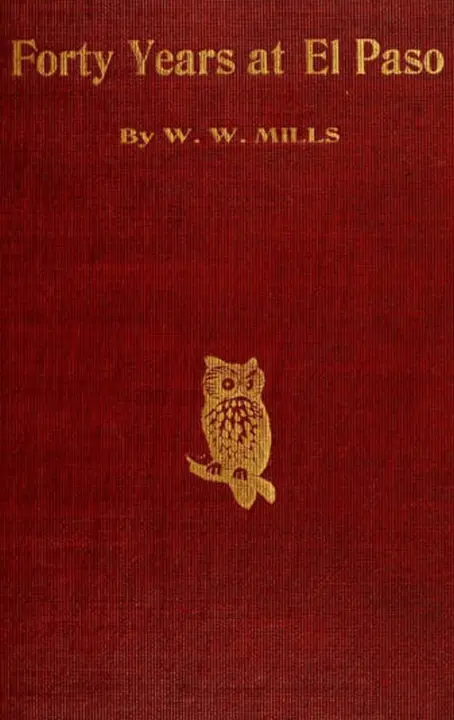
"Forty Years at El Paso, 1858-1898" by W. W. Mills is a historical account written in the late 19th century. The narrative captures Mills' personal recollections of life in El Paso, including its social, political, and military dynamics during a transformative era. The work likely centers on the author's experiences as a Union supporter in a region riddled with conflict, detailing the daily life, events, and notable figures he encountered. The opening of the book introduces the author, W. W. Mills, as he recounts his journey to El Paso in 1858, painting vivid images of the small adobe town and its predominantly Mexican populace. Mills shares his early impressions and business ventures, providing context about El Paso's geographical significance and the socio-political climate of the time. He discusses various events, including instances of violence, local politics, and the presence of military forces as tensions escalated ahead of the Civil War. Through personal anecdotes, the narrative sets the stage for a deeper exploration of the complexities of frontier life amid war and emerging societal changes.
Introduction adapted from the source catalogue; source summaries may be automatically generated.
Free to read · English · 42,014 words · No account needed
MAKE TIME FOR A GOOD BOOK
On by default. Untick to stop anonymous reading totals. Each page counts after 10 seconds in view. How this works.
Anonymous counting is on unless you have switched it off.
F. R. Diffendorffer, merchant in Juarez.
G. W. Gillock, justice of the peace and hotel-keeper; dead.
J. E. Terry, with the stage company; lives in El Paso.
Charles Music, merchant; lives in Mexico; and
Andrew Hornick, H. McWard, George Lyles, —— Tibbits, —— Milby, David Knox, Bill Conklin and Tom Miller.
There were usually about a dozen United States army officers at old Fort Bliss, now East El Paso.
The most prominent Mexican citizens in Paso del Norte (now Juarez) were:
Dr. Mariano Samaniego, Inocente Ochoa, José M. Flores, all still residing in Juarez; José M. Uranga, Jefe Politico, dead; Juan N. Zubiran, collector of customs, my partner and friend; and the venerable Ramon Ortiz, who ministered there as curate for fifty years, and died a few years since, beloved of the two races.
The Americans living at Ysleta and San Elizario before the war were: Price Cooper, Henry Corlow, Tom Collins, Henry Dexter, James McCarty, A. C. Hyde, William Claude Jones; and Fred Pierpoint, who died of hydrophobia at El Paso in 1869.
Of those named above as residing at El Paso in 1860, the following left with the retreating Texans in 1862: Crosby, Hart, the Gilletts, the Magoffins, Herbert, Merritt, O’Bannon, Morton, Cook, Skillman, Dowell, Richardson and Russ Howard. Some of the last named remained away for years and others never returned.
In their places there came soon (mostly discharged Union officers and soldiers): A. H. French, J. A. Zabriskie, G. J. Clarke, E. A. Mills, Nathan Webb, A. J. Fountain, William P. Bacon, Edmond Stein, S. C. Slade, John Evans, George Rand, Joe Shacker, Solomon Schutz, Louis Cardis, and Charles H. Howard.
Except those last named, there was but little increase in the American population of El Paso for about fifteen years.
On the second night after my arrival in El Paso I had my first experience of the manner of settling difficulties there. Samuel Schutz, still of El Paso, and one Tom Massie had had a misunderstanding about the rent of a house. My brother and I went across the river that afternoon, and on the way we met one Garver, a half-witted fellow, called “Clown,” who said he had been “fixing a canoe” at the river, and in a friendly way he advised us to return early because there would be some fun that night. We asked him what fun, and he replied: “Oh, killin’ a Dutchman!” That night, in front of the postoffice, I heard Massie say to a friend: “I have taken half a dozen drinks of straight brandy, but d—n me if I can get drunk.” I went into the postoffice and found an unusual crowd of men talking in low tones, and Mr. Schutz, in his shirt sleeves, was playing billiards with a friend. Presently Massie entered, and saying, “Mr. Schutz, you told a d—d lie,” presented a cocked pistol at that gentleman. There was no mistaking his intention. Murder was in his voice and in his face. Then there came from Mr. Schutz such a sound as I never heard before or since. It was not a shriek, or an outcry, for he did not distinctly articulate a single word. It was not exactly an expression of fear, but was more like a prolonged wail over some tragedy which had already occurred. But Schutz did the right thing, and quickly. He seized the barrel of Massie’s pistol and held it upward. Then commenced a struggle for life. Both were powerful men, and in their prime, one moved by hatred and revenge, and the other by the instinct of self-preservation. It was some seconds after they grappled before that strange sound ceased. Massie strove to bring his cocked pistol to bear on Schutz, and Schutz to move it in any other direction. Shocked and alarmed, and remembering my teaching about law and order, I stepped forward and said, “Gentlemen, would you see the man murdered?” Not a man moved. Massie finally let fall his pistol, drew a knife and drove it into Schutz’s shoulder. Schutz fled, but Massie recovered his pistol and fired two shots at him as he ran out through the front door. It was dark outside. Immediately after the shots Schutz stumbled over a water barrel and fell, and Massie, thinking him dead, crossed to Mexico in that canoe which Clown had “fixed.” Schutz was untouched by the bullets, and the knife wound was not serious.
Your reading position is saved on this browser. Take it to another device with a library code. Reading pages adapt to text, rather than matching a printed edition.
BEHIND THE BOOK
This eBook is for the use of anyone anywhere in the United States and most other parts of the world at no cost and with almost no restrictions whatsoever. You may copy it, give it away or re-use it under the terms of the Project Gutenberg License included with this eBook or online at www.gutenberg.org. If you are not located in the United States, you will have to check the laws of the country where you are located before using this eBook. Read the source licence.
The original source file, including credits and licence, is retained by this library. Request an original-format copy at no charge. Please include the book title and Project Gutenberg identifier #48691.
KEEP YOUR CURIOSITY GOING
Cécile Tormay

Moritz Busch
John L. Ransom
Frances Wright
Cécile Tormay

Mabel Potter Daggett