THE CLASSIC COLLECTION✦An outlaw’s diary: the CommuneCLASSIC FREE BOOKS
An outlaw’s diary: the Commune
Cécile Tormay
THE CLASSIC COLLECTION · 1901
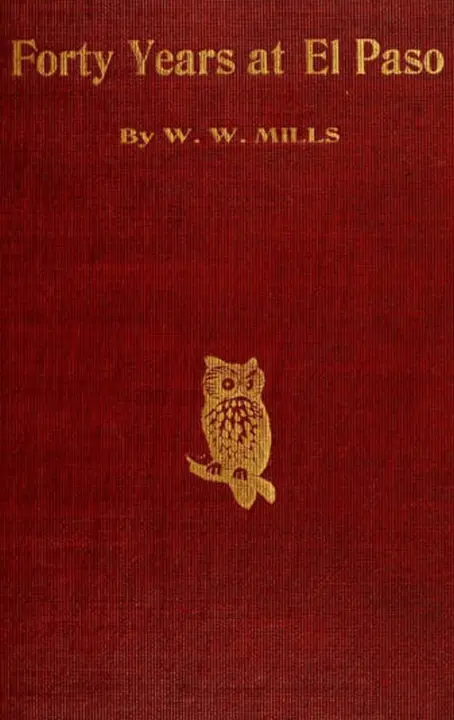
"Forty Years at El Paso, 1858-1898" by W. W. Mills is a historical account written in the late 19th century. The narrative captures Mills' personal recollections of life in El Paso, including its social, political, and military dynamics during a transformative era. The work likely centers on the author's experiences as a Union supporter in a region riddled with conflict, detailing the daily life, events, and notable figures he encountered. The opening of the book introduces the author, W. W. Mills, as he recounts his journey to El Paso in 1858, painting vivid images of the small adobe town and its predominantly Mexican populace. Mills shares his early impressions and business ventures, providing context about El Paso's geographical significance and the socio-political climate of the time. He discusses various events, including instances of violence, local politics, and the presence of military forces as tensions escalated ahead of the Civil War. Through personal anecdotes, the narrative sets the stage for a deeper exploration of the complexities of frontier life amid war and emerging societal changes.
Introduction adapted from the source catalogue; source summaries may be automatically generated.
Free to read · English · 42,014 words · No account needed
MAKE TIME FOR A GOOD BOOK
On by default. Untick to stop anonymous reading totals. Each page counts after 10 seconds in view. How this works.
Anonymous counting is on unless you have switched it off.
He had one fault. At rare intervals he would get very drunk and become wild and ride his horse into the stores and saloons of the village, firing his pistol the while, and order everybody to close up, as he desired to run the town himself. Then he would go home and sober up and come to town, pay the damages and apologize to every one and then go about his business.
As an offset to this peculiarity he would not allow any other man to play the same role, when he was around. Once, when a stranger attempted it, and everybody, including the peace officers, was terrified, Skillman was notified, and came up, sober, took away the ruffian’s arms, boxed his jaws, and notified him to leave town, which he did.
On another occasion, 1857, when my brother Anson had accused two El Paso men of counterfeiting, they plotted to assassinate him on the street, and then to swear that the killing was accidental. As they approached my brother, pretending to be very drunk, Skillman saw and understood the maneuver, and, springing to the rescue, called out: “Look out there, Mills; they are going to kill you.”
When the secession talk commenced, it was known to me and to a few others that Skillman, although his associates were nearly all Confederates, inclined strongly to the Union side; but he finally “went with his State,” and in 1864 he, with a small band of Confederates, was acting as a scout and keeping up communication between San Antonio and the Confederate colony at Juarez, Mexico, near El Paso.
General Carleton, then in command of New Mexico, decided upon the capture of Skillman and his party, and for that service he selected Capt. Albert H. French, of the California Volunteer Cavalry.
General Carleton was present at El Paso when French left on this dangerous expedition, and I KNOW that he gave French special instructions to bring Skillman in alive “if possible,” and I know the reason for this order.
French was a Boston man. He was as large and as well formed as Skillman, and, like him, was of sandy complexion, hair and beard.
Skillman and his party were near Presidio del Norte en route for Juarez when Captain French (himself unseen) discovered them and watched them go into camp (April 3, 1864).
At midnight, French, with a portion of his little command, including two citizens of San Elizario, crawled into Skillman’s camp, and, rising to their feet, called for surrender. Skillman arose, armed, and refused, when French shot him dead.
Your reading position is saved on this browser. Take it to another device with a library code. Reading pages adapt to text, rather than matching a printed edition.
BEHIND THE BOOK
This eBook is for the use of anyone anywhere in the United States and most other parts of the world at no cost and with almost no restrictions whatsoever. You may copy it, give it away or re-use it under the terms of the Project Gutenberg License included with this eBook or online at www.gutenberg.org. If you are not located in the United States, you will have to check the laws of the country where you are located before using this eBook. Read the source licence.
The original source file, including credits and licence, is retained by this library. Request an original-format copy at no charge. Please include the book title and Project Gutenberg identifier #48691.
KEEP YOUR CURIOSITY GOING
Cécile Tormay

Moritz Busch
John L. Ransom
Frances Wright
Cécile Tormay

Mabel Potter Daggett