THE CLASSIC COLLECTION✦An outlaw’s diary: the CommuneCLASSIC FREE BOOKS
An outlaw’s diary: the Commune
Cécile Tormay
THE CLASSIC COLLECTION · 1901
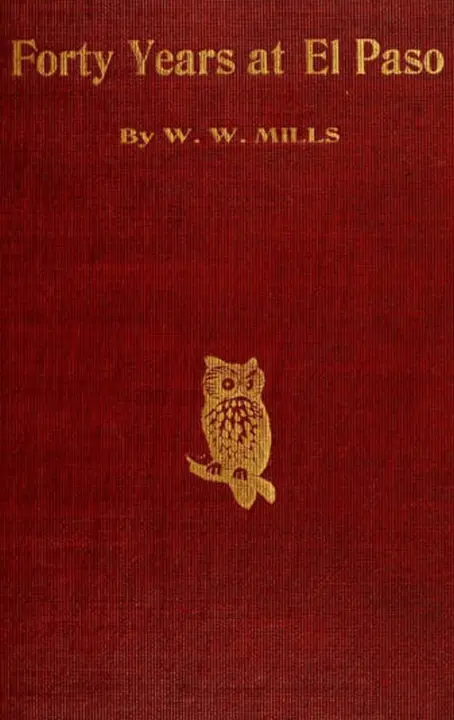
"Forty Years at El Paso, 1858-1898" by W. W. Mills is a historical account written in the late 19th century. The narrative captures Mills' personal recollections of life in El Paso, including its social, political, and military dynamics during a transformative era. The work likely centers on the author's experiences as a Union supporter in a region riddled with conflict, detailing the daily life, events, and notable figures he encountered. The opening of the book introduces the author, W. W. Mills, as he recounts his journey to El Paso in 1858, painting vivid images of the small adobe town and its predominantly Mexican populace. Mills shares his early impressions and business ventures, providing context about El Paso's geographical significance and the socio-political climate of the time. He discusses various events, including instances of violence, local politics, and the presence of military forces as tensions escalated ahead of the Civil War. Through personal anecdotes, the narrative sets the stage for a deeper exploration of the complexities of frontier life amid war and emerging societal changes.
Introduction adapted from the source catalogue; source summaries may be automatically generated.
Free to read · English · 42,014 words · No account needed
MAKE TIME FOR A GOOD BOOK
On by default. Untick to stop anonymous reading totals. Each page counts after 10 seconds in view. How this works.
Anonymous counting is on unless you have switched it off.
The Mexican population, now nearly all passed away by death or removal, were of a much better class than those who came in later with the advent of the railroads, to sell their labor—and their votes. It is but just to say, however, that votes cannot be sold unless there be purchasers, and that the purchasers have ever been of my own race.
The villages below El Paso were more prosperous then than now, because their population is agricultural and the lack of water in the river in recent times has caused great discouragement and even distress. The same was true of Juarez, Mexico, just opposite El Paso, then called Paso del Norte.
The county seat was first at San Elezario, twenty-two miles below El Paso, with fifteen hundred population, and later at Ysleta, with twelve hundred population (nearly all Mexicans), and still later at El Paso. Court proceedings and arguments to juries and political speeches were then made in the Spanish language.
Fort Bliss, garrisoned by regular United States troops, situated at the place now called East El Paso, was considered by army officers and their families as one of the most desirable posts in the whole country, and several officers who subsequently held very high rank during the Civil War had been stationed there. There was another fort, called Quitman, seventy miles below El Paso, on the river, and a chain of military posts from there to San Antonio. The nearest posts in New Mexico were Fort Fillmore, forty miles to the north, near Las Cruces, and Fort Craig, one hundred miles still further north toward Santa Fe.
As to hunting, there were at that time comparatively plenty of wild deer, turkeys, wild geese, ducks and mountain quail on the mountains and in the valley, and I got my share of them.
J. F. Crosby, then district judge, Confederate; is well known in El
Paso.
Simeon Hart, mill owner and contractor, Confederate. Died at El Paso.
Henry J. Cuniffe, merchant, Union man. Was United States Consul at
Juarez. Died at Las Cruces.
H. S. Gillett, merchant and Confederate, lives in New Mexico.
J. S. Gillett, merchant, Confederate; lives in New Mexico.
Col. Phil Herbert, lawyer, Confederate; killed in the war.
Col. James W. Magoffin, contractor, Confederate; sutler at Fort Bliss.
Died at San Antonio.
Joseph Magoffin, Confederate; served in the war; now lives in El Paso.
Sam Magoffin, Confederate; killed in the war.
Anson Mills, engineer, Union; now brigadier general, U. S. A. Lives in
Washington, D. C.
W. W. Mills, clerk, Union; served in the war; now United States Consul
at Chihuahua, Mexico.
Your reading position is saved on this browser. Take it to another device with a library code. Reading pages adapt to text, rather than matching a printed edition.
BEHIND THE BOOK
This eBook is for the use of anyone anywhere in the United States and most other parts of the world at no cost and with almost no restrictions whatsoever. You may copy it, give it away or re-use it under the terms of the Project Gutenberg License included with this eBook or online at www.gutenberg.org. If you are not located in the United States, you will have to check the laws of the country where you are located before using this eBook. Read the source licence.
The original source file, including credits and licence, is retained by this library. Request an original-format copy at no charge. Please include the book title and Project Gutenberg identifier #48691.
KEEP YOUR CURIOSITY GOING
Cécile Tormay

Moritz Busch
John L. Ransom
Frances Wright
Cécile Tormay

Mabel Potter Daggett