THE CLASSIC COLLECTION✦My diaries, being a personal narrative of events 1888-1914, Part 2 (1900-1914)CLASSIC FREE BOOKS
My diaries, being a personal narrative of events 1888-1914, Part 2 (1900-1914)
Wilfrid Scawen Blunt
THE CLASSIC COLLECTION · 1855
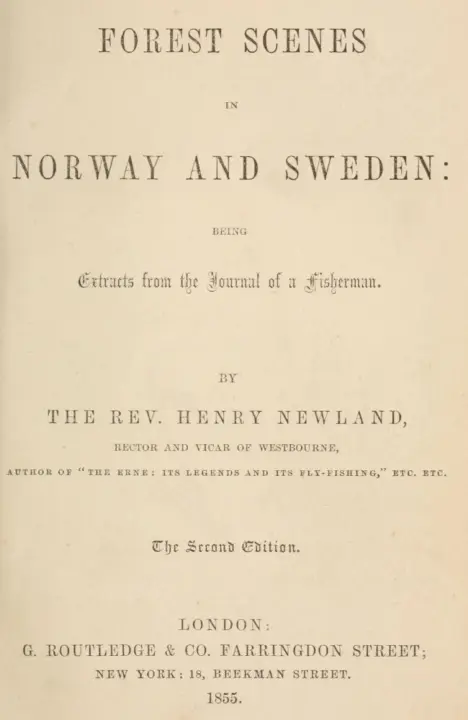
"Forest Scenes in Norway and Sweden: Being Extracts from the Journal of a Fisherman" by The Rev. Henry Newland is a collection of travel sketches written in the mid-19th century. This work intricately blends personal experiences and observations during fishing expeditions in the picturesque landscapes of Norway and Sweden. With a focus on the adventures of a clergyman and his companions, the narrative likely reveals both the beauty of the northern wilderness and the joys of fishing amidst various characters encountered along the way. The opening of the book introduces the author’s intentions and the whimsical tone he adopts throughout the journey. Initially, he addresses his audience, discussing the balance between work and leisure while hinting at the authenticity of the experiences documented. As he prepares for the expedition, readers meet the Parson and the Captain, who engage in lively discussions about their packing and plans. The Parson's methodical approach includes gathering fishing gear and necessary provisions, while playful banter reveals their personalities and foreshadows the misadventures to come. Overall, the opening sets the stage for a humorous yet informative exploration of the Scandinavian wilderness, preparing the reader for both the practical aspects of fishing and the charm of the local landscapes and cultures.
Introduction adapted from the source catalogue; source summaries may be automatically generated.
Free to read · English · 155,541 words · No account needed
MAKE TIME FOR A GOOD BOOK
On by default. Untick to stop anonymous reading totals. Each page counts after 10 seconds in view. How this works.
Anonymous counting is on unless you have switched it off.
These last words were addressed to the Parson, who having been sent forward on the previous summer to spy out this Land of Promise, had volunteered to act as guide.
“If there is one thing more puzzling than another,” said he, “it is this rectangular arrangement of streets. I wish those utilitarian Yankees, who claim the invention, had it all to themselves. It is fit only for them.”
“The English of that is, you have lost your way,” said the Captain.
“No, not lost my way,” said the Parson, who piqued himself on his organ of locality; “but the fact is, I cannot remember, in the dark, which of all these rectangular crossings is the right one. I wish I could see that great lump of a church they are so proud of. I say, Birger, knock up some one, and ask ‘if Monsieur Tonson lodges there.’”
“Not I,” said Birger. “You are the guide; besides, they must be coming ashore, some of them, from the steamer by this time; and, in good truth, here are a couple of them.”
This couple, much to their relief, turned out to be Ullitz and Torkel, who pointed out the road at once, but looked rather grave at the Captain’s pipe, which was now sending forth a bright red glow through the darkness, and occasionally illuminating a budding moustache which he was cultivating on the strength of being a military man.
Had the acquaintance been of longer standing, they possibly would have spoken out; as it was, they contented themselves with a muttered dialogue in their own language, in which the Parson soon made out the words, “Tobacco” and “Police,” both of which being modern inventions, bear nearly the same name in every language in Europe.
“By the by, I had forgotten that,” said he. “Captain, I am sorry to put your pipe out; but the fact is, you must not smoke.”
“Not smoke! why not?”
“For fear you should set fire to the town,” said the Parson,—“that is all. You need not laugh; the law is very strict about it, I can tell you.”
The Captain did burst out laughing; and, in truth, where they were standing, it seemed a ridiculous law enough, though it is pretty general both in Norway and Sweden. The street was one of unusual width, being one expanse of sand from side to side, and the houses, none of which boasted a storey above the ground floor, seemed absurdly distant,—almost indistinct in the darkness.
Your reading position is saved on this browser. Take it to another device with a library code. Reading pages adapt to text, rather than matching a printed edition.
BEHIND THE BOOK
This eBook is for the use of anyone anywhere in the United States and most other parts of the world at no cost and with almost no restrictions whatsoever. You may copy it, give it away or re-use it under the terms of the Project Gutenberg License included with this eBook or online at www.gutenberg.org. If you are not located in the United States, you will have to check the laws of the country where you are located before using this eBook. Read the source licence.
The original source file, including credits and licence, is retained by this library. Request an original-format copy at no charge. Please include the book title and Project Gutenberg identifier #67401.
KEEP YOUR CURIOSITY GOING
Wilfrid Scawen Blunt
Wilfrid Scawen Blunt

E. W. (Edgar Watson) Howe
Francis Greenleaf Allinson & Anne C. E. (Anne Crosby Emery) Allinson
Cyrenus Cole

John Martineau