THE CLASSIC COLLECTION✦My diaries, being a personal narrative of events 1888-1914, Part 2 (1900-1914)CLASSIC FREE BOOKS
My diaries, being a personal narrative of events 1888-1914, Part 2 (1900-1914)
Wilfrid Scawen Blunt
THE CLASSIC COLLECTION · 1855
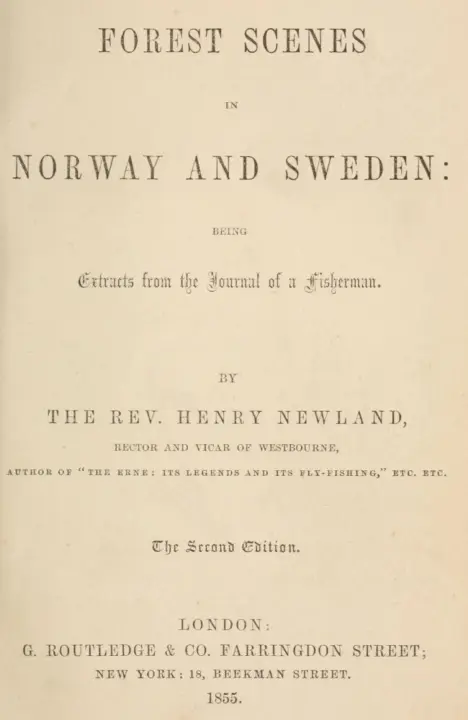
"Forest Scenes in Norway and Sweden: Being Extracts from the Journal of a Fisherman" by The Rev. Henry Newland is a collection of travel sketches written in the mid-19th century. This work intricately blends personal experiences and observations during fishing expeditions in the picturesque landscapes of Norway and Sweden. With a focus on the adventures of a clergyman and his companions, the narrative likely reveals both the beauty of the northern wilderness and the joys of fishing amidst various characters encountered along the way. The opening of the book introduces the author’s intentions and the whimsical tone he adopts throughout the journey. Initially, he addresses his audience, discussing the balance between work and leisure while hinting at the authenticity of the experiences documented. As he prepares for the expedition, readers meet the Parson and the Captain, who engage in lively discussions about their packing and plans. The Parson's methodical approach includes gathering fishing gear and necessary provisions, while playful banter reveals their personalities and foreshadows the misadventures to come. Overall, the opening sets the stage for a humorous yet informative exploration of the Scandinavian wilderness, preparing the reader for both the practical aspects of fishing and the charm of the local landscapes and cultures.
Introduction adapted from the source catalogue; source summaries may be automatically generated.
Free to read · English · 155,541 words · No account needed
MAKE TIME FOR A GOOD BOOK
On by default. Untick to stop anonymous reading totals. Each page counts after 10 seconds in view. How this works.
Anonymous counting is on unless you have switched it off.
[49] It must be remembered that the letter o, in Swedish, is pronounced like our oo, and that the g before ä e i ö, as well as the final g, is pronounced like the English y; the word “Modige,” therefore, will be pronounced very like the English word “Moodie.”
[50] Rubus Chamœmorus; called in the country, Möltebär.
[51] Baldur’s Eye-brow—Anthemis Cotula.—LINN.
[52] The Puritan Abbott, Archbishop of Canterbury, got into great trouble from his sporting propensities. One day, as he was shooting with Lord de le Zouch, at Branshill Park, he shot a keeper. According to canon law, a clergyman killing a man becomes, from that time forward, incapable of performing any clerical function; and three Bishops elect refused consecration at his hand,—“Not,” as they said, “out of enmity or superstition, but to be wary that they might not be attainted with the contagion of his scandal and uncanonical condition.” He was re-instated by a committee of Bishops, appointed for the purpose, but never entirely recovered his position.
[53] According to Scandinavian mythology, the sacred ash of Yggdrasil, which typifies the Vital Principle of the world, has seated on its topmost boughs an eagle, bearing perched between his eyes a falcon,—emblematic of Energy and Activity.
[54] According to the Prose Edda, the gods had originally no poetry in their souls. The mead of Poetic Inspiration was in the keeping of the giant Suttung, who entrusted it to his daughter, Gunlauth. Odin made love to her,—obtained possession of the mead, and deserted her. He had, however, the grace to be ashamed of himself, for these are the words of the Hávamál, in which he evidently alludes to this not very creditable passage in his life:
“Gunlauth gave me,
On a golden chair seated,
A draught of mead delicious;
But the return was evil
Which she experienced,—
With all her faithfulness—
With all her deep love!
“A holy ring oath
I mind me gave Odin,—
Now, who can trust him?
Suttung is cheated—
His mead is stolen—
Gunlauth is weeping!”
[55] A Norwegian slang expression, for “early rising.”
[56] There is a beautiful superstition—if it is not a real religious truth—in Norway, that those we have loved best on earth become our unseen guardians, and follow us always, to warn us of danger.
“Then shall brethren be
Each other’s bane,
And sister’s children rend
The ties of kin.
“Hard will be the age,
And harlotry prevail,—
An axe-age, a sword-age—
Shields oft cleft in twain,—
A storm-age, a wolf-age,
Ere earth shall meet its doom.”
The Völuspà.
Your reading position is saved on this browser. Take it to another device with a library code. Reading pages adapt to text, rather than matching a printed edition.
BEHIND THE BOOK
This eBook is for the use of anyone anywhere in the United States and most other parts of the world at no cost and with almost no restrictions whatsoever. You may copy it, give it away or re-use it under the terms of the Project Gutenberg License included with this eBook or online at www.gutenberg.org. If you are not located in the United States, you will have to check the laws of the country where you are located before using this eBook. Read the source licence.
The original source file, including credits and licence, is retained by this library. Request an original-format copy at no charge. Please include the book title and Project Gutenberg identifier #67401.
KEEP YOUR CURIOSITY GOING
Wilfrid Scawen Blunt
Wilfrid Scawen Blunt

E. W. (Edgar Watson) Howe
Francis Greenleaf Allinson & Anne C. E. (Anne Crosby Emery) Allinson
Cyrenus Cole

John Martineau