THE CLASSIC COLLECTION✦My diaries, being a personal narrative of events 1888-1914, Part 2 (1900-1914)CLASSIC FREE BOOKS
My diaries, being a personal narrative of events 1888-1914, Part 2 (1900-1914)
Wilfrid Scawen Blunt
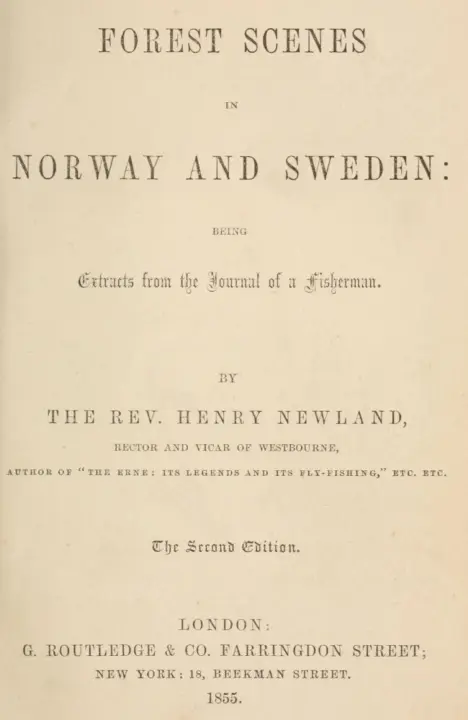
THE CLASSIC COLLECTION · 1855
"Forest Scenes in Norway and Sweden: Being Extracts from the Journal of a Fisherman" by The Rev. Henry Newland is a collection of travel sketches written in the mid-19th century. This work intricately blends personal experiences and observations during fishing expeditions in the picturesque landscapes of Norway and Sweden. With a focus on the adventures of a clergyman and his companions, the narrative likely reveals both the beauty of the northern wilderness and the joys of fishing amidst various characters encountered along the way. The opening of the book introduces the author’s intentions and the whimsical tone he adopts throughout the journey. Initially, he addresses his audience, discussing the balance between work and leisure while hinting at the authenticity of the experiences documented. As he prepares for the expedition, readers meet the Parson and the Captain, who engage in lively discussions about their packing and plans. The Parson's methodical approach includes gathering fishing gear and necessary provisions, while playful banter reveals their personalities and foreshadows the misadventures to come. Overall, the opening sets the stage for a humorous yet informative exploration of the Scandinavian wilderness, preparing the reader for both the practical aspects of fishing and the charm of the local landscapes and cultures.
Introduction adapted from the source catalogue; source summaries may be automatically generated.
Free to read · English · 155,541 words · No account needed
MAKE TIME FOR A GOOD BOOK
On by default. Untick to stop anonymous reading totals. Each page counts after 10 seconds in view. How this works.
Anonymous counting is on unless you have switched it off.
‘If my bride may not in peace remain,
I will go and unto the king complain.’
‘Just as you like,’ quoth John.
Early next morn, when the birds ’gan to sing,
Sir Lavé is off to complain to the king;—
‘I will go, too!’ quoth John.
‘I was betrothed but yesterday,—
Sir John has taken my bride away!’
‘Yes, so I have!’ quoth John.
‘If that the maiden to both is dear,
It must be settled at point of spear.’
‘I’m very willing!’ quoth John.
As soon as the morrow’s sun was bright,
Came all the knights to see the fight;—
‘Here am I!’ quoth John.
The two were mounted, and at the first round The knees of Sir John’s horse touched the ground. ‘Now help me, Heaven!’ quoth John.
Once more, and in the second round
Sir Lavé lies upon the ground;—
‘There let him lie,’ quoth John.
Sir John he rode to his hall in state,
And his maiden met him at the gate;—
‘Now thou art mine,’ quoth John.
Thus was Sir John made happy for life, And the maiden became his wedded wife. ‘I knew I should have her,’ quoth John. ‘Put on helmets of gold, to follow Sir John.’”
“Come, come! Jan!” growled old Torgensen, “hold your saucy tongue; Svensen was a better man than you will ever be in a year of Sundays. And you, you grinning flirts,”—to the servant-girls, with whom Master Jan was an especial favourite, and upon whom the application was by no means lost—“get along with you, and mind your own business,—as if you had nothing to do, on such a morning as this, but to listen to such fooleries! Be off with you, I say!”
In the meanwhile the Parson and Birger,—who, by the way, hardly recognised each other in their gala habits, for the one was habited, in honour of the occasion, in the black dress of an English clergyman, while the other, with his sword clinking by his side, blazed in all the blue and yellow splendour of the Swedish guard,—took up their old position at the lich gate of the church; one as before balancing on the stocks, the other astride on the dwarf wall, glad to be out of the din of preparation. It was not a happy day for any of them, for it was the last day of the expedition, which every member of it had enjoyed so thoroughly;—Birger’s leave of absence was running to an end, and the two Englishmen had taken passage with young Torgensen to the Haabet. They were to sail—so Torgensen said—that night; but, as it was quite certain that, before that time, the whole crew would be drunk, in honour of their young mistress, this probably meant to-morrow. Still, to-morrow was to be the final break-up of the party; and Tom had been philosophizing, with tears in his eyes, on the transitory nature of human pleasures; and Torkel, bridegroom as he was, would willingly have postponed his wedding if he could have prolonged the expedition,—at least, so Lota had told him the evening before, and he did not look as if he was speaking the truth when he denied it.
Your reading position is saved on this browser. Take it to another device with a library code. Reading pages adapt to text, rather than matching a printed edition.
BEHIND THE BOOK
This eBook is for the use of anyone anywhere in the United States and most other parts of the world at no cost and with almost no restrictions whatsoever. You may copy it, give it away or re-use it under the terms of the Project Gutenberg License included with this eBook or online at www.gutenberg.org. If you are not located in the United States, you will have to check the laws of the country where you are located before using this eBook. Read the source licence.
The original source file, including credits and licence, is retained by this library. Request an original-format copy at no charge. Please include the book title and Project Gutenberg identifier #67401.
KEEP YOUR CURIOSITY GOING
Wilfrid Scawen Blunt
Wilfrid Scawen Blunt

E. W. (Edgar Watson) Howe
Francis Greenleaf Allinson & Anne C. E. (Anne Crosby Emery) Allinson
Cyrenus Cole

John Martineau