THE CLASSIC COLLECTION✦My diaries, being a personal narrative of events 1888-1914, Part 2 (1900-1914)CLASSIC FREE BOOKS
My diaries, being a personal narrative of events 1888-1914, Part 2 (1900-1914)
Wilfrid Scawen Blunt
THE CLASSIC COLLECTION · 1855
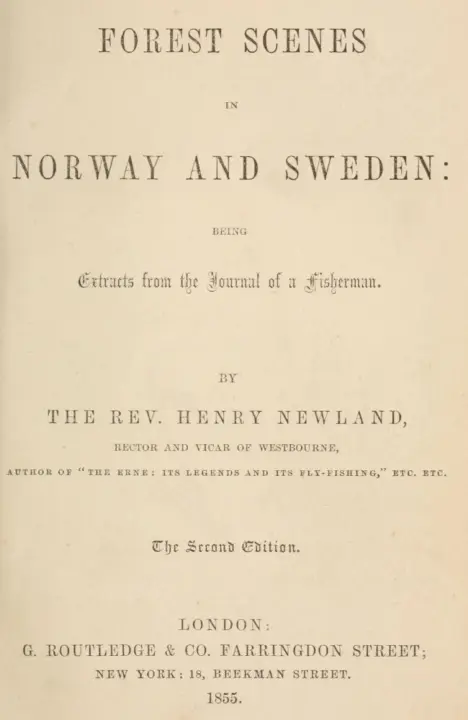
"Forest Scenes in Norway and Sweden: Being Extracts from the Journal of a Fisherman" by The Rev. Henry Newland is a collection of travel sketches written in the mid-19th century. This work intricately blends personal experiences and observations during fishing expeditions in the picturesque landscapes of Norway and Sweden. With a focus on the adventures of a clergyman and his companions, the narrative likely reveals both the beauty of the northern wilderness and the joys of fishing amidst various characters encountered along the way. The opening of the book introduces the author’s intentions and the whimsical tone he adopts throughout the journey. Initially, he addresses his audience, discussing the balance between work and leisure while hinting at the authenticity of the experiences documented. As he prepares for the expedition, readers meet the Parson and the Captain, who engage in lively discussions about their packing and plans. The Parson's methodical approach includes gathering fishing gear and necessary provisions, while playful banter reveals their personalities and foreshadows the misadventures to come. Overall, the opening sets the stage for a humorous yet informative exploration of the Scandinavian wilderness, preparing the reader for both the practical aspects of fishing and the charm of the local landscapes and cultures.
Introduction adapted from the source catalogue; source summaries may be automatically generated.
Free to read · English · 155,541 words · No account needed
MAKE TIME FOR A GOOD BOOK
On by default. Untick to stop anonymous reading totals. Each page counts after 10 seconds in view. How this works.
Anonymous counting is on unless you have switched it off.
“No,” said the Parson, solemnly, “no one can.”
“You see,” said Torkel, “the whole question hinges on the fact whether Nilssen was damned or not; now he certainly did take us in about the fish—we were obliged to throw away half of it. I should like very much to have your opinion on the subject.”
“Why,” said the Parson, gravely, “will you take upon yourself to say, on your conscience, as a Christian man, that there was no potato-haulm in the wash from which your brandy was distilled?”
Torkel laughed, and rubbed his hands at the recollection. “No,” said he, “that I will not; I do not think the old scoundrel made much by us, after all.”
“Well, if that is the case, I do not think, if I were you, I would be too hard upon poor Nilssen about the next world. But you ought to be able to judge for yourself whether the laager was a ghost-house or not; what became of it?”
“O, there it is still,” said Torkel. “I have slept in it often myself since, and no harm has happened from it. But all that hill-country is a terrible place. Do you know, the Evil One once leaped over the Tind Sö, where it is four miles across? He did, indeed; I have seen the prints of his footsteps with my own eyes—and a very curious thing it is, that one foot is bigger than the other. Our Kyrkesonger says it is to mark the difference between mortal and venial sins.”
“I am afraid your Kyrkesonger will never rise to the rank of Candidatus,” said the Parson, “if he does not get up his theology a little better. Is not this the place where your witches meet?”
“It is not far from it; and it is generally supposed that it was in hurrying away from one of these meetings, which was suddenly dispersed by some one having accidentally named a holy name, that the Devil left the mark of his feet on the shores of the Tind Sö; but the actual place of meeting is the top of Gousta Fjeld. The ridge of the mountain is so narrow that you may sit astride on it, with a leg on each side in the air, and no resting-place under either foot for a thousand fathoms. On this ridge the Devil sits playing on the bagpipe, while the witches dance the polska round him in the air. They come from all parts of the country, riding upon the skyts-horse, which looks like a flying cow, and carrying with them all the children they can catch, in order to enlist them in the Devil’s service; for each witch has a needle, by which she unlocks the sides of the houses, and makes an opening, if she likes, big enough for a carriage and horses to pass through; and after she has passed, she locks them up so that no one can know where she has been. When she arrives at the convent—so the assembly is called,—she presents to the Devil all those children whom she has brought with her: she cannot force the children to take service with him,—some refuse, and the witches are obliged to carry them back again. These are good and holy people ever afterwards; but most of them do enter the Devil’s service, for though he is bound down with a chain, which he has always worn ever since our Lord came upon earth, yet he can make himself look so fine and so glorious that very few of them like to say ‘no,’ and to go back to their homes through the dark night. If they once say ‘yes,’ he gives them a silver dollar each, and marks them, by biting the crown of their heads; and then they are taught to curse all that is holy—the Heaven, and the earth, and the fruits of the field, and the birds of the air,—all except the magpie, for that is the Devil’s own peculiar favourite. And then the witches make them a mess of rö-gröd, with corn that has been stolen. They have a way of their own for stealing corn: they put a sack to the roof of the granary as they fly past, and say ‘Corn draw corn, and straw draw straw,’ and then all the corn flies up into their sacks, and the straw remains behind. I know this to be true, for I have lost lispund after lispund myself that way. I had a girl in my service once, who was a witch, and I lost as much as three tonne of corn, and a great many things besides, while she was with me. But she vanished one night and has never been heard of since, and with her a great scoundrel, who had lately come into our parts, whom she called her lover,—but the people said he was the Devil in disguise.”
Your reading position is saved on this browser. Take it to another device with a library code. Reading pages adapt to text, rather than matching a printed edition.
BEHIND THE BOOK
This eBook is for the use of anyone anywhere in the United States and most other parts of the world at no cost and with almost no restrictions whatsoever. You may copy it, give it away or re-use it under the terms of the Project Gutenberg License included with this eBook or online at www.gutenberg.org. If you are not located in the United States, you will have to check the laws of the country where you are located before using this eBook. Read the source licence.
The original source file, including credits and licence, is retained by this library. Request an original-format copy at no charge. Please include the book title and Project Gutenberg identifier #67401.
KEEP YOUR CURIOSITY GOING
Wilfrid Scawen Blunt
Wilfrid Scawen Blunt

E. W. (Edgar Watson) Howe
Francis Greenleaf Allinson & Anne C. E. (Anne Crosby Emery) Allinson
Cyrenus Cole

John Martineau