THE CLASSIC COLLECTION✦My diaries, being a personal narrative of events 1888-1914, Part 2 (1900-1914)CLASSIC FREE BOOKS
My diaries, being a personal narrative of events 1888-1914, Part 2 (1900-1914)
Wilfrid Scawen Blunt
THE CLASSIC COLLECTION · 1855
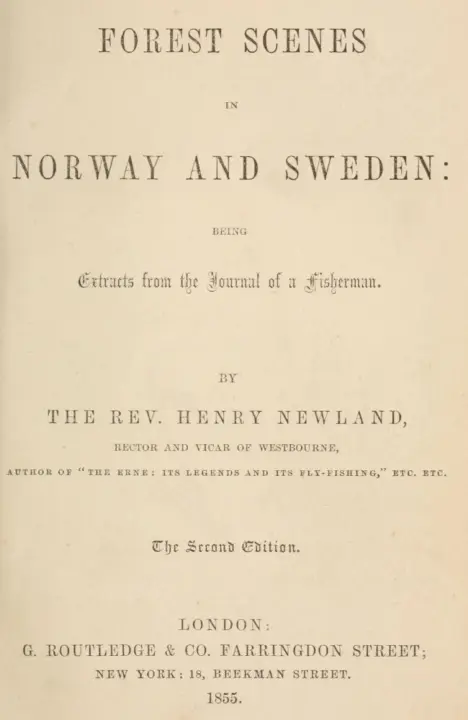
"Forest Scenes in Norway and Sweden: Being Extracts from the Journal of a Fisherman" by The Rev. Henry Newland is a collection of travel sketches written in the mid-19th century. This work intricately blends personal experiences and observations during fishing expeditions in the picturesque landscapes of Norway and Sweden. With a focus on the adventures of a clergyman and his companions, the narrative likely reveals both the beauty of the northern wilderness and the joys of fishing amidst various characters encountered along the way. The opening of the book introduces the author’s intentions and the whimsical tone he adopts throughout the journey. Initially, he addresses his audience, discussing the balance between work and leisure while hinting at the authenticity of the experiences documented. As he prepares for the expedition, readers meet the Parson and the Captain, who engage in lively discussions about their packing and plans. The Parson's methodical approach includes gathering fishing gear and necessary provisions, while playful banter reveals their personalities and foreshadows the misadventures to come. Overall, the opening sets the stage for a humorous yet informative exploration of the Scandinavian wilderness, preparing the reader for both the practical aspects of fishing and the charm of the local landscapes and cultures.
Introduction adapted from the source catalogue; source summaries may be automatically generated.
Free to read · English · 155,541 words · No account needed
MAKE TIME FOR A GOOD BOOK
On by default. Untick to stop anonymous reading totals. Each page counts after 10 seconds in view. How this works.
Anonymous counting is on unless you have switched it off.
“O, that goes for nothing in Sweden,” said the Captain, laughing; “there are plenty of cases in point. I have no doubt Birger is quite right.”
“Well, if you come to scandalising national divinities,” retorted Birger, “I am sure that story about Endymion was never cleared up very satisfactorily.”
“Clear up your own story, at all events, and place the oxen in any relationship to the maiden goddess which you may think best suited to her fair fame.”
“Then I will call them what the Edda calls them,” said Birger, gallantly, “her sons, and never sully the fair fame of the maiden Gefjon either. The whole is an allegory. Sweden achieved the sea-path, or inland navigation by the labour of her own sons, and that is what the old Skald Bragi means when he likens them to oxen, and says—
“‘Four heads and eight eyes bearing,
While hot sweat trickled down them,
The oxen dragged the reft mass
That formed this winsome island.’
And now Gefjon and her sturdy sons have been at work again. The whole south of Sweden is an island now, and it is this canal from the Cattegat to the Baltic that makes it so.”
“Well, so it is; and though it is a long while since the days of the Goddess Gefjon, or even of good Bishop Brask, the work is complete at last, and a very creditable work it is. I think, by-the-way, that we English had something to do with it.”
“England had a hand, and a very considerable one, in the other end of it,” said Birger, “but these locks are home manufacture, and the thing really has answered very well. See what a trade it has opened with the Wener only, which was the original plan; the communication with the Baltic being a sort of after-thought of the Ostergöthlanders, carried out by Count Platen. This part of the canal, which was opened in 1800, has made four of our inland counties, Wenersborglan, Mariestadslan, Carlstadslan, and Orebrö, into so many maritime states; and now the other end has done the same for Jonköping and Linköping. In national wealth, it has paid a dozen times over. There is no one who has ever lived, since the days of Oxenstjerna, to whom we owe so much as we do to Count Platen. In the very heat of the war—that is to say, in 1808—he conceived the idea of prolonging the water communication to the Baltic. He went over to England to inspect, with his own eyes, the Caledonian canal. He engaged Telford, returned to Sweden, and, within two months, sent in his plans, with their specification and estimates, which, strange to say, have not been exceeded in the execution. It is this old part of the canal, however, which is, at all events, the most showy job; here are two miles of solid rock cut through, and, as you see, these falls are pretty high—not less than a hundred and twenty feet of them, besides the rapids,—they require, therefore, a good many locks; in fact, as you see, it looks more like a staircase than anything else.”
Your reading position is saved on this browser. Take it to another device with a library code. Reading pages adapt to text, rather than matching a printed edition.
BEHIND THE BOOK
This eBook is for the use of anyone anywhere in the United States and most other parts of the world at no cost and with almost no restrictions whatsoever. You may copy it, give it away or re-use it under the terms of the Project Gutenberg License included with this eBook or online at www.gutenberg.org. If you are not located in the United States, you will have to check the laws of the country where you are located before using this eBook. Read the source licence.
The original source file, including credits and licence, is retained by this library. Request an original-format copy at no charge. Please include the book title and Project Gutenberg identifier #67401.
KEEP YOUR CURIOSITY GOING
Wilfrid Scawen Blunt
Wilfrid Scawen Blunt

E. W. (Edgar Watson) Howe
Francis Greenleaf Allinson & Anne C. E. (Anne Crosby Emery) Allinson
Cyrenus Cole

John Martineau