THE CLASSIC COLLECTION✦My diaries, being a personal narrative of events 1888-1914, Part 2 (1900-1914)CLASSIC FREE BOOKS
My diaries, being a personal narrative of events 1888-1914, Part 2 (1900-1914)
Wilfrid Scawen Blunt
THE CLASSIC COLLECTION · 1855
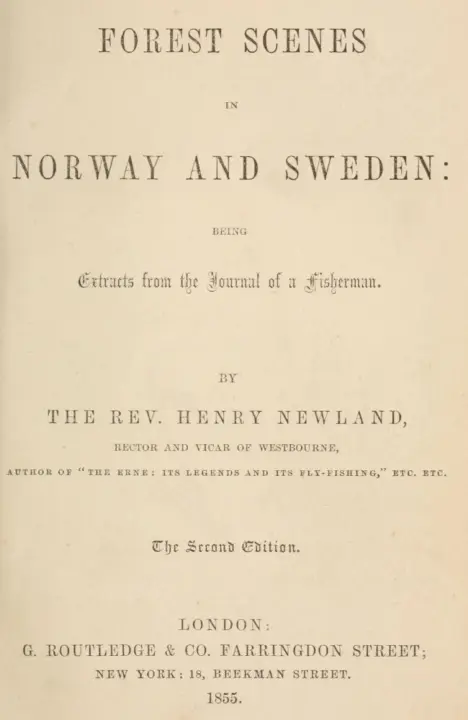
"Forest Scenes in Norway and Sweden: Being Extracts from the Journal of a Fisherman" by The Rev. Henry Newland is a collection of travel sketches written in the mid-19th century. This work intricately blends personal experiences and observations during fishing expeditions in the picturesque landscapes of Norway and Sweden. With a focus on the adventures of a clergyman and his companions, the narrative likely reveals both the beauty of the northern wilderness and the joys of fishing amidst various characters encountered along the way. The opening of the book introduces the author’s intentions and the whimsical tone he adopts throughout the journey. Initially, he addresses his audience, discussing the balance between work and leisure while hinting at the authenticity of the experiences documented. As he prepares for the expedition, readers meet the Parson and the Captain, who engage in lively discussions about their packing and plans. The Parson's methodical approach includes gathering fishing gear and necessary provisions, while playful banter reveals their personalities and foreshadows the misadventures to come. Overall, the opening sets the stage for a humorous yet informative exploration of the Scandinavian wilderness, preparing the reader for both the practical aspects of fishing and the charm of the local landscapes and cultures.
Introduction adapted from the source catalogue; source summaries may be automatically generated.
Free to read · English · 155,541 words · No account needed
MAKE TIME FOR A GOOD BOOK
On by default. Untick to stop anonymous reading totals. Each page counts after 10 seconds in view. How this works.
Anonymous counting is on unless you have switched it off.
A grand place was that homestead, which, hidden by a projecting point, and occupying a secluded valley of its own, had hitherto escaped their observation,—a good, snug, wealthy farm it really was, even as compared to others in the country; but in Norway, so much cover is always wanted; and building—at least timber building—is so cheap, that moderate-sized farm-houses, with their appurtenances, are little villages; and the house itself looks always larger than it is, as an habitation, because the whole upper storey, frequently called the rigging loft, is invariably used as a store-room for their provisions, and hides, and wool, and flax, and apples, and sometimes corn, in the winter, and not unfrequently as a ball-room, when they have eaten out sufficient space in it.
The house, like all the rest, a wooden building with a planked roof and gabled ends, was unusually painted. Torgensen, in his youth, had himself commanded the Haabet, and had traded in her for provisions and corn along the coast of Scånia, and from it had imported Scånian fashions. Instead of the deep, dull red, which harmonizes so well with the tints of the country, he had painted his house in figures, blue, and yellow, and white, and black, which had a singular, but, upon the whole, a not unpleasant effect. Texts of Scripture in rough black letter, and dates, and monograms of himself, and wife, and children, were written under every window and every gable; and the barge-boards and ridge timber-ends, were carved as elaborately and grotesquely as those of the church.
There was but little delicacy in accepting Torgensen’s hospitality; his house was large enough for a barrack, and its doors were as wide open as those of an inn. A large room, that could not exactly be called kitchen, hall, workshop, or dining-room, but served equally for any one of these offices (and occasionally for a ball-room also, when the store-room was too full to be used in that capacity), was open to all comers; half-a-dozen boards, as thick almost as baulks of timber, and placed upon trestles that might have supported the house, formed the principal table; two great chairs, like thrones, elaborately carved, and looking as if they required a steam-engine to move them, stood on a sort of dais;—these are not uncommon pieces of furniture in old houses; they are called grandfather and grandmother chairs, and are the seats of honour, though very seldom occupied at all, unless the master and mistress of the house are old enough to have lost their active habits. The more ordinary seats were substantial benches, with or without backs, and three-legged stools. Here and there was a great chest, a sort of expense magazine for stowing away the wool, and the flax, and the skins, which were in process of being converted into linen, wadmaal, or shoes, by the farm servants. Over these a series of shelves, like an ancient buffet, containing pewter drinking-vessels, large brass embossed plates with the bunch of grapes from the promised land or the expulsion of Adam and Eve glittering upon them in all the brightness of constant polish. Over these, again, were slung a row of copper cauldrons and pots; and on the opposite side a chest of drawers, carved and painted with grotesque figures, was ornamented with heaps of blue and white dishes, and pewter dinner-plates, and rows of brass candlesticks.
Your reading position is saved on this browser. Take it to another device with a library code. Reading pages adapt to text, rather than matching a printed edition.
BEHIND THE BOOK
This eBook is for the use of anyone anywhere in the United States and most other parts of the world at no cost and with almost no restrictions whatsoever. You may copy it, give it away or re-use it under the terms of the Project Gutenberg License included with this eBook or online at www.gutenberg.org. If you are not located in the United States, you will have to check the laws of the country where you are located before using this eBook. Read the source licence.
The original source file, including credits and licence, is retained by this library. Request an original-format copy at no charge. Please include the book title and Project Gutenberg identifier #67401.
KEEP YOUR CURIOSITY GOING
Wilfrid Scawen Blunt
Wilfrid Scawen Blunt

E. W. (Edgar Watson) Howe
Francis Greenleaf Allinson & Anne C. E. (Anne Crosby Emery) Allinson
Cyrenus Cole

John Martineau