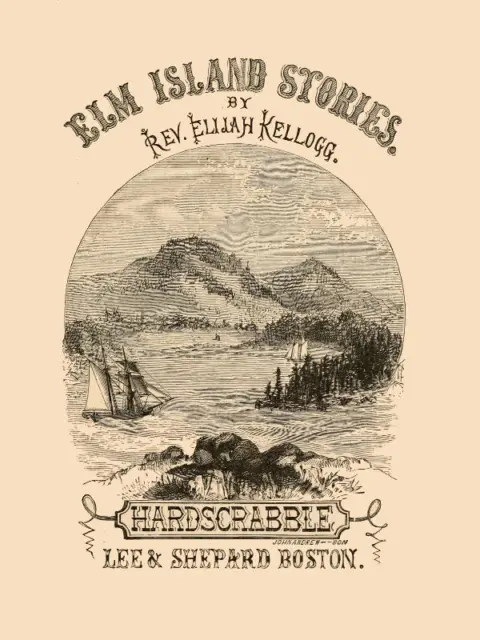
The Hard-Scrabble of Elm Island
Elijah Kellogg
THE CLASSIC COLLECTION · 1877
"Forest Glen; or, The Mohawk's Friendship" by Elijah Kellogg is a historical novel written in the late 19th century. The book explores the intense and perilous life of frontier settlers during the brutal Indian wars, focusing on themes of survival, bravery, and inter-race relationships. The narrative likely features characters like the settlers and a Mohawk Indian, whose friendship serves as a central point of tension and conflict amid the backdrop of war and cultural exchange. At the start of the novel, the scene is set in the quiet yet ominous valley of Wolf Run, where the settlers are grappling with the threat of impending Indian attacks. As summer transitions to autumn, a sense of foreboding looms, with the settlers—and particularly the children—training for battles that they may soon have to fight. The opening introduces the realities of life on the frontier: the settlers' preparations for defense, the mixed sentiments of fear and determination, and the daily struggles of survival amid an environment filled with both natural beauty and danger. This sets the stage for the tale of war, friendship, and courage that unfolds as the settlers face both external and internal conflicts.
Introduction adapted from the source catalogue; source summaries may be automatically generated.
Free to read · English · 64,187 words · No account needed
MAKE TIME FOR A GOOD BOOK
On by default. Untick to stop anonymous reading totals. Each page counts after 10 seconds in view. How this works.
Anonymous counting is on unless you have switched it off.
Once across, they crept along beneath the high bank near to where the settlers were posted, and, concealing themselves among the drift-wood, lay unnoticed till the Indians, returning by degrees, had obtained such positions as to command the ford.
There was now no such thing as sending them home; and well they knew it, and no longer hesitated to show themselves and take part in the conflict.
Great was the alarm of the parents at home when Sam and Tony did not make their appearance at the breakfast-table, and when they found their beds had not been slept in.
Their fears were by no means allayed when (after the most searching inquiries of the other boys, mingled with threats of summary punishment if they refused to tell) they ascertained, partly from Ike Proctor and partly from Archie Crawford, where they had gone.
"Did ever anybody in this world see such children?" said Mrs. Sumerford. "That's what comes of letting them have rifles, tomahawks, and scalping-knives, and bringing them up like wolves, as Mr. Honeywood says."
"It's a sair thing, nae doubt, to hae the weans sae greedy for fight when they've nae come till't; still I ken there's nae knowledge mair needfu' than the knowledge o' fighting in these waefu' times, for it's just kill or be kilt," said Mrs. Stewart, who took a more practical view of the matter.
It was a source of great mortification to Sam Sumerford, that he had never yet been able to kill an Indian, although Tony had killed two; and he was prepared to incur any risk to accomplish that feat; and, after long waiting, the opportunity was presented.
The Indians are extremely dexterous in carrying away their dead, and even during the time of action will generally contrive to remove or conceal their bodies.
Tony saw a savage conveying away the body of another who had been shot by Holdness. Having fastened a line to the head of the corpse, this savage, lying flat on the ground, taking advantage of every inequality, was worming himself along, and almost imperceptibly drawing the body after him.
Sammy crept along after him, gradually drawing near, till within short range. The body at length came in contact with a log: and, the Indian cautiously raising himself from the ground to lift it over the obstacle, Sammy, firing, killed him.
Entirely occupied in endeavoring to accomplish his purpose, he had crawled much farther than he was aware. The next moment an Indian, rushing out of a thick clump of trees, caught the boy, and, holding him before him as a protection from the fire of the settlers, began to walk slowly backwards.
Your reading position is saved on this browser. Take it to another device with a library code. Reading pages adapt to text, rather than matching a printed edition.
Elijah Kellogg

Elijah Kellogg

Elijah Kellogg

Elijah Kellogg
BEHIND THE BOOK
This eBook is for the use of anyone anywhere in the United States and most other parts of the world at no cost and with almost no restrictions whatsoever. You may copy it, give it away or re-use it under the terms of the Project Gutenberg License included with this eBook or online at www.gutenberg.org. If you are not located in the United States, you will have to check the laws of the country where you are located before using this eBook. Read the source licence.
The original source file, including credits and licence, is retained by this library. Request an original-format copy at no charge. Please include the book title and Project Gutenberg identifier #63160.
KEEP YOUR CURIOSITY GOING
Cécile Tormay

Moritz Busch
Coulson Kernahan
John L. Ransom

Maurice Baring
Frances Wright