
Last letters from the living dead man
David Patterson (Spirit) Hatch
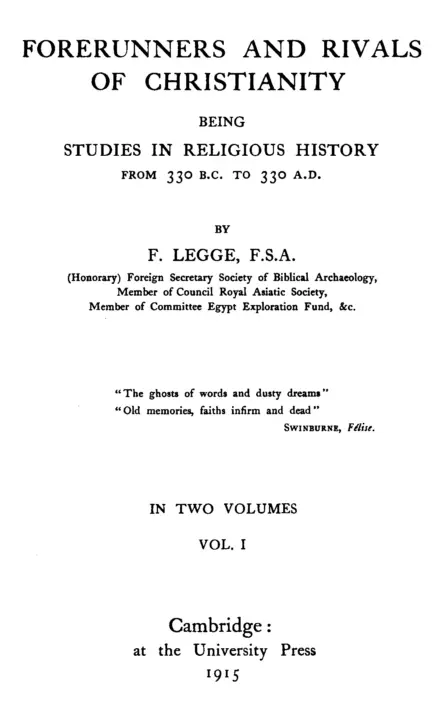
THE CLASSIC COLLECTION · 1915
"Forerunners and Rivals of Christianity: Being Studies in Religious History" by F. Legge is a scholarly historical account likely written in the early 20th century. The book explores documents crucial for understanding the origins and developments of Christianity, highlighting lesser-known religious movements and texts. Its focus is on the interplay between early Christianity and its contemporaries, including various Gnostic sects and Eastern religions. The opening of the work introduces the author's intent to compile and elucidate documents that, while previously translated, remain obscure and misunderstood in contemporary discourse. Legge expresses his desire to foster a clearer understanding of these religious fragments by providing context and commentary, which he believes will clarify their significance. He acknowledges the challenges presented by historical interpretations and notes his efforts to make these texts accessible to both scholars and the general public. Through his methodical approach, he aims to shed light on the diverse influences that shaped early Christianity.
Introduction adapted from the source catalogue; source summaries may be automatically generated.
Free to read · English · 99,528 words · No account needed
MAKE TIME FOR A GOOD BOOK
On by default. Untick to stop anonymous reading totals. Each page counts after 10 seconds in view. How this works.
Anonymous counting is on unless you have switched it off.
So Clem. Alex. Strom. Bk VI. c. 13, says the worship of the sun, moon, and stars was instituted, so that the nations might not become utterly godless.
Footnote 599:
See Bouché-Leclercq, L’Astrologie grecque, Paris, 1899, p. 21, for
references.
Footnote 600:
Philo, de Monarch. Bk I. c. 1.
Footnote 601:
Except perhaps Marcion. But we have so little literature remaining which can with any certainty be attributed to the Marcionites that we cannot speak with any certainty as to his phraseology. In his treatise against the Valentinians (c. XX.) Tertullian gibes at that sect for “thinking the different heavens intelligent, and for making angels of them.”
Footnote 602:
Irenaeus, Bk I. c. 16, § 2, p. 192, Harvey. Theodoret, Haer. Fab. Bk I. c. 5, echoes the statement, and Hippolytus, Bk VI. c. 1, § 19, p. 263, Cruice, gives what is probably the original Greek of Irenaeus. Hatch, H. L. pp. 185, 186, points out that Philo held not only that the angels were God’s instruments in making the worlds, but the patterns after which they were made. Cf. Philo, de Monarch. Bk II. c. 6.
Footnote 603:
These “orders” of supernatural beings passed into orthodox Christianity. Cf. the εἴτε θρόνοι, εἴτε κυριότητες, εἴτε ἀρχαί, εἴτε ἐξουσίαι of Coloss. i. 16, whence the “Thrones, Dominations, Virtues, Princedoms, Powers” of Milton. The functions of all these different orders are set out by Dionysius the Areopagite so-called, and present a certain likeness to Simon’s ideas as given in the text. See Lupton in Dict. Christian Biog. s.v. Dionysius.
Footnote 604:
That is Zeus, “Father of Gods and Men”; not the Juppiter Optimus Maximus of later philosophy.
Footnote 605:
Possibly an allusion to the “rib” story of Genesis.
Footnote 606:
οὐχ ἁπλοῦν, ἀλλὰ διπλοῦν κατ’ εἰκόνα καὶ καθ’ ὁμοίωσιν. Hippolytus, Bk VI. c. 1, § 14, p. 253, Cruice.
Footnote 607:
So Philo, Legg. Allegor. III. p. 1089, Mangey; Quis rer. divin. p. 503 id. Cf. Döllinger, Jud. und Heid. Eng. ed. II. p. 430.
Footnote 608:
Hippolytus, Bk VI. c. 1, § 17, p. 259, Cruice.
Footnote 609:
See last note.
Footnote 610:
So Iacchos is at once the father, son, and spouse of Persephone. Horus is by his identification with Osiris in like manner the son, spouse and brother of Isis. The seeking and finding seems to be an allusion to this last pair. Cf. P.S.B.A. 1914, p. 93.
Footnote 611:
Your reading position is saved on this browser. Take it to another device with a library code. Reading pages adapt to text, rather than matching a printed edition.
BEHIND THE BOOK
This eBook is for the use of anyone anywhere in the United States and most other parts of the world at no cost and with almost no restrictions whatsoever. You may copy it, give it away or re-use it under the terms of the Project Gutenberg License included with this eBook or online at www.gutenberg.org. If you are not located in the United States, you will have to check the laws of the country where you are located before using this eBook. Read the source licence.
The original source file, including credits and licence, is retained by this library. Request an original-format copy at no charge. Please include the book title and Project Gutenberg identifier #71384.
KEEP YOUR CURIOSITY GOING
David Patterson (Spirit) Hatch

David Patterson (Spirit) Hatch

David Patterson (Spirit) Hatch
Cécile Tormay

Moritz Busch
John L. Ransom